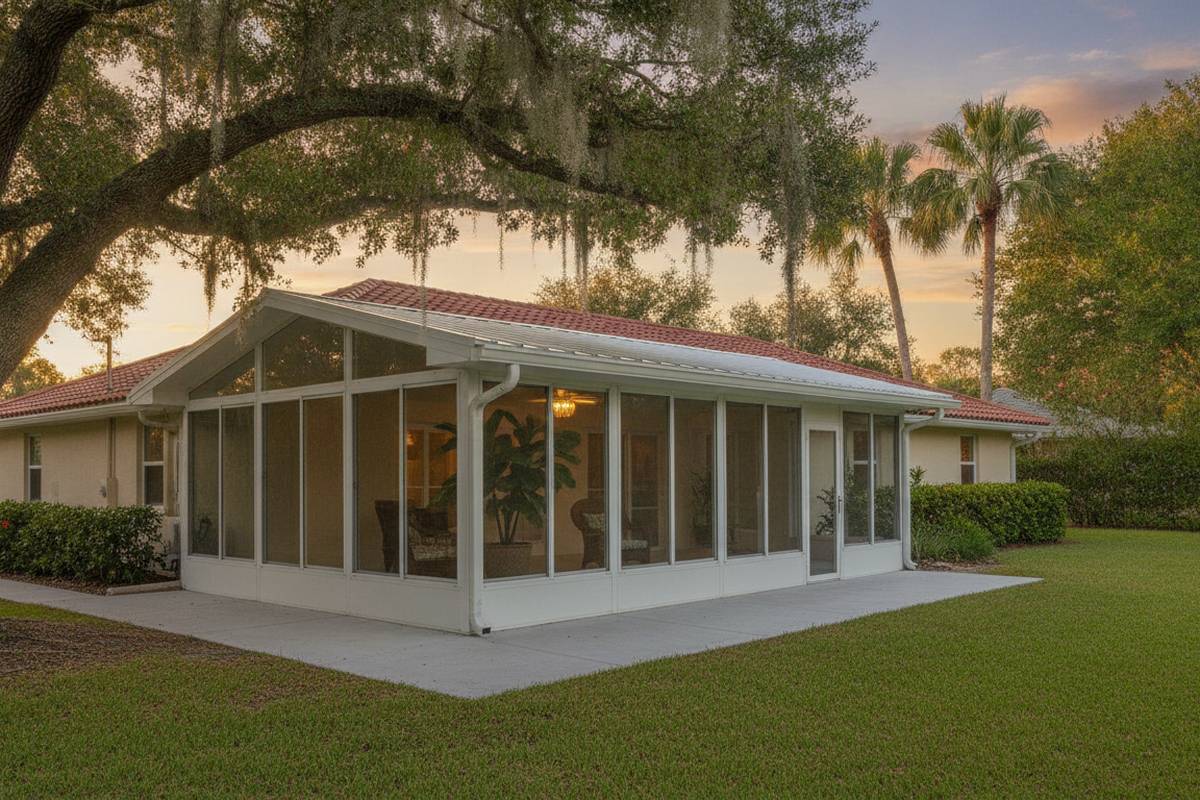
A sunroom needs a building permit in every Polk County jurisdiction, every time, with no size or type exception. That part is simple. What is not simple is the word “category,” which the state building code requires on your construction documents and which quietly decides whether you are permitting a screen room with glass panels or a real room addition. Two sunroom quotes can use the same word to describe two different structures built under two different rule sets, and reading a stack of bids side by side without knowing that is how homeowners end up comparing prices on products that were never the same thing.
What a sunroom permit covers in Polk County
Florida Building Code section 105.1 requires a permit to construct, enlarge, or alter a structure, and Polk County’s own guidance quotes that section directly. A sunroom clears that bar without argument, no matter how small it is or how it gets built.
The only structure the county exempts by size is a storage-only prefab shed capped at 5 feet of mean height, 50 square feet, and 250 cubic feet, with no electric or plumbing run to it. A sunroom sits nowhere near those numbers, so the small-structure exemption people ask about does not reach it.
The City of Lakeland’s own permit list makes the same point from the other direction. Screening any space that requires structural or infill framing needs a permit there, and additions go through residential plan review like any other room. A sunroom is framing and an addition at once, which puts it under both rules at the same time.
That plan review is also where an inspection gets scheduled, not just a permit number issued. A sunroom that never gets its final inspection has a permit on paper without the sign-off that actually protects you, so ask any bidder whether they close out inspections themselves or leave that step for you to chase.
The category on your quote decides the rules
The Florida Building Code Residential, which mirrors IRC section R301.2.1.1.1, requires a sunroom to comply with the AAMA/NPEA/NSA 2100 sunroom standard, engineered to the wind loads assigned to your address. That standard sorts every sunroom into one of five categories, and the code requires the permit applicant to state the category right on the construction documents.
That single line explains why one $10,000 quote and one $35,000 quote can both get called a sunroom. They are not competing bids on the same structure. They are quotes for different categories, permitted under different rules, and the price gap is mostly the rule difference rather than a markup. What a sunroom really costs in Lakeland walks through what drives that spread in dollars.
Here is what each category actually means for your project.
Category I is screen walls or thin plastic film, nonhabitable and unconditioned. It is a screen room wearing the sunroom name.
Category II is enclosed with vinyl or glass walls, still nonhabitable and unconditioned.
Category III is enclosed with glass or plastic that also meets air-infiltration and water-penetration requirements, and it stays nonhabitable and unconditioned. Categories II and III are the territory where a three season room lives, and which of the two applies comes down to how its panels test.
Category IV is designed to be heated or cooled by its own separate system, thermally isolated from the rest of the house.
Category V is heated or cooled and open to the main house, with glazing that has to meet thermal performance requirements. It is the only one of the five treated as habitable living space.
Screen room, three season room, or sunroom breaks down which of these products actually fits a given problem, if the category names alone are not enough to decide.
Why Category V changes everything else
A Category V room is legally part of the house, and that status carries real consequences past the permit itself.
The glazing has to meet thermal performance requirements because the room is thermally joined to the conditioned side of the house instead of sealed off from it. Categories I through III are exempt from the electrical code’s receptacle outlet requirements that apply to habitable rooms, and Category V is not, because it counts as one.
A conditioned, permitted sunroom generally gets added to the heated square footage on your property record too, which can affect your assessment. The tax side of a sunroom covers that in more detail, including why the trade is often still worth making.
Who issues your permit
Polk County is a patchwork, and the short version is worth knowing even though it is not the point of this post.
Unincorporated county property permits through the county’s Building Division in Bartow. Lakeland runs its own building department, and so do the other incorporated cities, each with its own fee schedule. A crew that pulls permits across several of those offices tends to know which ones want extra detail on the energy code sheet before they will move a Category V submission forward. This page does not publish how long any of those desks takes.
Screen enclosure permits in Polk County covers the full patchwork in depth, jurisdiction by jurisdiction, if you want the complete picture before you call anyone.
Whichever office issues yours, the notice of commencement rule is state law and reads the same everywhere. A sunroom contract clears the $5,000 line without trying, so plan on recording one before the first inspection.
The upgrade path from screen room to glass sunroom
Plenty of Polk County sunrooms start life as something smaller, and the upgrade path is real, but it is not free of permits along the way.
A screen room today and glass tomorrow means a second permit, and it can mean a different category too, since moving from Category I screen to Category III or V glass changes what the construction documents have to say. Screening a covered space is one job. Glazing it later is a separate one with its own review.
Whether the upgrade is realistic usually comes down to the slab and footer question rather than the permit itself. Older lanai slabs frequently were not poured to carry a wall, and that decides feasibility before the category does. The slab and footer breakdown covers what that inspection involves.
This shows up constantly in the fast-growing corridor around Haines City, where builders handed over covered lanais that were never enclosed. Screening in a builder covered lanai covers that first step, the one most homeowners out there are actually standing on right now.
HOA review runs in front of the permit
In the newer I-4 corridor subdivisions, architectural review through the homeowner association comes before the county or city permit, not alongside it.
Around Davenport and the short-term-rental subdivisions built up along that corridor, covenants often restrict glazing color, sightlines from the street, or placement. Read the documents for that community. Carport permits and setbacks in Polk County walks through the same HOA pattern in more depth if your subdivision has it.
What happens if you skip the permit
An unpermitted sunroom does not usually cause a problem on the day it goes up. The trouble arrives later, and it arrives at two of the worst possible times.
A stop-work order can land if the county or city notices work in progress without a permit on file, which forces the project to pause until it gets resolved. A permit-after-the-fact process is possible for finished work, but it means documenting and exposing construction that is already closed up, a harder and more expensive conversation than pulling the permit up front would have been.
The habitable-space angle makes an unpermitted sunroom riskier than an unpermitted screen room in one specific way: it is claiming to be conditioned living space without the property record or an insurer ever having verified that it actually is. That gap tends to surface at sale, when a buyer’s inspector or the title work turns up square footage with no permit history behind it, or at claim time, when an insurer starts asking questions about a room nobody can document.
If you inherited the room from a previous owner and want to know what is actually on file, how to look up a building permit in Polk County covers the search and what an open permit from a prior owner means for you under Florida law. If you’re the one selling, selling a house with unpermitted work in Polk County walks through the disclosure question and the two ways to clear the record before closing.
How long the permit stays valid
This page does not publish how long sunroom plan review takes. How long a building permit is good for in Polk County covers the validity clock after issuance.
A Category V room still adds energy-code detail on the glazing and the conditioning path, on top of the standard wind-load engineering every category needs. That is drawing work, not a separate inspection, and a shop that builds Category V rooms regularly will not blink at it.
Frequently asked questions
Do you need a permit for a sunroom in Polk County?
Yes, every time, in every jurisdiction in the county. A sunroom is a permanent structure under the Florida Building Code, and no size or category qualifies for an exemption. The only structure Polk exempts by size is a tiny storage shed, which no sunroom resembles.
Do I need a permit to enclose my lanai with windows?
Yes. Enclosing a lanai with windows or solid walls moves it toward a higher sunroom category, and Polk County treats that conversion as its own permit even when the roof and slab already exist. The City of Lakeland lists structural or infill framing as a permit trigger on its own.
Is there a small-sunroom exemption in Polk County?
No. The only size-based exemption Polk County publishes is a storage-only shed capped at 5 feet of mean height, 50 square feet, and 250 cubic feet, with no electric or plumbing. A sunroom of any size sits well outside those limits, so no version of it qualifies.
What happens if I built my sunroom without a permit?
It usually surfaces later rather than right away, at sale when an inspector or title search finds square footage with no permit history, or at claim time when an insurer asks about a room nobody can document. Options at that point are a retroactive permit on work that is already closed up, or a discount at sale.
Is a glass room the same as a sunroom for permitting purposes?
Only if it complies with the AAMA/NPEA/NSA 2100 standard at the category stated on the permit. A glass-walled space that skips that standard is not a legally recognized sunroom category no matter what it is called in a sales conversation, and it will not pass the same inspection.
Getting a sunroom permit that matches what you actually want built
The fastest way to avoid a permit surprise is to say the category out loud before anyone draws anything. Tell the crew whether you want a screen room, a three season room, or a true Category V sunroom you can sit in with the door to the house open in August, and let that answer drive the construction documents instead of the other way around.
At Lakeland Outdoor Pro we connect Polk County homeowners with insured local crews who pull the permit under their own license and state the category up front. Call (863) 777-5379 for a free on-site measure, and ask which category your quote is actually built to before you sign anything.