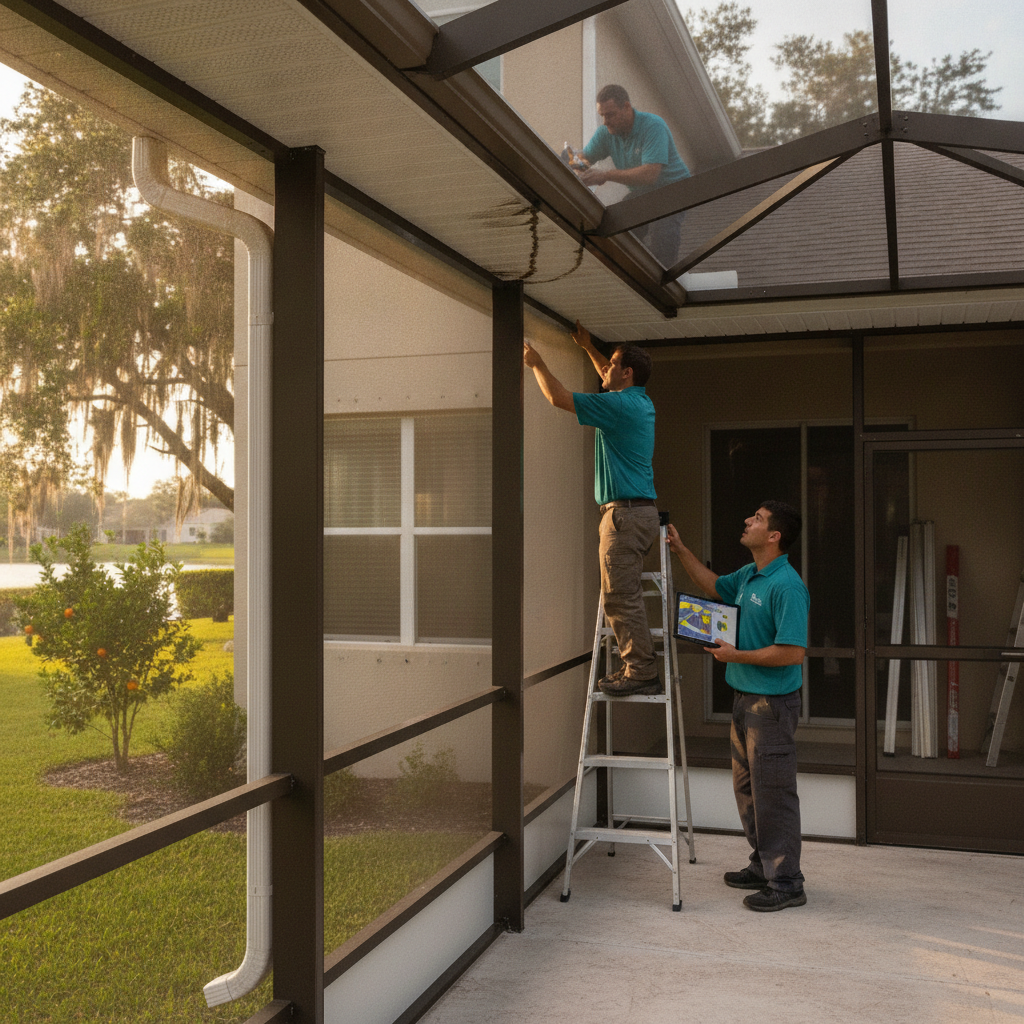
Yes, a pool cage in Lakeland needs a permit once you add structural or infill framing, and tying that frame into the house is usually what trips it. Polk County’s Building Division lists “Screening of any space, which requires structural or infill framing to be added.” The City of Lakeland lists the same work: “Screening of any space that requires structural or infill framing.” The inspector starts at the fascia, not at the water, because that joint is both the load path and the leak path.
Where the cage meets the roof edge
A pool cage that lands on the house is permitted work. The aluminum does not hover over the deck. On a typical Lakeland lot it either stands on its own posts or it picks up the fascia, the soffit, or a ledger on the wall. Adding beams, posts, and a roof that bites the house is structural framing. Stapling a few extra screen panels into an opening that is already there is a different job.
Inside city limits you deal with Lakeland’s Building Inspection division and the list it publishes. Outside the city line you deal with the Polk County Building Division. A crew that mostly works unincorporated Winter Haven or Bartow can still hit friction on a Lake Morton bungalow or a South Lakeland ranch, because the city runs its own counter. Bring the address. The right office is the one that actually issues the permit for that parcel.
The Florida Building Code then reads the drawing, not a slogan. The code assigns an ultimate design wind speed to your specific address. The engineered sheet in the permit package states the value the structure was designed to. Inland Polk carries a lower number than a Gulf-front county, which is why the same cage prices differently here. Nobody should quote you a wind figure from memory. It lives on the plan.
A two-story mansard that ties into the house wall is a different build from a low screen room on an existing slab. A new residential pool cage in the Lakeland area commonly lands between $9,000 and $18,000. Once you add a large deck, a two-story mansard tied into the house wall, or a high clear span, the published range moves to $20,000 to $35,000. The house attachment is one of the things that pushes you from the first band into the second: longer beams, more connections, more flashing, more inspection.
HOA review in a Davenport or Four Corners subdivision is not the permit. Architectural approval is color, height, and whether the cage matches the street. The building official is load path, anchors, and water. You can need both. Neither one stands in for the other.
If someone takes more than 10 percent of the contract price up front on residential work, Florida law gives them 30 days to apply for the permits that job needs. That rule is Florida Statutes 489.126, and it is the consumer protection most homeowners never hear until a beam is already sitting in the yard.
Fascia rot and a ledger that was lagged into nothing
A ledger lagged into a wet Lakeland fascia is holding the cage on paint and pulp. Live oaks over Dixieland and Lake Morton keep that board damp: catkins in April, acorns in fall, and a gutter that overflows in a summer cell. By the time someone wants a cage, a pre-1960 1x fascia can look fine from the driveway and still take a screwdriver to the web.
The fastener then spins. The hole ovalizes. The first real wind event walks the beam away from the house and opens a slot at the shingles. On those same older lots the rear patio slab is often poured thin, with no perimeter footer, so the posts have the same problem at the other end. There is not enough concrete to hold an anchor. Those two failures like to show up together.
The repair is carpentry, then aluminum. The crews we send do not hang a cage on a board they can push a screwdriver through. The fascia comes off, the subfascia gets read, and if the rafter tails are soft the roof carpenter goes first. Then the aluminum ledger or clip gets a solid nailing surface. How that fascia board damage shows up around Polk County is its own pattern: stain at the soffit vents, spongy paint at the drip edge, and a gutter that has already pulled away from the board.
A ledger on a block wall is a cleaner story if the wall is sound and the fasteners are in the block, not in the stucco skin. Stucco is a finish. It is not a structure. On a 1990s cage around Cypress Gardens or the rest of the Chain of Lakes, the original ledger often sat on painted block that later got another coat, and the old holes hid under the paint. Pool cage rescreening will not fix a walking frame. New mesh on a loose house connection just dresses up a leak. The attachment has to be rebuilt.
Florida Statutes 489.113 is plain: a person must be certified or registered to engage in the business of contracting in this state. Several license classes can lawfully build aluminum structures. Ask which class the contractor holds, then look it up yourself with the state’s Verify a License tool. Do not take a truck door as the answer.
Flashing so Polk summer rain does not enter the soffit
Flashing at the house tie-in has one job: keep the afternoon storm out of the soffit bay. The Polk County zone forecast comes out of the National Weather Service office in Ruskin. The rain that matters here is the daily summer cell, not spray off a coast we do not have. Water hits the shingles, runs to the drip edge, and looks for the hole you just made when a beam was through-bolted into the fascia.
A smear of caulk is not flashing. Caulk shrinks in the first hot week. A kick-out and a continuous flashing pan at the ledger shed water back into the gutter instead of into the soffit. Once water is in that bay it stains the lanai ceiling, swells the subfascia, and starts the rot cycle the ledger already lost to.
Gutters at that corner have to be in the plan, not an afterthought. A downspout that dumps inside the cage is a pond on the deck. Building America program guidance is to discharge surface runoff at least 5 feet from the foundation. That is program guidance, not a local code we verified against Polk’s books. Dumping against the house wall still wets the same fascia you just repaired.
On a west-facing cover along US-98 in South Lakeland, afternoon storms drive rain under a lazy overlap. On a Winter Haven cage the south and west elevations take the sun, so the mesh there often goes brittle in that seven-to-twelve-year window while the north side still looks new. The house tie-in sits in more shade, which is why people miss the rot until the beam moves.
Do not cut the roof. Do not sister a ledger into a wet fascia. That is licensed work, and it is the joint the inspector actually looks at.
What the Florida Building Code actually reviews
The Florida Building Code does not hand you a one-page “pool cage” checklist. The plans examiner reads an engineered drawing: member sizes, connections, slab anchors, and how the frame loads the house. Inspections then check that the cage in the yard matches the cage on the sheet. Skip the permit and you still have the physics. You just do not have a record when you sell, refinance, or file a storm claim.
Polk County has no coastal mean high water line, so the coastal test in the wind-borne debris definition cannot apply here. The remaining test in that definition is an ultimate design wind speed of 140 mph or greater. Whether a given address clears that line is a determination for the code at that address, written on the engineered sheet, not a number for a website to invent.
A cage is also not a magic pass on pool safety. Florida’s Residential Swimming Pool Safety Act never names “screen enclosure” as a category. Section 515.29 asks a barrier to be at least 4 feet high on the outside, to have no gap or protrusion a young child could crawl under, squeeze through, or climb, and to carry a gate that opens out, self-closes, and self-latches with the release on the pool side, out of a child’s reach. Whether a given cage does all of that is what the building official signs off on. Do not take a sales pitch as that signature.
The City of Lakeland collects non-utility impact fees for Polk County at the time of permit: transportation, fire protection, law enforcement, and parks. That is collection at the city counter for the county’s fees, not two separate systems. No page on this site publishes a dollar figure for those fees, and a contractor who quotes one from memory is guessing.
Do you need a permit for a pool cage in Florida?
Yes, once the cage needs structural or infill framing, and a house tie-in is exactly that. Polk County and the City of Lakeland both say so in their published lists. Screening that does not add framing is a narrower case. A new pool cage over water and deck is not that narrower case. If the work already went in without paper, that is an after-the-fact problem for the Building Division on that parcel, not a number anyone should invent.
Do you need a cage over your pool in Florida?
No. Florida does not require a screen cage as the only way to make a residential pool safe. Chapter 515 lists several options, including an enclosure that meets the barrier rules in 515.29, an approved safety cover, exit alarms on doors and windows, self-closing and self-latching doors with the release at least 54 inches up, or a pool alarm that meets ASTM F2208. A cage is a product you may choose. If you build one and want it to serve as the enclosure option, it still has to independently meet those barrier specifications, and the official decides that on the permit.
How much does it cost to put a cage over your pool in Florida?
In the Lakeland area a new residential pool cage commonly runs $9,000 to $18,000. A large deck, a two-story mansard tied into the house wall, or a high clear span moves the published range to $20,000 to $35,000. Those are this site’s published bands, not a bid. What moves a job is span, height, slab condition, and that house connection: rotten fascia, a thin patio slab, and flashing at the roof edge all add labor before a post is set. A full-cage rescreen, if the frame is sound, is a different ticket at $1,400 to $3,200.
When to call us
Call when the cage has to pick up the house, when the fascia is soft, or when you need a licensed contractor to pull the permit that framing requires. Lakeland Outdoor Pro matches you with licensed local screen and aluminum crews for that look, that drawing, and that inspection. Call us at (863) 777-5379.