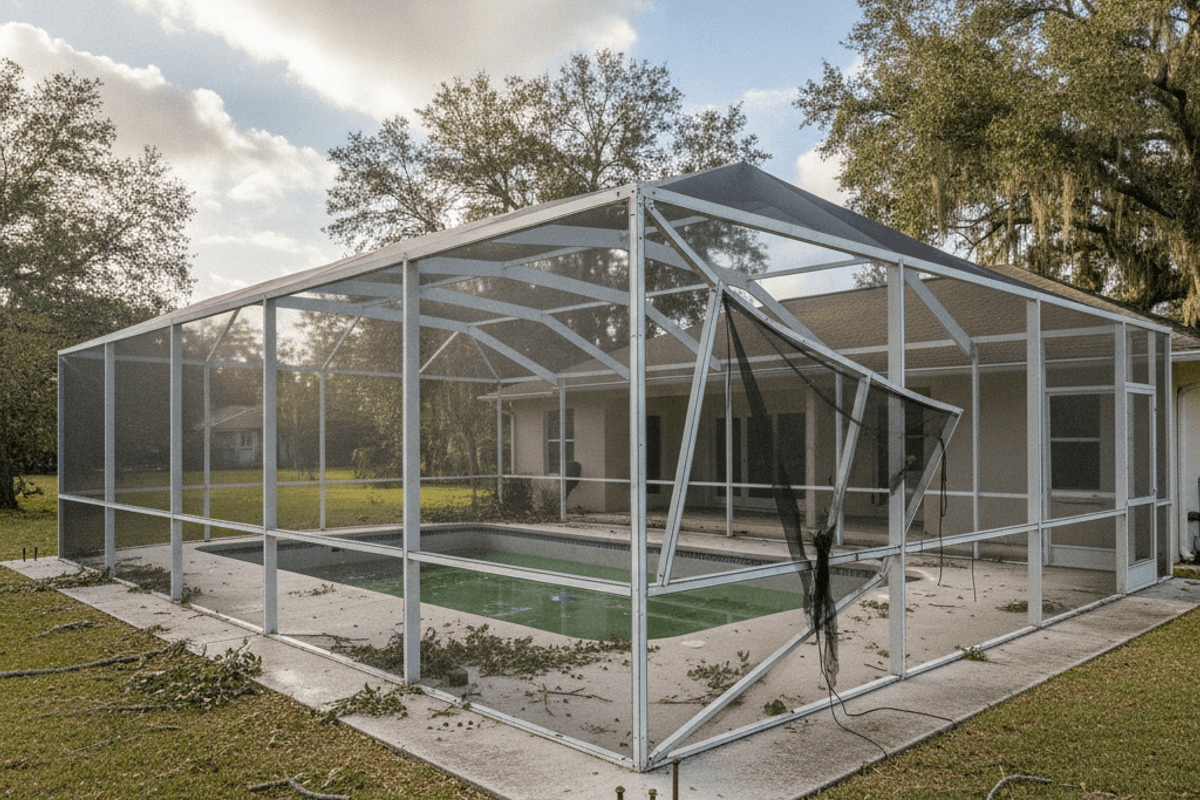
A storm takes down the pool cage a previous owner put up in 1998. The adjuster writes a number based on what that cage was worth the morning before the wind hit. Then the building department tells your contractor the replacement has to be engineered to today’s requirements, and the quote comes back higher than the check.
That difference has a name in Florida law, and there’s a decent chance your policy already carries some of it without your ever having asked for it.
Why the rebuild costs more than the thing that fell down
An aluminum enclosure isn’t grandfathered into the code it was built under. The old frame could stay standing for decades, but the moment it comes down and a permit gets pulled for a new one, the new structure is reviewed against the requirements in force now.
For a screen enclosure in Polk County that mostly shows up in the engineering. The code assigns an ultimate design wind speed to a specific address, and the engineered drawings in the permit package have to show the frame, the connections and the anchors holding up under it. That can mean heavier extrusions, more uprights, different anchor spacing, and approved components where the old cage had whatever the installer had on the truck. Wind load on a Polk County screen enclosure walks through how that number reaches your drawings, and Florida product approval for a screen enclosure covers the component side.
None of that is the adjuster being difficult. It’s two different questions. What was the old cage worth, and what does the law now require of the new one.
What law and ordinance coverage actually is, in the statute’s words
Florida’s name for it is law and ordinance coverage. Most policies and most searches call it ordinance or law coverage. Same thing.
F.S. 627.7011 is titled “Homeowners’ policies; offer of replacement cost coverage and law and ordinance coverage.” Before issuing a policy, an insurer has to put two offers in front of you, and the only real difference between them is this cost.
The first, in 627.7011(1)(a), is replacement cost “but not including costs necessary to meet applicable laws and ordinances regulating the construction, use, or repair of any property or requiring the tearing down of any property, including the costs of removing debris”.
The second, in 627.7011(1)(b), is replacement cost “and also including costs necessary to meet applicable laws and ordinances regulating the construction, use, or repair of any property or requiring the tearing down of any property, including the costs of removing debris”.
Read those twice. One phrase separates them, and it’s the phrase that covers the gap between your 1998 cage and the drawings your contractor needs now. Debris removal sits inside the same clause, which matters more than it sounds when a collapsed mansard has to come off a pool deck before anything else happens.
You may already have 25 percent of your dwelling limit
This is the part most homeowners don’t know. The coverage isn’t something you have to remember to buy. Under 627.7011(2):
“Unless the insurer obtains the policyholder’s written refusal of the policies or endorsements specified in subsection (1), any policy covering the dwelling is deemed to include the law and ordinance coverage limited to 25 percent of the dwelling limit.”
Deemed included unless you refused it in writing. The refusal has to be on a form the office approved, and the statute gives that form real weight: “If this form is signed by a named insured, it is conclusively presumed that there was an informed, knowing rejection of the coverage or election of the alternative coverage on behalf of all insureds.”
So the question isn’t whether you bought it. The question is whether, somewhere in a stack of paperwork at closing or at a renewal, somebody signed it away. 627.7011(1)(b) lets a policyholder select 25 percent or 50 percent of the dwelling limit, so there’s a higher tier available too.
One note on the number itself. It’s a percentage of the dwelling limit, not of your claim, not of the repair estimate, and not of what the cage is worth. Those are different figures and they don’t track each other.
Where to look on your own paperwork
Florida made this easy on purpose. 627.7011(4)(a) requires an insurer to include with the policy documents, at first issue and at every renewal, “in bold type no smaller than 18 points”, this exact statement:
“LAW AND ORDINANCE: LAW AND ORDINANCE COVERAGE IS AN IMPORTANT COVERAGE THAT YOU MAY WISH TO PURCHASE. PLEASE DISCUSS WITH YOUR INSURANCE AGENT.”
Eighteen point bold is large. If you have your renewal packet, it’s in there and it’s hard to miss. Separately, 627.7011(2) requires the insurer to notify you that the coverage is available “at least once every 3 years”.
Then read the declarations page for the enclosure itself, which is a separate exercise. Does homeowners insurance cover screen enclosures goes through what that line usually says and why the screens and the frame can be treated differently.
The limit that decides whether any of this reaches your cage
Here’s the honest part, and it’s the reason to read your own policy rather than take a general answer.
627.7011 measures this coverage against the dwelling limit, and 627.7011(1)(b) adds that the coverage “applies only to repairs of the damaged portion of the structure unless the total damage to the structure exceeds 50 percent of the replacement cost of the structure”.
Whether a screen enclosure or a pool cage is insured under your dwelling limit, under a separate screened enclosure limit, or not at all is a policy-by-policy question. Florida carriers treat screened structures inconsistently, and that line on your declarations page decides more about your claim than almost anything else on it. Your carrier and your agent can answer it in one phone call. Nobody can answer it for you from the outside, and anyone who tells you otherwise without reading your policy is guessing.
The statute also carves out some policies entirely. 627.7011(6)(b) says it does not “Apply to mobile home policies”, which matters if the cage is attached to a manufactured home. Screen rooms on a mobile home in Polk County covers the permitting side of those.
Betterment, and one useful line in a different statute
There’s a second statute worth knowing about, because the words in it come up in adjuster conversations. F.S. 626.9744 governs claim settlement practices on replacement cost policies, and 626.9744(1) says:
“The insured may not be required to pay for betterment required by ordinance or code except for the applicable deductible, unless specifically excluded or limited by the policy.”
Betterment is the upgrade. The newer, stronger, more expensive version of what you had. The clause says you shouldn’t be made to pay for the part of that upgrade the code is forcing, beyond the deductible. Notice both ends of the sentence, though. The whole section opens with “Unless otherwise provided by the policy”, and this clause closes with “unless specifically excluded or limited by the policy”. Your policy language can change the answer. That’s exactly why the coverage in 627.7011 exists as a named, priced thing rather than something everybody just gets.
Mismatched screen and the adjoining areas rule
The same statute has a rule that comes up constantly on partial cage damage. Under 626.9744(2):
“When a loss requires replacement of items and the replaced items do not match in quality, color, or size, the insurer shall make reasonable repairs or replacement of items in adjoining areas.”
A wind event tears four panels on the south wall of a cage whose screen has been fading in the Florida sun for nine years. New screen next to nine-year-old screen does not look like the same cage. That’s the situation the subsection is written for.
It is not a guarantee of a full rescreen. The statute lets the insurer weigh “the cost of repairing or replacing the undamaged portions of the property, the degree of uniformity that can be achieved without such cost, the remaining useful life of the undamaged portion, and other relevant factors”. Reasonable is the insurer’s call first, and then a dispute process. If you’re weighing the scope either way, rescreen or replace a Polk County pool cage lays out what pushes a job one direction or the other, and pool cage rescreening is the work itself.
The money arrives in two pieces
Even with replacement cost coverage, you don’t get one check. 627.7011(3)(a) sets the sequence:
“For a dwelling, the insurer must initially pay at least the actual cash value of the insured loss, less any applicable deductible. The insurer shall pay any remaining amounts necessary to perform such repairs as work is performed and expenses are incurred.”
Actual cash value first, which on a twenty-five year old cage is a depreciated number. The rest comes as the work actually happens. Practically, that means the first check is not the budget, and a homeowner who treats it as the budget ends up scoping a smaller cage than the policy would have paid for. It also means a contractor who wants the full job paid up front is working against how the statute says the money moves. What to do after storm damage to a pool cage covers the documentation side of that.
The clock, and it’s shorter than people expect
Florida tightened the deadline for reporting a claim, and the number surprises people whose last hurricane claim was years ago. F.S. 627.70132(2) says a claim or reopened claim “is barred unless notice of the claim was given to the insurer in accordance with the terms of the policy within 1 year after the date of loss. A supplemental claim is barred unless notice of the supplemental claim was given to the insurer in accordance with the terms of the policy within 18 months after the date of loss.”
One year to report. Eighteen months for a supplemental claim, which 627.70132(1)(b) defines as a claim “for additional loss or damage from the same peril which the insurer has previously adjusted or for which costs have been incurred while completing repairs or replacement pursuant to an open claim for which timely notice was previously provided to the insurer”. That’s the one that matters here, because code-driven costs often surface late, when the engineer’s drawings come back and the real scope lands.
The clock’s start is defined too. For weather, 627.70132(3) says the date of loss “is the date that the hurricane made landfall or the tornado, windstorm, severe rain, or other weather-related event is verified by the National Oceanic and Atmospheric Administration”. Landfall date, not the day you noticed the sag.
This is not the floodplain 50 percent rule
Two different 50 percents float around Polk County conversations and they get mixed up constantly.
One is the insurance threshold in 627.7011(1)(b), where law and ordinance coverage reaches beyond the damaged portion once total damage exceeds half the structure’s replacement cost. The other is Polk County’s floodplain ordinance, where a repair running past half the structure’s market value has to meet current floodplain rules. One is a coverage term in your policy. The other is a local permitting trigger that doesn’t care what you’re insured for. Screen enclosures in a Polk County flood zone handles the second one.
They share a number and nothing else.
Frequently asked questions
Is ordinance or law coverage the same as law and ordinance coverage?
Yes. Florida’s statute uses “law and ordinance coverage” in the title and body of 627.7011, and the mandated notice reads “LAW AND ORDINANCE”. Policies and agents often flip the words. There’s no difference in what’s being described.
Do I have to buy it, or do I already have it?
627.7011(2) says any policy covering the dwelling “is deemed to include the law and ordinance coverage limited to 25 percent of the dwelling limit” unless the insurer obtained your written refusal. So it’s included by default and removed by signature. Check your declarations page and ask your carrier whether a rejection form is on file.
Does it cover my pool cage specifically?
That depends on how your policy insures the cage, not on the statute. 627.7011 measures the coverage against the dwelling limit, so the controlling question is whether your screen enclosure falls under the dwelling limit, under a separate screened enclosure limit, or outside coverage. Read the enclosure line on your declarations page and confirm it with your carrier.
Why does a replacement cage have to meet current code if the old one didn’t?
Because the permit is for new construction, not for the structure that used to be there. The old cage was reviewed under the rules in effect when it went up. A new enclosure is reviewed under the rules in effect when the permit is issued, and the engineered drawings have to demonstrate it.
What is betterment on a claim?
It’s the portion of a repair that leaves you with something better than you had. 626.9744(1) says an insured “may not be required to pay for betterment required by ordinance or code except for the applicable deductible, unless specifically excluded or limited by the policy”. The qualifier at the end is real, which is why policy language still decides it.
Will insurance replace all my screen so the panels match?
626.9744(2) requires an insurer to make “reasonable repairs or replacement of items in adjoining areas” when replacements don’t match in quality, color or size. It does not guarantee a full rescreen. The statute lets the insurer weigh cost, achievable uniformity and the remaining useful life of the undamaged sections.
How long do I have to report storm damage to a screen enclosure?
627.70132(2) bars a claim or reopened claim unless notice was given within 1 year after the date of loss, and a supplemental claim unless notice was given within 18 months. For a hurricane, 627.70132(3) sets the date of loss at the landfall date. Whether a specific claim is still open is a question for your carrier.
Why did my first insurance check look so small?
627.7011(3)(a) requires the insurer to initially pay at least actual cash value less the deductible, and to pay “any remaining amounts necessary to perform such repairs as work is performed and expenses are incurred”. The first payment is the depreciated value, not the whole replacement cost. The balance follows the work.
When to call us
Rebuilding or repairing a screen enclosure after storm damage is permitted, engineered work, and in Polk County it belongs to a licensed contractor who can get drawings through the building department and tie the frame back down correctly. If you’re reading a settlement and trying to work out whether it covers the cage your drawings actually call for, a contractor who has done the permit side can at least tell you what the rebuild involves. Your carrier and your agent are the ones who answer the coverage question. We’ll connect you with licensed local crews for pool cage rebuilds and enclosure repair across Lakeland, Winter Haven, Bartow and the rest of the county. Call us at (863) 777-5379.