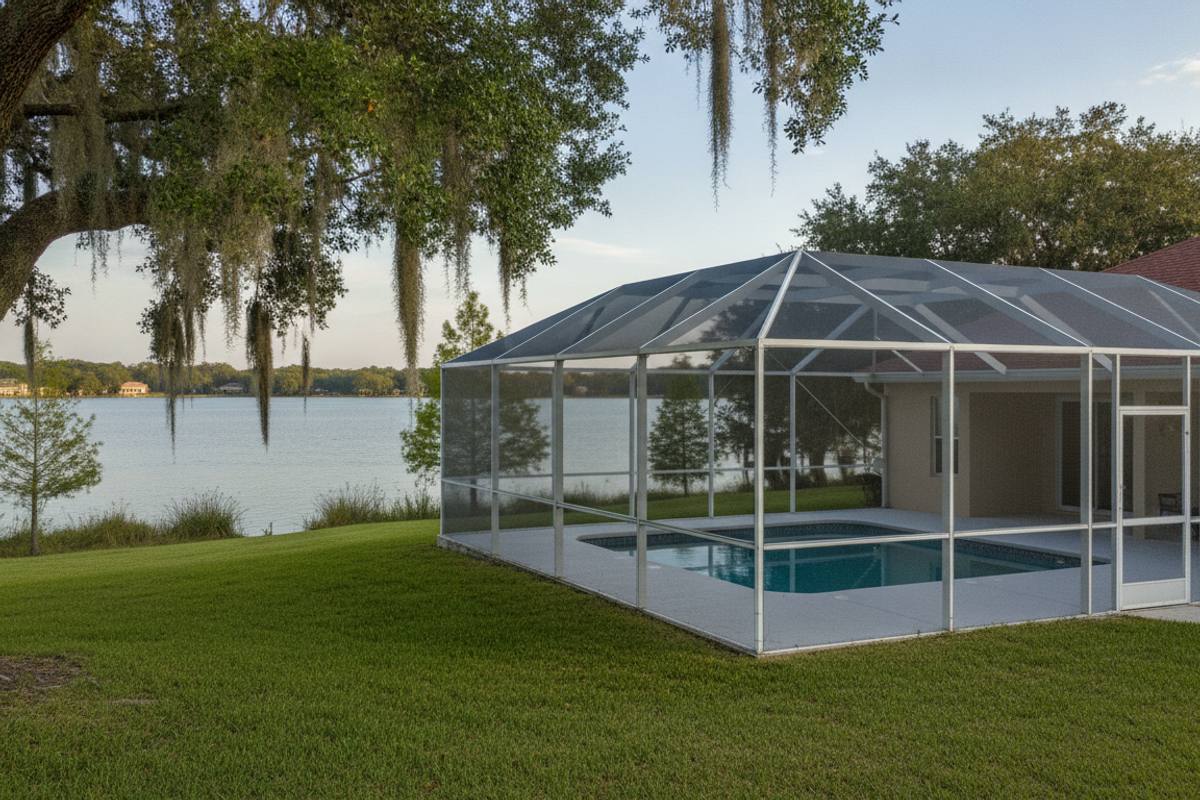
A screened pool enclosure is allowed in any Polk County flood zone. A glass one is not. Florida’s Office of Floodplain Management says pools in any flood zone may be surrounded by “lattice, insect screening, decorative concrete block, or aluminum screening that allows the free passage of floodwater,” and that “breakaway walls, walls with flood openings, and glass walls do not satisfy this requirement.”
That single line decides more lakefront projects around the Chain of Lakes than any cost estimate does. A screened pool cage is the design the rule was written to allow, because floodwater passes straight through the mesh. A glassed-in sunroom over the same pool is a different conversation with the county entirely.
One scope note before anything else. That state guidance is written about enclosures around pools, which is most lakefront work here. A screened structure with no pool in it is governed by different provisions for accessory structures and enclosures, and the county is the authority on which set applies to your job. Ask before you assume this post’s answer covers it.
Here’s how to find out which zone your address sits in, what Polk County asks for once you’re in a high-risk one, and the rule that catches people repairing a cage rather than building one.
How to find out which Polk County flood zone you’re in
Polk County publishes its own flood zones map, and the county runs it as a public mapping application on its GIS site at gis.polk-county.net. You can also look the property up on FEMA’s Flood Map Service Center at msc.fema.gov, which is the source the county points residents to for seeing the flooding sources near an address.
The faster answer is often a phone call. Polk County’s Floodplain Management Program takes calls at (863) 534-6765 or (863) 534-6767, and the county says that’s the number to reach for free flood assistance and inspections, to find out whether an area has flooded before, or to determine whether you’re in a Special Flood Hazard Area.
That office is also where elevation certificates live. Polk County keeps copies of all elevation certificates that it receives, so if your house already has one on file, you may not need to pay a surveyor to produce a new one. Ask before you order anything.
One framing worth keeping in mind, in the county’s own words: everyone lives in a flood zone, and the only question is whether it’s a low, moderate or high-risk one.
What Polk County’s high-risk zones actually are
The county sorts flood risk into two buckets and names the zones in each.
High flood risk is Zone AE, A, AH or AO. Properties in those zones have a one percent chance of flooding in any given year, and a 26 percent chance over the life of a 30-year mortgage. Those are the areas called Special Flood Hazard Areas, and flood insurance is mandatory there for most mortgage holders.
Low or moderate risk is Shaded X and X. Shaded X sits outside the high-risk zones, where the county is careful to say the risk is reduced but not removed. Lower-cost Preferred Risk Policies are often available in those areas.
Notice which zones are not on that list. Zone V and Coastal A Zone trigger the heaviest requirements in the code, including compliance with the ASCE 24 flood standard and an engineered free-of-obstruction analysis. Coastal A Zones are defined as areas subject to wave heights of 1.5 to 3 feet, seaward of a line FEMA delineates on maps for coastal communities. Polk County’s own high-risk list stops at A, AE, AH and AO. That’s the same inland advantage that shows up in wind load and engineering for a Polk County enclosure, where distance from open Gulf water lowers the design number and the price with it.
The county also names its own floodplains rather than leaving them abstract. The areas around Gator Creek, Itchepackesassa Creek and Peace Creek are examples it lists directly.
The floodplain development permit, and what it asks for
Polk County requires a building permit for all new construction before work starts, and plans get approved before the permit issues. That part applies everywhere in the county. The county also maintains a separate form for work in a flood hazard area, its Floodplain Development Permit Application.
Whether your specific job triggers that form is a question for the Floodplain Management Program at (863) 534-6765, not something to guess at from a contractor’s opinion. But it’s worth knowing what the form asks, because the answers have to come from your property rather than from a catalog.
It asks for the tax parcel number and the location, then a development type from a list that includes excavation, fill, grading, residential construction, addition, renovation, and other. It asks for FIRM data: the map panel number, the map panel date, and the flood zone. It asks whether the site is inside a regulatory floodway, outside one, or whether there’s no regulatory floodway at all. Inside a regulatory floodway, the form requires engineering certification and supporting data attached.
Then it asks for the regulatory flood elevation at the site, which it defines as base flood elevation plus the county’s locally adopted freeboard. The Florida Building Code baseline is base flood elevation plus one foot, and Florida communities can adopt amendments requiring more than that. Ask the county what its adopted number is for your address instead of assuming the code minimum.
Two more fields matter for aluminum work. If a foundation wall is used, the form requires a minimum of two openings, sized at one square inch of opening per square foot of enclosed footprint below base flood elevation. And it asks whether any watercourse will be altered or relocated, which is a real question on a lot that backs onto water.
The acknowledgment at the bottom is the part people skim. It says that before the permitted structure is occupied, an elevation or floodproofing certificate signed by a professional engineer or registered land surveyor has to be on file with the county, showing the as-built elevations relative to mean sea level. That’s a line item, and it belongs in the quote before anyone breaks ground.
Setback from the top of bank, the field nobody expects
The floodplain form has a field for the proposed setback from the top of bank. It sits right next to the floodway questions, and it’s separate from the zoning setbacks every enclosure project already deals with.
If your lot backs onto a lake in Winter Haven or a canal in Lake Alfred, that field decides how far the cage can reach toward the water before the county has a problem with it. Homeowners plan the footprint around the pool deck and the view. The county is looking at the distance from the bank.
Measure that before you fall in love with a size. It’s the same lesson as the zoning setback in carport permits and setbacks in Polk County, except there are now two setbacks in play and they don’t come from the same office.
The 50 percent rule, and why repairs hit it harder than new builds
Polk County’s floodplain management ordinance carries a Substantial Damage and Substantial Improvement rule, which the county itself calls the dreaded 50 percent rule. Under it, if a structure is damaged or improved by 50 percent or more of the structure’s market value, it has to comply with current floodplain management rules rather than the rules it was originally built under.
That is a repair problem far more than a new-construction problem. A lakefront cage built in the 1990s was permitted under the code of its day. A storm takes out most of it, the repair estimate lands past half of what the structure is worth, and now the rebuild answers to today’s rules instead of the old ones.
This is exactly why the scope of a screen enclosure repair matters more than the price on a lakefront lot. A partial repair, or a rescreen where the frame is sound, sits on one side of that line. A near-total rebuild sits on the other. Storm damage and insurance on a Florida pool cage covers how to document the loss; the 50 percent question is what decides which code the repair gets built to.
The county’s own point about this rule is that most structures built before the rules existed would not meet them today. Knowing your elevation, and how it compares to the current standard, is the whole reason an elevation certificate is worth having before you need it.
Where the pool equipment has to sit
Equipment is the quiet failure point in a flood zone, and the state guidance is specific about it.
Pool equipment can sit below base flood elevation plus freeboard, but only if three things are true. It has to be elevated to the extent practical, because even partial elevation protects against low-level flooding. It has to be anchored to prevent flotation and to resist flood forces. And it has to be supplied by branch circuits with ground-fault circuit interrupter protection.
A structure built to contain that equipment and nothing else is treated as its own thing. It either gets elevated, or it gets built to the accessory-building requirements for the flood zone it’s in.
None of that is exotic work. It’s the kind of detail that separates a crew that has permitted on the water before from one that hasn’t.
What flood insurance does not cover
The pool itself is not covered. The NFIP Flood Insurance Manual excludes coverage for indoor and outdoor swimming pools, and for hot tubs and spas except where they’re used as bathroom fixtures.
What the flood policy covers is insurable buildings and the machinery and equipment serving them. That’s a different question from whether your homeowners policy covers a screen enclosure, which is where most pool cage claims actually get decided.
There is money on the table in the other direction, though. Polk County participates in FEMA’s Community Rating System at a Class 6 rating, which earns policyholders a 20 percent reduction on flood insurance premiums. The county reports the average saving on a policy in a Special Flood Hazard Area at $132 per year.
Which jurisdiction handles your address
Unincorporated Polk County goes through the county’s Building Division, at 330 W. Church Street in Bartow, FL 33830, reachable at (863) 534-6080. The floodplain questions go to the Floodplain Management Program at (863) 534-6765.
Incorporated cities run their own building departments, so a property inside city limits in Lake Wales or Lakeland answers to that city rather than to the county. For the full breakdown of who issues what, see screen enclosure permits in Polk County, and to check what’s already on file for your parcel, a Polk County permit search runs free with no login.
If you’re weighing a screened structure against a glassed one on a flood-zone lot, the comparison in screen room versus three season room versus sunroom is worth reading alongside this, because the walls are the deciding factor here in a way they aren’t on a dry lot. A three season room or a solid-roof patio cover each answer the flood question differently than a screen room does. Runoff is worth settling at the same time, since any solid roof needs a seamless gutter plan on a lot that already sits close to water.
Frequently asked questions
Can I build a screen enclosure in a Polk County flood zone?
For a pool enclosure, yes. Florida’s Office of Floodplain Management states that pools in any flood zone may be surrounded by insect screening or aluminum screening that lets floodwater pass through freely. A permit is still required, and a high-risk zone adds the county’s floodplain requirements on top. A screened structure with no pool falls under different provisions, so confirm that one with the county.
Why are glass walls treated differently than screen?
Because floodwater has to pass through. The state guidance names breakaway walls, walls with flood openings, and glass walls as designs that do not satisfy the free-passage requirement around a pool. Screen and lattice do.
How do I find out my flood zone in Polk County?
Call Polk County Floodplain Management at (863) 534-6765 or (863) 534-6767, or look the address up on the county’s flood zones map at gis.polk-county.net or on FEMA’s Flood Map Service Center at msc.fema.gov.
What are Polk County’s high-risk flood zones?
Zone AE, A, AH and AO. The county classifies those as high flood risk, with a one percent chance of flooding in any year and a 26 percent chance over a 30-year mortgage. Shaded X and X are the lower-risk designations.
What is the 50 percent rule for a pool cage repair?
If the structure is damaged or improved by 50 percent or more of its market value, Polk County’s floodplain ordinance requires it to meet current floodplain rules rather than the code it was built under. That threshold is why repair scope matters on an older lakefront cage.
Do I need an elevation certificate for a screen enclosure?
Ask the county first. Polk County already keeps copies of every elevation certificate it receives, so one may exist for your property, and the floodplain permit form requires a signed elevation or floodproofing certificate on file before a permitted structure is occupied.
Getting your zone answered before anyone quotes
A flood zone doesn’t stop a screen enclosure. It changes the paperwork, the equipment details, and sometimes the footprint, and every one of those belongs in the quote instead of arriving later as a change order.
At Lakeland Outdoor Pro, we connect Polk County homeowners with insured local crews who work lakefront lots across the Chain of Lakes and know which office answers which question. Call (863) 777-5379 and ask two things before you sign: what flood zone is this parcel in, and who is pulling the floodplain paperwork if it’s needed. A crew that answers both without hedging has built on the water before.