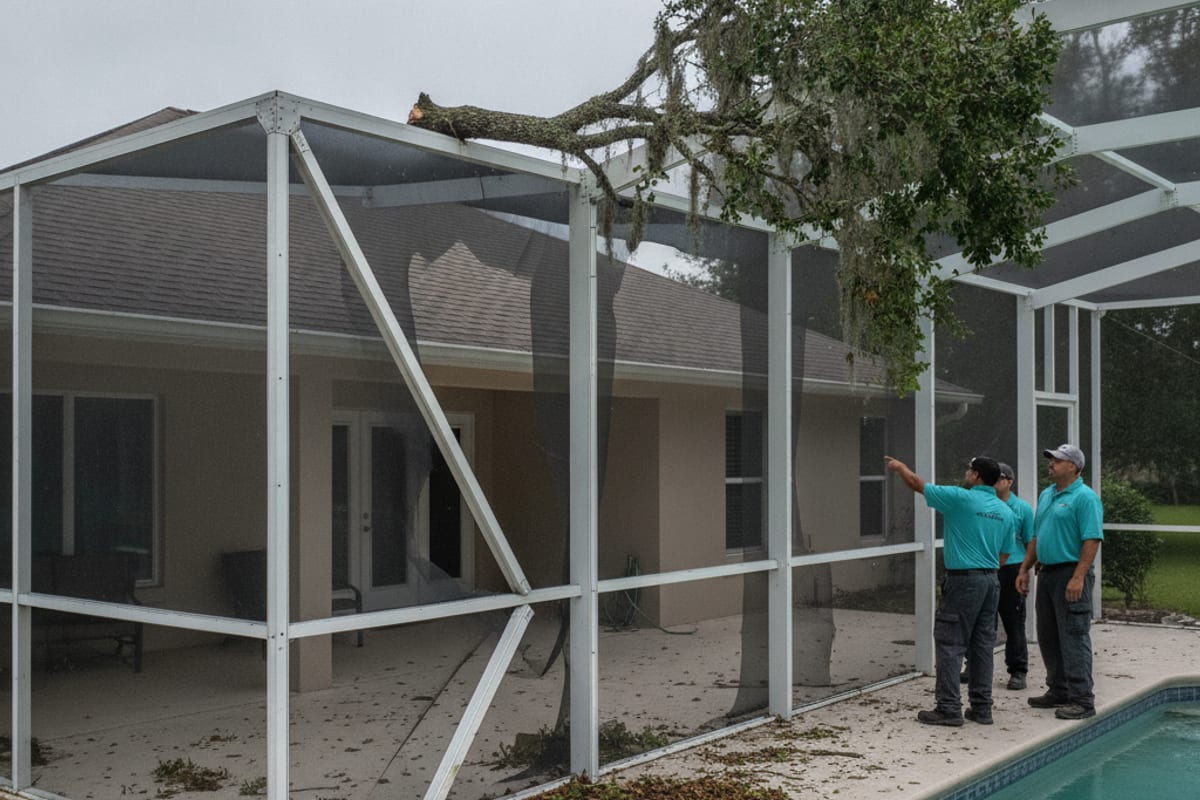
Polk County sits inland, so what hits us is wind and rain rather than surge. That distinction matters for a lot of things. It does not help your pool cage. Screen enclosures are among the first structures to come apart in a serious wind event, and they are also among the most commonly limited items in a Florida homeowners policy.
The order you do things in after a storm affects what gets paid. Here is the sequence.
Photograph everything before you touch it
This is the step people skip and regret, usually because the instinct after a storm is to clean up.
Before you pull a single torn panel or move a bent upright, photograph the whole enclosure from several angles. Then photograph each damaged area close up. Then get at least one wide shot that includes the house, so the location and the scale are obvious to someone who has never been there. If a limb caused it, photograph the limb where it landed, before it goes to the curb. Photograph anything inside the enclosure that got damaged too.
Adjusters work from evidence. A cleaned-up enclosure is much harder to document than a wrecked one, and “it looked worse before we cleaned it” carries no weight.
If a section is an immediate safety hazard, secure it first and photograph the hazard. Reasonable emergency mitigation is normally expected of you rather than penalized, but document what you did and why.
Read the screened enclosure line on your declarations page
This is where Florida policies vary far more than people expect, and where the assumption “it’s covered, I have homeowners insurance” goes wrong.
Common patterns worth checking for on your own policy:
The structure is covered but the screen is not. A lot of policies cover the aluminum and specifically exclude the mesh. Since the mesh is what tears first and covers the most area, that exclusion can eliminate most of a claim.
A separate, lower limit for the enclosure. Many Florida policies carry a dollar cap on screened enclosures that is far below the dwelling limit, sometimes low enough that it does not replace a large cage.
A separate deductible. Hurricane deductibles in Florida are frequently a percentage of the dwelling coverage rather than a flat number, which on a modest cage claim can exceed the claim itself.
Scheduling requirements. Some policies exclude the enclosure entirely unless it was specifically listed.
Read that line before you commit to a repair scope. It changes whether a full replacement is realistic or whether you are looking at targeted screen enclosure repair mostly out of pocket. Neither answer is wrong. Choosing between them without knowing the numbers is.
Call early, and say what kind of damage you have
Immediately after a named storm, every aluminum shop in Central Florida is triaging, and lead times stretch from days to weeks. Calling in the first few days matters more than anything else you can do.
It matters most on the county’s outer edges. Frostproof, Waverly, Babson Park, and the rural Ridge properties get to the front of fewer queues than a Lakeland address does, simply because fewer shops run that ground regularly.
When you call, be specific rather than general. Say whether a section is leaning or is an actual hazard. Say whether the pool is unusable. Say whether the property is a short-term rental that is now offline, which is common around Davenport, Loughman, and Four Corners and genuinely changes scheduling priority at most shops. “My cage got damaged” puts you in a long undifferentiated line.
Watch for storm chasers
After every serious Florida storm, crews from out of the area show up unsolicited, ask for money up front, and sometimes ask homeowners to sign paperwork assigning insurance benefits.
You do not have to decide anything on your doorstep. Verify any contractor’s license yourself at myfloridalicense.com before signing, and be wary of anyone who cannot show you a license number, will not pull the permit under their own license, or wants a large deposit before a scope is agreed. There is a number behind that last one: Florida Statute 489.126 attaches permit and start-work deadlines to any initial payment over 10 percent of the contract price. Legitimate local shops will be busy and will tell you honestly when they can get to you. That is a better sign than immediate availability at your door.
Repair or replace: the rough rule
Crews in Polk County use a rule of thumb that holds up reasonably well. If more than about a third of the frame is compromised, or the cage is already twenty-plus years old with oxidized aluminum, replacement usually wins on total cost over the next five years. Under that, a targeted repair is the better money.
Aluminum does not rust, so a frame can look far worse than it is. Chalky finish, faded color, and dead mesh are cosmetic and consumable. Bent members, racked corners, and anchors pulled out of the deck are structural. Get someone to tell you which category you are in before deciding.
Anchors deserve their own note. When anchors pull, the cause is often the concrete rather than the storm: thin, cracked, or spalled edge concrete that never had much holding power. Putting the same anchor back in the same hole buys you until the next storm. The real fix is moving to sound concrete, using epoxy anchors, or adding a footer. This comes up constantly around Bartow and Mulberry, where reclaimed phosphate ground settles and takes slab edges with it. If a repair bid does not mention what they found in the deck, ask.
There is one more threshold to know if the cage sits on a lakefront lot. Polk County’s floodplain ordinance carries a 50 percent rule, and a repair that runs past half the structure’s market value has to meet current floodplain rules rather than the code the cage was built under. Screen enclosures in a Polk County flood zone walks through that threshold and how to confirm your zone before the scope gets set.
What to do before the next storm
Hurricane season runs June through November, and there are a few things worth doing in May rather than in August.
Clear the cage of anything that becomes a projectile: furniture, planters, umbrellas, and pool toys. Check that your screen doors latch properly, because a door that swings open in wind loads the frame in ways it was not designed for. Walk the perimeter and look for anchors that have worked loose, because the storm will find them if you do not. Trim limbs that overhang the enclosure, since falling limbs cause more Polk County cage damage than raw wind does.
If you have been putting off a rescreen, doing it before the season rather than after has a practical benefit beyond looks: fresh mesh in a clean channel is far less likely to blow out of the spline than brittle mesh that is already creeping.
After the repair, keep the paperwork
Keep the permit, the final inspection, and the invoice. Insurers ask about them at renewal, buyers’ inspectors ask about them at sale, and on an unpermitted repair the answer to both questions is expensive.
Does homeowners insurance cover a pool cage in Florida?
It depends on your policy. Screen enclosures are one of the most commonly limited items in Florida homeowners coverage. Many policies cover the structure but exclude the screen, and many carry a separate lower limit plus a separate hurricane deductible. Read the screened enclosure line on your declarations page rather than assuming.
Should I clean up before the adjuster comes?
Photograph everything first, thoroughly. Then do only the mitigation needed to prevent further damage or remove a safety hazard, and document that too. Cleaning up before documenting is the most common self-inflicted problem after a storm.
How long will I wait for a repair crew after a hurricane?
Days to weeks, depending on the storm and where you are in the county. Outer areas wait longer. Calling in the first few days and being specific about hazards and offline rentals is what moves you up.
Is it cheaper to repair or replace a damaged cage?
Repair, until roughly a third of the frame is compromised or the cage is twenty-plus years old with oxidized aluminum. Past that, replacement generally wins on five-year cost. A crew should give you that read before quoting either.
Can I file a claim for just the screen?
You can file, but many Florida policies specifically exclude screen material while covering the aluminum structure. Check that line before you build your expectations around it, because it is the single most common exclusion on this type of claim.
If a storm has taken part of your enclosure and you want an honest assessment of repair versus replacement before you talk to your adjuster, call (863) 777-5379. Photograph everything first, then let a crew tell you what is structural and what is just screen.