Gutter installation: catchment, outlets, and discharge
A house gutter is a fascia channel that collects roof runoff and sends it through outlets and downspouts to a planned discharge. Size the trough with those outlets, not by a five-inch habit. Pacific Northwest National Laboratory's Building America guide is the design reference we use for that pairing, and it is educational guidance, not a Polk permit rule. A pool enclosure's structural gutter is a different member. We connect you with licensed and insured Polk County crews who measure the roof and the fascia before they roll coil.
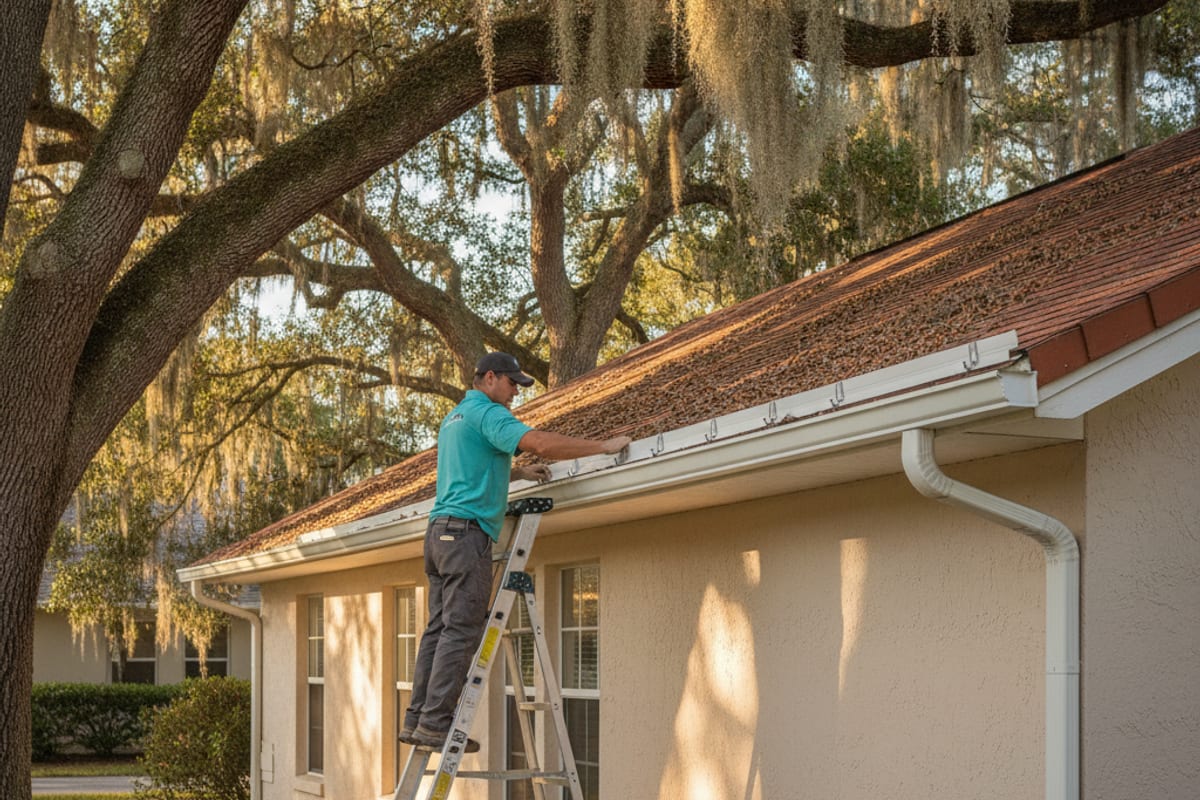
What does a provider scope on this job?
- Measure the roof area that actually drains to each run
- Size the channel together with outlet and downspout capacity
- Roll aluminum to length on site from coil
- Fit end caps, corner miters, outlets, and hangers as separate parts
- Check the fascia fastening surface before hanging a new run
- Set discharge away from the building on a planned path
- Keep house fascia gutters distinct from enclosure structural gutters
When should you request a referral?
- Water sheeting over the front lip in a storm
- Staining or washout along a walk, door, or foundation line
- Separated sectional joints or sagging runs
- A new roof that changed drip-edge geometry
- A patio cover, carport, or enclosure that moved where water lands
What do homeowners ask about Seamless Gutter Installation?
How much do seamless gutters cost in Lakeland?
We do not publish an installed average. On 2026-09-05, Gutter Works / Lakeland Seamless Gutters advertised 6-inch seamless gutter at $9.60 per linear foot, 6-inch corners at $27.50 each, 3x4 downspouts at $9.60 per linear foot, 7-inch gutter at $18.80 per linear foot, and take-down from $2.00 per linear foot. Those are one provider's dated line items, not our rate and not a market survey. Tax, fascia, access, and unlisted labor are not in that list. See the cost guide for a labeled hypothetical add-up.
Do I need 5-inch or 6-inch gutter?
Neither size is a default for Polk County roofs. Building America lists 4-, 5-, and 6-inch channels and says a larger trough only helps if downspouts can drain it. Senox's 2026 catalog also sells 7-inch K-style end caps and miters. Choose from roof catchment to each run, pitch, valleys, outlet spacing, and downspout cross-section, not from a five-inch or six-inch habit.
Where should the downspouts discharge?
Away from the building, on a path you can see. Building America / EPA Indoor airPlus educational guidance sends surface discharge at least 5 feet from the foundation, or to an underground catchment at least 10 feet away that is not tied into the foundation drain. That is program guidance, not a local code we verified. A buried line is a designed drain, not a default. Dumping at the slab corner is the habit to question.
Should gutters go on before or after a new roof?
After the roof. New drip edge and shingles change the plane the gutter has to catch, and crews working over a new trough tend to dent it. The same order applies after a new carport, patio cover, or screen room, because those change where water lands.
How is a house gutter different from a pool-cage super gutter?
A house gutter hangs on the fascia and drains the roof. A pool enclosure's structural gutter is part of that frame and is sized and attached as enclosure work. Do not treat them as the same product, and do not assume every cage gutter dumps into the house run.
Seamless Gutter Installation information organized by Polk County city
Use the city links below to open the local page for seamless gutter installation in Lakeland & Polk County.
Open the 35 city pages for seamless gutter installation
Need a referral for seamless gutter installation in Polk County?
Describe the roof edge, debris, drainage, fascia, or overflow and request a measured quote. Lakeland Outdoor Pro connects Polk County homeowners with licensed and insured local crews.