When people compare pool cage quotes, they compare aluminum and screen, because those are the parts you can see. The part that actually decides whether the structure is standing after a storm is the part nobody looks at: the engineered design and the anchors.
Polk County has a genuine advantage here, and it is worth understanding before you shop. We sit thirty-plus miles from either coast, which puts us in a lower design wind speed zone than Pinellas, Sarasota, or Lee County. That is real money saved on the same cage. It is not a reason to skip the engineering.
What the design wind speed actually is
The Florida Building Code assigns an ultimate design wind speed to every address in the state. It is not one number for Florida and it is not one number for Polk County. It varies by location, and the permit package for your specific project spells out the value your structure was designed to. Which map that value comes off depends on the structure’s risk category, and whether the number crosses 140 mph is what decides impact protection on glazed openings. Our guide to the wind-borne debris region in Polk County walks through both tests.
Coastal counties carry higher numbers because they take the strongest sustained wind in a landfalling hurricane. Inland Polk takes hurricane wind too, but by the time a storm reaches Lakeland or Bartow it has usually lost some of that peak. We get wind and inland flooding rather than storm surge, which is a meaningfully different design problem than the one a Gulf-front property has.
Lower design wind speed means lighter members can carry the same span, fewer anchors are required, and the aluminum package costs less. Building the identical pool cage in Polk County genuinely costs less than building it on the coast, and any contractor telling you otherwise is either not from here or not being straight with you.
What you are actually buying
Here is the thing that surprises people: on a screen enclosure, the engineering is most of the product.
A sealed engineered drawing specifies member sizing, anchor type, anchor spacing, connection detail, and how the whole assembly transfers load into the deck and the ground. It is signed by a Florida engineer for your address, your dimensions, and your wind speed. It is what the building department reviews, and it is what the inspector checks against.
The enclosures that fail in Polk County wind events are overwhelmingly not the ones designed a little too light. They are the unpermitted kits anchored with short fasteners into the edge of a thin slab, put up by someone who quoted $2,000 less because they skipped the entire engineering and permitting step.
That is the price gap you are looking at when one bid comes in dramatically low. You are not getting the same thing cheaper. You are getting a different thing.
The anchors are the weak point, not the aluminum
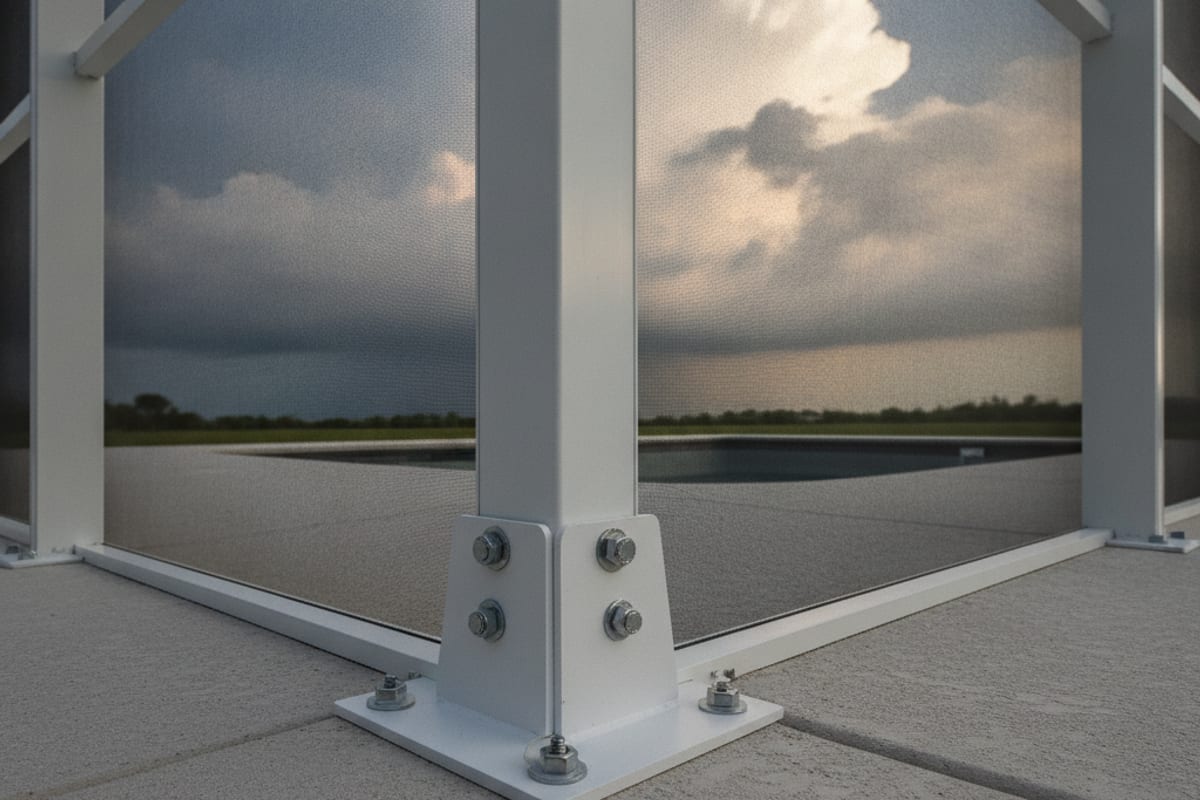
Aluminum members almost never fail in the middle. Enclosures come apart at the connections, and the connection that fails first is usually where the frame meets the concrete.
An anchor is only as good as what it lands in. That is why a competent crew probes or cores the slab edge during the measure rather than after they show up with materials. Older Polk County patios were frequently poured thin with no perimeter footer, because nobody was planning to stand a structure on them. Anchoring a frame into four inches of unreinforced concrete at the edge is how you buy a repair in three years.
Two parts of the county make this more than theoretical.
Bartow, Mulberry, Fort Meade, and Homeland sit on or near reclaimed phosphate mine land in the Bone Valley district. Ground that has been mined and refilled settles differently than undisturbed ground. That shows up as cracked slab edges, anchors that work loose, and enclosures that have gone out of square. On those properties the concrete gets evaluated before the structure gets designed, and poured footings frequently replace slab-edge anchoring.
The Lake Wales Ridge around Lake Wales, Babson Park, and Frostproof runs the opposite risk. The ground is fine, but the exposure is not. Open citrus land with almost no tree cover gives wind a clean run at a structure. Same code, same design wind speed for the address, but a cage there is working harder than one tucked between houses in a Lakeland subdivision.
A lot that backs onto water adds a third question that has nothing to do with wind. Anything inside a Special Flood Hazard Area answers to the county’s floodplain rules on top of the building code, and screening is the one enclosure design those rules were written to allow. Screen enclosures in a Polk County flood zone covers how to confirm your zone and what the county asks for.
What a clean permit package looks like
The contractor pulls the permit under their own license. Not you. If anyone asks you to pull an owner-builder permit for work they are performing, that shifts liability onto you, and it is the single clearest signal that something is off.
The package should include a signed and sealed engineered drawing for your address, not a generic detail sheet photocopied for every job. Expect at least an anchor or footer inspection and a final inspection.
Who issues the permit depends on where you live, and Polk County is a patchwork. Unincorporated county property goes through Polk County. Lakeland, Winter Haven, Bartow, Lake Wales, Haines City, and Auburndale each run their own building departments with their own queues and their own setback rules. A crew that works mostly in the county can hit friction the first time they pull inside Lakeland city limits, and the reverse is true too.
If you are in one of the newer I-4 corridor subdivisions around Davenport, Loughman, or Four Corners, add a step in front of all of that: architectural review through the homeowner association, which governs anything visible including frame color. That review frequently takes longer than the county permit does. Start it early.
Timeline, and why fall is the right time to start
Plan on six to twelve weeks from signing to a finished cage. The build itself is one to two weeks. The rest is engineering, plan review, and material lead time.
Storm season compresses everything. After a named storm, every aluminum shop in Central Florida is triaging damage, plan review queues fill up, and material gets scarce. The worst possible time to start a new enclosure is the week after a hurricane, which is unfortunately exactly when most people decide they want one.
If you want a cage for next summer, start it in the fall. If you have storm damage right now, that is a different job with different urgency, and screen enclosure repair crews prioritize it accordingly.
Where you should not accept a cheaper bid
Compare bids on span, roof style, mesh, and finish all you want. Those are legitimate places to save money, and a dome roof genuinely costs less than a gable.
Do not shop on anchor spacing, fastener type, or whether the design is sealed. Those are not features. They are the structure. A bid that saves you money by spacing anchors further apart or by skipping the engineered drawing is selling you something that looks identical on day one and is not remotely the same thing on the day it matters.
What wind speed is my pool cage designed for?
Whatever the Florida Building Code assigns to your specific address, which the permit package spells out. Inland Polk County carries a lower design wind speed than the coastal counties, which is why the same cage costs less to build here.
Does a screen enclosure really need engineering?
Yes. It is a structure, and every Polk County jurisdiction requires a permit with an engineered design and an inspection. The engineering is not paperwork wrapped around the product. On a screen enclosure it substantially is the product.
Will a permitted cage survive a hurricane?
A permitted, engineered, properly anchored enclosure is designed to the wind standard assigned to your address, and that is the honest limit of what anyone can promise. Nothing is hurricane-proof. What fails in Polk County storms is overwhelmingly the unpermitted work, not the permitted work.
Why did my anchors pull out of the deck?
Usually because the concrete at the edge was thin, cracked, or spalled rather than because the anchor was wrong. Re-setting the same anchor in the same hole buys you until the next storm. The fix is sound concrete, epoxy anchors, or adding a footer.
Do I need HOA approval before the permit?
In most newer subdivisions along the I-4 corridor, yes, and it comes first. Architectural review governs anything visible including frame color. This page does not publish how long that review takes.
If you want a quote that includes the engineering and the permit rather than quietly leaving them out, call (863) 777-5379. The on-site measure is free, and it starts with looking at what your slab or deck will actually hold.