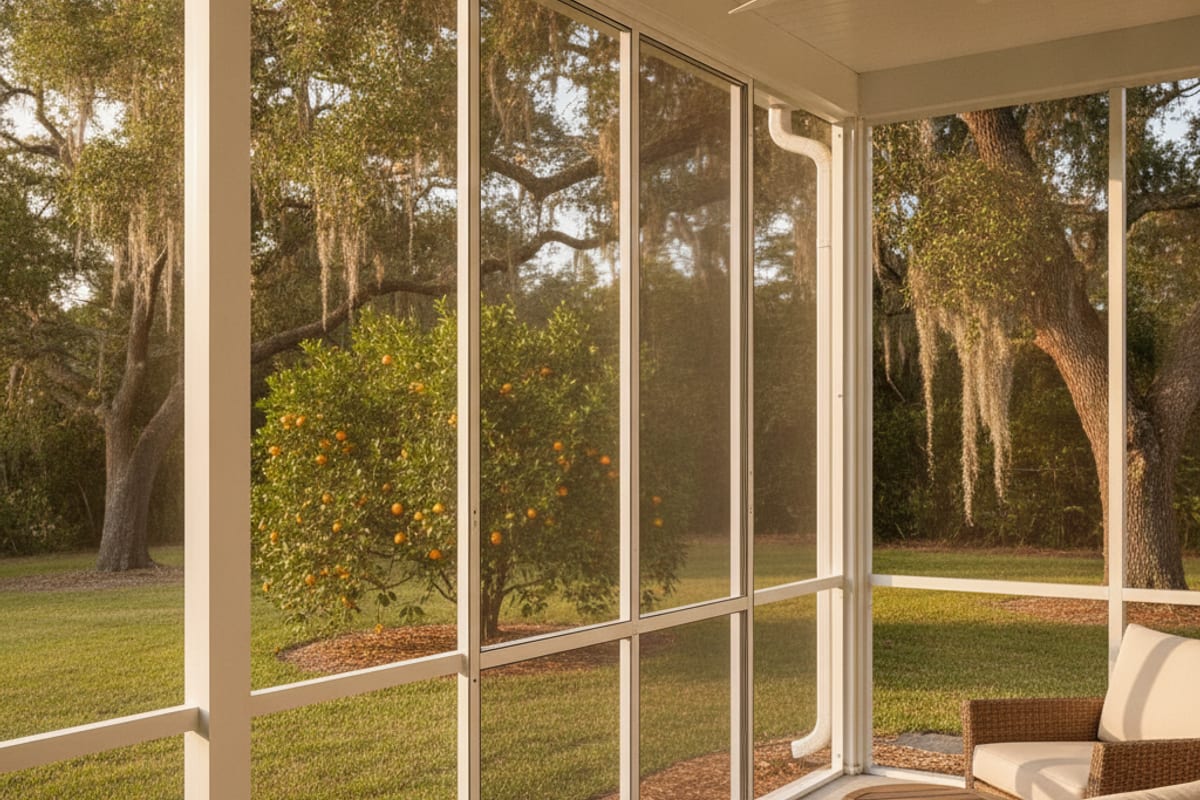
Three products get sold under similar-sounding names in Florida, including all three under the same nickname, and the price gap between the cheapest and the most expensive is roughly ten to one. People end up disappointed less often because they bought a bad product than because they bought the wrong one of the three.
Here is the honest breakdown, with what each actually does in a Polk County summer.
What a Florida room means on this comparison
Listings and quotes in Polk County use “Florida room” for all three products on this page: a screened lanai, a vinyl or acrylic three season room, and a glass sunroom. What is a Florida room is the nickname page. This page stays the three-way comparison. Ask which product they mean before you compare prices.
Screen room: $1,500 to $14,000
A screen room is an aluminum frame with mesh panels and either a screen mansard roof or an insulated aluminum roof panel. It keeps out bugs, leaves, and direct sun. It does not keep out rain blowing sideways, cold air, or humidity, and it never will.
That sounds like a limitation. In Central Florida it is mostly not one, because the thing making your patio unusable from May through September is the bugs and the sun, not the temperature by itself. Put a roof and screen over a slab under mature oak canopy in Dixieland or Crystal Lake and you have converted dead space into the most-used room in the house for eight months a year.
Cost splits sharply on one question: do you already have a roof? Screening in an existing covered lanai runs $1,500 to $3,500 because the roof is the expensive half and it is already built. Building the roof and the enclosure together runs $6,000 to $14,000. Builders across Davenport, Loughman, and Haines City hand over covered patios that were never enclosed, which is why screen room installation is the cheapest job on this list in that corridor.
Three season room: $8,000 to $20,000
A three season room is a screen room with vinyl or acrylic panels added, so the openings close up when you want them closed and stack open when you do not.
This is the middle option and in Central Florida it is often the smart one. You keep the screen behind the panels, so the room still works as a screen room all summer. When a January cold front drops the temperature into the forties, or when wind-driven rain is coming sideways off the Chain of Lakes, you close it up.
What it will not do is stay comfortable in July with the panels closed. Sealed up in peak summer it becomes a greenhouse, and any honest crew will tell you that before you sign. People who understand that going in are happy with the product. People who were sold it as a cheap sunroom are not.
Acrylic versus vinyl is the one real decision inside this category. Acrylic is rigid, optically clearer, and holds up far better to UV over ten-plus years, which matters on a west-facing lanai in Florida sun. Vinyl is cheaper and stacks more compactly but clouds and yellows faster. If the lanai takes afternoon sun, pay for acrylic. If it is shaded, vinyl is fine.
Price tracks the number of openings far more than the square footage, because every opening is hardware and labor. A wide lanai with six openings costs more than a deeper one with four.
Sunroom: $22,000 to $45,000
A sunroom is construction. Real insulated glass, thermally broken aluminum framing, an engineered slab and footer, and a permit path much closer to a room addition than to an enclosure. You can run conditioned air in it and use it in August with the door to the house open.
That capability is the entire reason for the price. If what you want is a room you can use year round with the AC on, this is the only one of the three that does it, and the others are not substitutes.
Two things catch people. First, existing lanai slabs are frequently too thin and lack a perimeter footer, because they were never poured to carry a wall. An engineer or contractor cores it during the estimate, and if it needs a new footer, that is real money that belongs in the quote up front rather than as a change order after demo. Second, a conditioned permitted sunroom generally does get added to the heated square footage on your property record, which can affect your assessment. The Polk County Property Appraiser is the authority on your specific parcel, and it is worth a call before you commit if that matters to you.
If you are seeing sunroom quotes near $10,000, that is almost certainly a three season acrylic room being described as a sunroom. Ask directly whether the glass is insulated and whether the room is designed to be conditioned.
How to pick, in three questions
Do you want to use it in August? If yes, sunroom. Nothing else does that. If you are fine using it eight or nine months a year and closing it up during the worst of summer, keep reading.
Do you get real cold fronts that bother you, or wind-driven rain? If yes, three season. Panels turn a handful of unusable January weeks and a dozen sideways-rain afternoons into usable ones. If your complaint is purely bugs and sun, skip the panels.
Do you already have a covered roof out back? If yes, a screen room is dramatically cheaper than you probably think, because you have already paid for the expensive part. If no, factor in the roof, and consider that an insulated aluminum roof panel costs more than a screen mansard but stays noticeably cooler underneath.
The upgrade path, and why sequence matters
You can start with a patio cover, screen it in later, and add panels after that. Each step is legitimate on its own. But it only works cleanly if the first contractor knows the plan.
If they know a screen room is coming, they set post spacing, header height, and beam sizing so the screen frame drops in without new posts. Retrofitting a cover that was not planned for it usually means rebuilding the posts, which throws away most of the first job. Tell the patio cover crew where you eventually want to end up, even if the eventual part is three years out.
The one upgrade that is rarely cheap is three season to true sunroom. The limiting factor is almost always the slab and footer, which were not built to carry a conditioned glass structure. If you suspect a sunroom is where you will end up, price the footer work now rather than paying to redo the room twice.
What Polk County adds to the decision
Sun exposure is worth checking before you pick. A west-facing space on the Lake Wales Ridge, with open citrus land and no canopy, is a fundamentally different heat problem than a shaded lanai in central Lakeland under seventy-year-old oaks. The Ridge property wants an insulated roof panel and acrylic rather than vinyl. The Lakeland property can get away with less.
Proximity to water changes the mesh, not the category. Anywhere near the Winter Haven Chain of Lakes, 20/20 no-see-um is the default rather than an upgrade, because standard 18/14 fiberglass lets no-see-ums straight through and they are abundant at dusk, which is exactly when a lakefront space is worth sitting in.
Is a three season room worth it in Florida?
For most Polk County houses, yes, if you understand what it does. You get the screen room all summer with the panels open, plus a genuinely usable room during winter cold fronts and wind-driven rain. What you do not get is a room that is comfortable sealed up in July.
How much cheaper is a screen room than a sunroom?
Substantially. A screen room over an existing covered patio runs $1,500 to $3,500, against $22,000 to $45,000 for a glass sunroom. They solve different problems, and the gap is what it costs to make a space conditionable.
Can I add AC to a three season room?
Some owners add a mini split, which changes the comfort math and also changes the permit picture. Talk to the contractor about it before the room is built rather than after, since it affects the electrical and the way the room gets detailed.
Does a screen room add square footage to my property record?
Generally not, because it is unconditioned. A permitted conditioned sunroom usually does. The Polk County Property Appraiser is the authority on your specific parcel.
Which one holds up best in a storm?
All three are engineered to the design wind speed at your address if they are permitted. The glass in a sunroom is the component with the most to lose, and the screen in a screen room is by far the cheapest to replace afterward.
If you are not sure which of the three you actually want, that is a good reason to have someone walk the space. Call (863) 777-5379 and we will get you a free on-site measure with real numbers for more than one option, so you can compare them side by side instead of in the abstract.