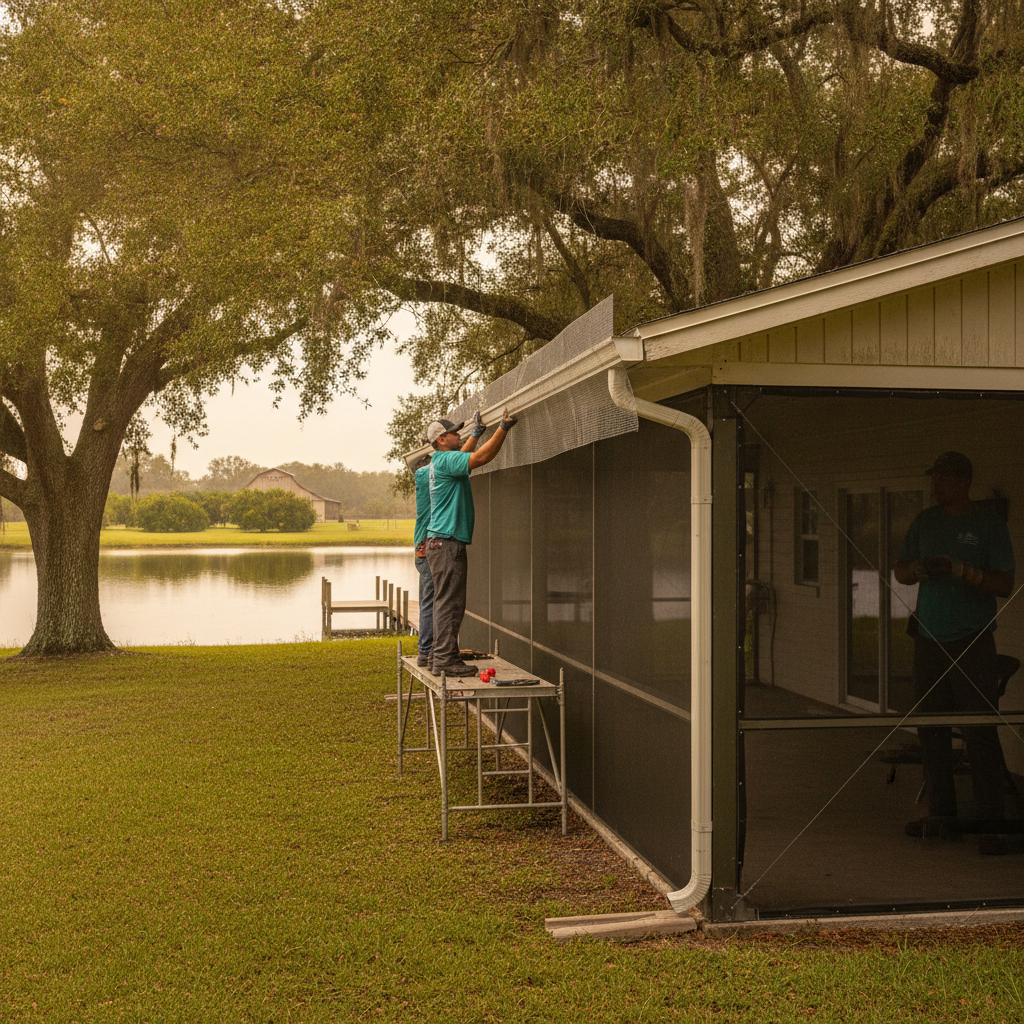
A Winter Haven roof on a lake lot loads in two moves. Wet oak leaves, twigs, and Spanish moss sit in the trough, then an afternoon thunderstorm dumps a sheet of water on top of that mat. The cover you pick has to shed both, and it has to screw into fascia that has already lived through decades of that cycle.
Lake-lot debris versus Lakeland oak catkins
Winter Haven debris stays wet. That is the difference that decides the product.
Homes across Winter Haven and the Chain of Lakes sit close to the water. Live oaks along Lake Howard, Lake Eloise, and the Cypress Gardens shoreline hold moisture in the canopy. Leaves plaster the gutter instead of blowing off. Spanish moss comes down in clumps after wind around Eagle Lake, Wahneta, and Fussells Corner. Mixed lots toward Auburndale add pine needles that sift through a coarse grid.
The Lakeland gutter-guard page is the oak-canopy story: a spring flush of catkins under heavy trees near Lake Morton, matting on a wide-opening screen. A Winter Haven lake lot is a damper load. The trees sit closer to the water, the air stays wetter, and the litter stays soaked long enough to become a blanket. Buy for that blanket.
A Lake Wales ridge ranch is a third county story: sand, citrus litter, and drier air. The Chain of Lakes is water volume plus damp oak litter. A wide-opening screen that passes water under dry catkins loads here because the leaves are already soaked. They mat. They hold the next cell’s rainfall on top of the screen instead of letting it into the trough.
The Polk County zone forecast comes from the National Weather Service Tampa Bay office in Ruskin. Summer cells build over the lakes and dump hard, then move on. A packed run cannot move that water to the outlets, so it sheets over the front lip and down the fascia. The Atlantic hurricane season runs from June 1 to November 30. A cover already packed with wet moss in August is an overflow problem before a named storm ever arrives.
Building America, a federal building-science program, says gutter channels are typically available in 4-, 5-, and 6-inch sizes, and that surface discharge should land at least 5 feet from the foundation, with underground catchment at least 10 feet. That is program guidance, not a local code we verified. On a Winter Haven lot that grades toward the lake, overflow that never reaches the downspout never gets that far. It soaks the fascia and the soil at the wall instead.
Neither 5-inch nor 6-inch is a default for Polk County roofs. Sizing follows catchment per run, pitch, valleys, outlet spacing, and downspout cross-section. A long lake-facing slope with a valley dumping into one corner needs more trough and more outlets than a short ranch run on a quiet street off Cypress Gardens Boulevard. West-facing lake lots around Lake Howard also take wind-driven rain into the gutter at an angle, which is how water gets under a hood lip that looked tight on a calm morning.
Cover, screen, and micro-mesh on a Winter Haven roof
A hood-style cover sheds large lake-lot leaves. A wide-opening screen lets water through and then loads with wet moss. Micro-mesh stops the small stuff when the pitch is right and the water has a path.
Pick the product for the debris on your lot, then have a licensed crew set it on a trough that can still move water.
| Style | What it does on a Chain of Lakes roof | Where it struggles |
|---|---|---|
| Hood or reverse-curve cover | Large oak leaves and twigs shed off the top | Fine grit and soaked moss can wash under the lip in a hard dump |
| Wide-opening screen | Water reaches the trough through a coarse grid | Wet oak leaves and Spanish moss mat on top and hold the next storm |
| Micro-mesh | Stops pine needles, roof grit, and small lake-lot litter | Sheets over if the pitch is flat or the outlets are already slow |
A wide-opening screen is the mismatch most Winter Haven homeowners inherit. It looks like it should pass water. On a dry day it does. After a July cell over Lake Winterset, the mat on top becomes a dam. The next storm never sees the trough.
Micro-mesh earns its keep on mixed lots where pine needles and small oak fragments are the daily load. It still needs a true pitch toward the outlets. Flattened, sagging 1990s gutter will sheet over a fine mesh the same way it sheets over a clogged open trough. Shallow-pitch ranches in Inwood and along the south shore toward Eagle Lake are where that shows up first.
Hood-style covers help on the big-leaf lake lots in Cypress Gardens and around Lake Eloise, where the problem is a wet blanket of oak leaves rather than grit. They still need the trough underneath to be open, pitched, and tied into enough downspouts. A cover on a crushed, undersized run just hides the overflow until it stains the siding.
Gutter guards installed run $5 to $14 per linear foot. What moves you through that range is access, stories, roof pitch, and whether the existing trough and fascia can take the product. The gutter guard cost picture for Polk County walks those drivers without treating every house as the same length of eave.
If the trough itself is rusted, pulled off the board, or pitched backward, a cover is the wrong first move. Seamless gutter installed runs roughly $8 to $14 per linear foot, which puts most Polk County homes between $1,300 and $2,800. The crews we send size the channel to the roof. A long lake-facing slope with two valleys is not a short street-side run off Recker Highway, and the linear-foot number moves with that.
Florida law is plain on who may contract the work. A person must be certified or registered in order to engage in the business of contracting in this state. Ask which class the contractor holds, then verify it yourself at myfloridalicense.com. The crews we send are licensed and insured. That is a claim about the network, and it is true.
Fascia on older Chain of Lakes houses
The cover is only as good as the board it screws into.
Winter Haven, Cypress Gardens, and Eagle Lake still carry a large stock of 1990s ranch and two-story houses. Many of those runs were hung with spikes and ferrules. Summers of overflow soften the fascia. A screw into punky wood does not hold a cover through the next storm season.
Look at the board from the yard after a rain. Dark streaks under the gutter line, peeling paint at the drip edge, and a trough that sags between hangers are the same story. Water has been sitting on that fascia for years. The crews we send check the board before they set a cover. If the wood is gone, the repair sequence is fascia, then trough, then cover. Skip a step and the new product pulls out of the same rot.
Spike-and-ferrule hangers work loose as the board swells and dries. Hidden hangers spread the load along the back of the trough. On a 1990s Chain of Lakes house, converting the hangers while the cover goes on is often the difference between a product that stays put and one that lifts on the first hard dump.
A two-story elevation or a steep lake-facing pitch is not a ladder job for a homeowner. Cutting into a roof or a fascia to tie a cover in belongs to a licensed contractor. Height, fascia, and the water path off the roof stay with the crew.
A gutter cover is not on the county’s published permit list the way screening with framing or a rigid-roof carport is. Ask the building official who covers your Winter Haven address on the specific design rather than guessing from a neighbor’s job.
Gutter cover questions in Winter Haven
A Winter Haven cover fails when the product, the trough, and the fascia do not match the lake-lot load. These are the questions that come up most.
Do gutter covers work on Winter Haven lake lots?
They work when the product matches wet oak litter and afternoon storm volume, and when the trough and fascia underneath can still carry water. A wide-opening screen on a lake lot often mats with soaked leaves and Spanish moss. A hood-style cover or a micro-mesh system, set on a pitched seamless gutter with enough outlets, is the pairing that actually moves a July cell off the roof.
How much do gutter guards cost around Winter Haven?
Installed gutter guards run $5 to $14 per linear foot. Access, stories, pitch, and fascia repairs move the number. A cover on failed wood costs more because the board and the trough have to be right first. Linear footage on a long lake-facing ranch is simply more product than a short street-side run.
Should the gutters come off before the cover goes on?
If the trough is crushed, pitched backward, leaking at the joints, or hanging off spike holes, yes. A cover cannot correct a trough that already dumps over the front lip. Replace the run, set hidden hangers into sound fascia, then fit the cover. If the existing seamless gutter is sound and pitched, the crews we send can set a cover on it.
When to call us
Call when a Winter Haven run overflows in an afternoon storm, when the fascia is staining under the trough, or when you want a cover matched to lake-lot debris instead of a product built for a different part of the county. Licensed crews handle the height, the fascia, and the water path. Call us at (863) 777-5379.