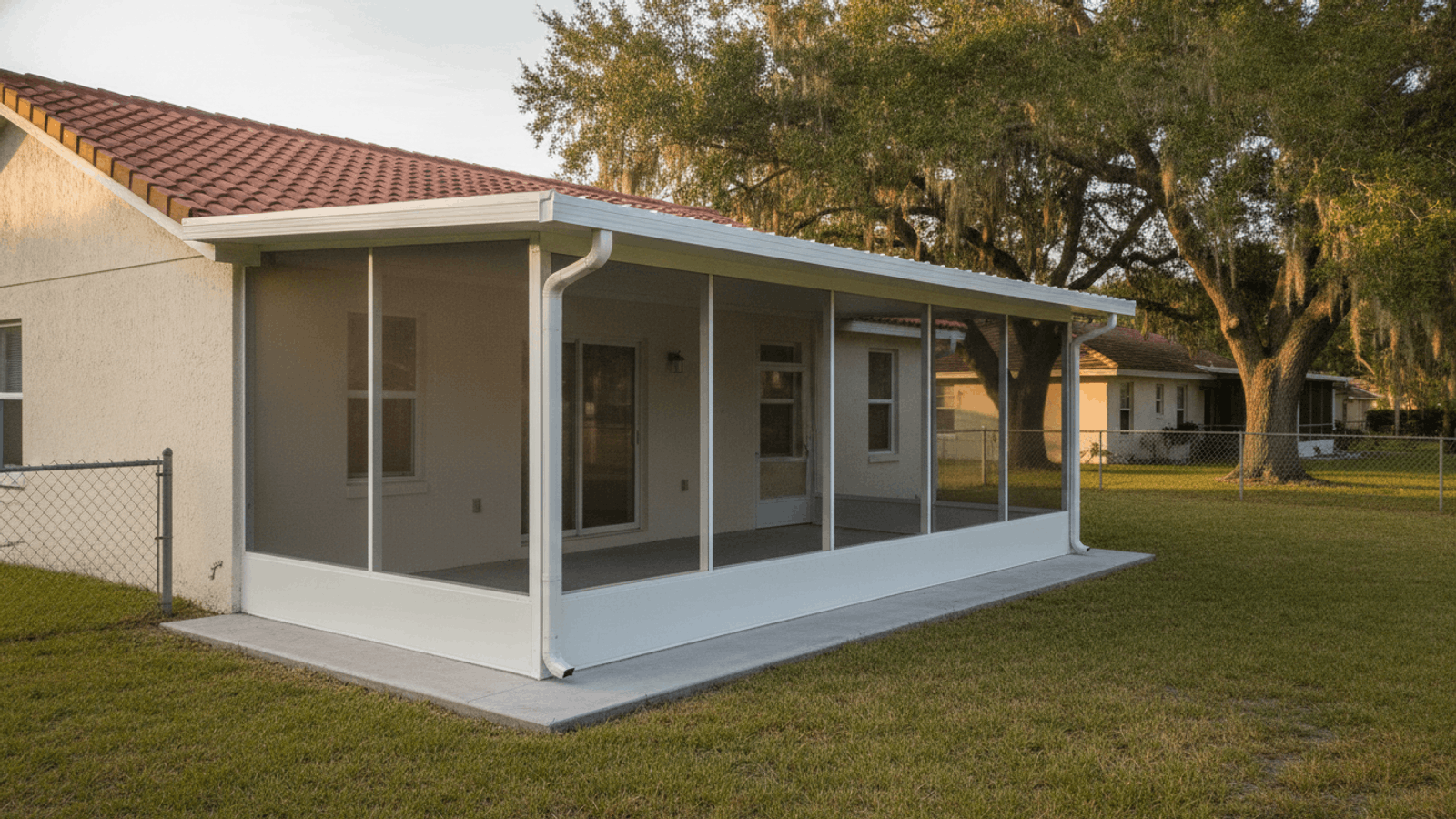
Does a screened in porch increase your property taxes?
Usually yes, and the three percent homestead cap does not stop it. F.S. 193.155(4)(a) takes the new work out from under that cap: “Except as provided in paragraph (b) and s. 193.624, changes, additions, or improvements to homestead property shall be assessed at just value as of the first January 1 after the changes, additions, or improvements are substantially completed.” Paragraph (b) is the misfortune-or-calamity replacement case. It is not an ordinary addition.
The clock is substantial completion, then the first January 1 after that.
How much the bill moves depends on what the Polk County Property Appraiser determines the structure contributes. That is a parcel-level determination. It is not a number a web page can supply.
Someone who just priced a pool cage, a screen room, or a sunroom is doing this last piece of arithmetic before they sign. The same statute is what people mean when they ask whether adding a lanai increases property taxes. The statute names changes, additions, or improvements. It does not name those structures.
Why the three percent cap does not cover it
Because an addition is assessed at just value, not at three percent. The cap still runs on the house you already had. The new value sits on top.
Just value and capped assessed value are not the same number. Save Our Homes, the homestead cap in F.S. 193.155(1), is the second of those. Homestead property “shall be reassessed annually on January 1”. “Any change resulting from such reassessment shall not exceed the lower of the following:” “Three percent of the assessed value of the property for the prior year” or “The percentage change in the Consumer Price Index for All Urban Consumers, U.S. City Average, all items 1967=100, or successor reports for the preceding calendar year as initially reported by the United States Department of Labor, Bureau of Labor Statistics.”
That CPI leg is why the cap is often less than three percent. It is still a cap on the homestead you already had.
It is not a cap on the addition. The Polk County Property Appraiser’s FAQ is the sentence that makes the sequencing click: “The market value of physical alterations to the property such as additions or improvements (not including normal maintenance)” is added to the assessment after the limited assessed value has already been applied to the qualifying homestead. The house stays under the cap. The new thing does not fold under it.
A Polk rental or second home is not on that homestead track. A lot of Davenport and Haines City readers are in exactly that position. Nonhomestead residential property has its own cap, F.S. 193.1554(3): “Any change resulting from such reassessment may not exceed 10 percent of the assessed value of the property for the prior year.” The Property Appraiser’s FAQ adds the school-board exception: “No, the 10% cap will apply to all millages except for school board millage.”
The carve-out for additions is the same shape. F.S. 193.1554(6)(a) says “changes, additions, or improvements to nonhomestead residential property shall be assessed at just value as of the first January 1 after the changes, additions, or improvements are substantially completed.”
Homestead or not, the improvement comes in at just value. The cap protects what was already there.
What the Property Appraiser is actually valuing
Contributory value, not the contract price. Those are different numbers.
The county names a backyard structure directly. The FAQ says “When changes to your property occur, the Property Appraiser’s values are adjusted to reflect these changes. For instance, if you build a swimming pool in your backyard, the market value would increase proportionately based on the contributory value of the pool.”
That is the closest the Polk appraiser comes to this kind of backyard work, and contributory value is the term that matters. It is not what the crew billed. The published cost of a new pool cage in Lakeland does not tell you what the structure will add to the roll.
F.S. 193.011 is titled “Factors to consider in deriving just valuation”. Present cash value is “The present cash value of the property, which is the amount a willing purchaser would pay a willing seller, exclusive of reasonable fees and costs of purchase, in cash or the immediate equivalent thereof in a transaction at” a willing-buyer sale. Replacement value is “The cost of said property and the present replacement value of any improvements thereon”. Condition is “The condition of said property”. Location is “The location of said property”. Size is “The quantity or size of said property”.
The county’s own FAQ describes two of the methods in plainer words: “Comparing the selling prices of comparable properties to your property is one method for estimating MARKET value.” And “Another way is based on REPLACEMENT COST in its current condition.”
None of those is a promise about a specific structure. None of them maps a build cost onto an assessed amount. Just value is the appraiser’s determination on that parcel.
When does it show up on your bill?
After the work is substantially completed, on the first January 1 that follows. Not on the day the crew finishes. Not on the day a permit is issued.
A building permit is a different file. The screen enclosure permit path in Polk County is that file. It is not the event that starts this tax clock. The only timing the statute gives is substantial completion, then the first following January 1.
That January 1 value shows up next on the TRIM notice. TRIM is the Notice of Proposed Property Taxes. The Property Appraiser’s tax-roll page states the mailing rule: “No later than 55 days after certification of value the Property Appraiser will mail out the Notice of Proposed Property Taxes (TRIM), to all taxpayers by first class mail.” The same page named August 17 as the mailing date for that notice. That is a dated note on the page, not a rule that every year lands on the same calendar day. The mailing rule that always applies is the 55-day sentence.
F.S. 200.069 sets the column headings on that notice. These headings appear on the form:
- “Taxing Authority”
- “Your Property Taxes Last Year”
- “Your Taxes This Year IF NO Budget Change Is Adopted”
- “Your Taxes This Year IF PROPOSED Budget Change Is Adopted”
The two millage-rate headings sit on the same form. They are the last-year adjusted rate and this year’s millage columns. Read them on the notice. Do not treat this page as a substitute for the paper that carries your millage code.
A Polk County permit search tells you whether the enclosure has a building file. It does not print that millage code. If the live issue is a sale and work that never had a permit, selling a house with an unpermitted enclosure is that lane, and it is not this tax clock.
What the arithmetic looks like in Polk County
There is no single Polk County millage rate, and there is no single Lakeland rate. The 2025 certified table published by Polk County Property Appraiser Neil Combee, revised 10/2025 and printed 10/07/2025, lists the same city on more than one row.
The table itself builds each millage code from the unincorporated tax code, the city code, and a special-district digit. A last digit of zero means no special district. Lakeland appears three times: 90510 at 17.5402, 91510 at 18.0402, and 91511 at 20.0402. That last row is also the one that carries the Lakeland DDA 2.0000 component. Auburndale appears at 90330 (16.3594) and 92330 (16.6847). Winter Haven appears at 90410 (18.6979) and 92410 (19.0232).
Read the millage code printed on your own TRIM notice. Do not borrow a citywide number from this page.
These are 2025 certified totals. They are the latest published final millage. Other codes exist. A city’s total applies inside that city’s limits, and county properties inside city limits do not pay the MSTU tax that unincorporated totals include.
| Area | Millage code | 2025 total millage |
|---|---|---|
| Unincorporated, SWFWMD | 90 | 12.9291 |
| Unincorporated, South FL WMD | 30 | 12.9761 |
| Lakeland | 90510 | 17.5402 |
| Lakeland | 91510 | 18.0402 |
| Lakeland | 91511 | 20.0402 |
| Winter Haven | 90410 | 18.6979 |
| Winter Haven | 92410 | 19.0232 |
| Auburndale | 90330 | 16.3594 |
| Auburndale | 92330 | 16.6847 |
| Bartow | 90310 | 18.2159 |
| Haines City | 90420 | 19.4474 |
| Davenport | 90430 | 19.3579 |
The county’s published method is “Divide the taxable value of your property by $1,000.” Then multiply by the millage rate.
Here is arithmetic, not an estimate. Take a hypothetical $10,000 of taxable value, an illustration, not an estimate of what any enclosure is worth. Divide by $1,000. That is 10. Against unincorporated SWFWMD code 90 at the 2025 certified rate of 12.9291, 10 times 12.9291 is 129.291. Against Lakeland code 90510 at 17.5402, 10 times 17.5402 is 175.402. Same hypothetical value, two real 2025 codes, and the spread is the point.
That annual ad valorem tax is a different charge from a one-time impact fee. Polk County impact fees are the one-time schedule. Millage is the yearly one.
The county puts its own limit on that math: “We cannot say if this will reduce your taxes due to such other factors as millage rates and non-ad valorem assessments.”
Does a repair or a rescreen change anything?
The published distinction is additions and improvements on one side, and normal maintenance on the other. The FAQ does not name a pool cage rescreen.
A rescreen puts mesh back on an existing frame. That is what a rescreen is. The FAQ’s additions answer excludes “normal maintenance” in its parenthetical. It does not say a rescreen, a repair, or a repaint escapes assessment. This page does not say that either.
Ask the Polk County Property Appraiser about the parcel. The published line is the parenthetical. The parcel question is theirs.
Frequently asked questions
Will a screen enclosure raise my property taxes?
Usually yes when the work is a change, addition, or improvement. Florida assesses those at just value after substantial completion. The homestead cap does not cover that new value. How much is the Property Appraiser’s contributory value for that parcel, not the contract price.
Does adding a lanai increase property taxes?
Florida assesses changes, additions, or improvements at just value after they are substantially completed. A lanai is not named in the statute or the Polk FAQ. The Property Appraiser decides what it contributes on that parcel. The cap still protects the house you already had.
What is the Save Our Homes cap in Florida?
It is the homestead cap in F.S. 193.155(1). A homestead is reassessed each January 1, and the change cannot exceed the lower of three percent of last year’s assessed value or the CPI change. Additions are not under that cap. They come in at just value on top of the house.
What is a TRIM notice in Florida?
It is the Notice of Proposed Property Taxes. Polk County mails it by first class mail no later than 55 days after certification of value. It is not the tax bill. Read the millage code on yours. Lakeland appears three times on the 2025 certified table.
What is the Polk County millage rate?
There is not one rate. The 2025 certified table lists Lakeland at 17.5402, 18.0402, and 20.0402 depending on millage code. Unincorporated SWFWMD code 90 is 12.9291. Read the code on your own TRIM notice rather than borrowing a citywide number from this page.
Do home improvements increase property taxes in Florida?
Changes, additions, or improvements are assessed at just value after they are substantially completed. The Polk FAQ excludes normal maintenance from that additions answer. It does not name rescreening, so a repair is a parcel question for the Property Appraiser.
A free on-site measure before you sign
Lakeland Outdoor Pro connects Polk County homeowners with experienced, insured local aluminum crews. We do not pull the permit, and we do not set the assessment. The crews in the Polk County network pull permits under their own licenses. The Property Appraiser values the parcel.
The free on-site measure is the proof point that exists. Full Polk County coverage means the unincorporated lots along the Polk Parkway and the I-4 corridor, not only a Lakeland address. Call (863) 777-5379, Monday through Saturday, 7am to 7pm.