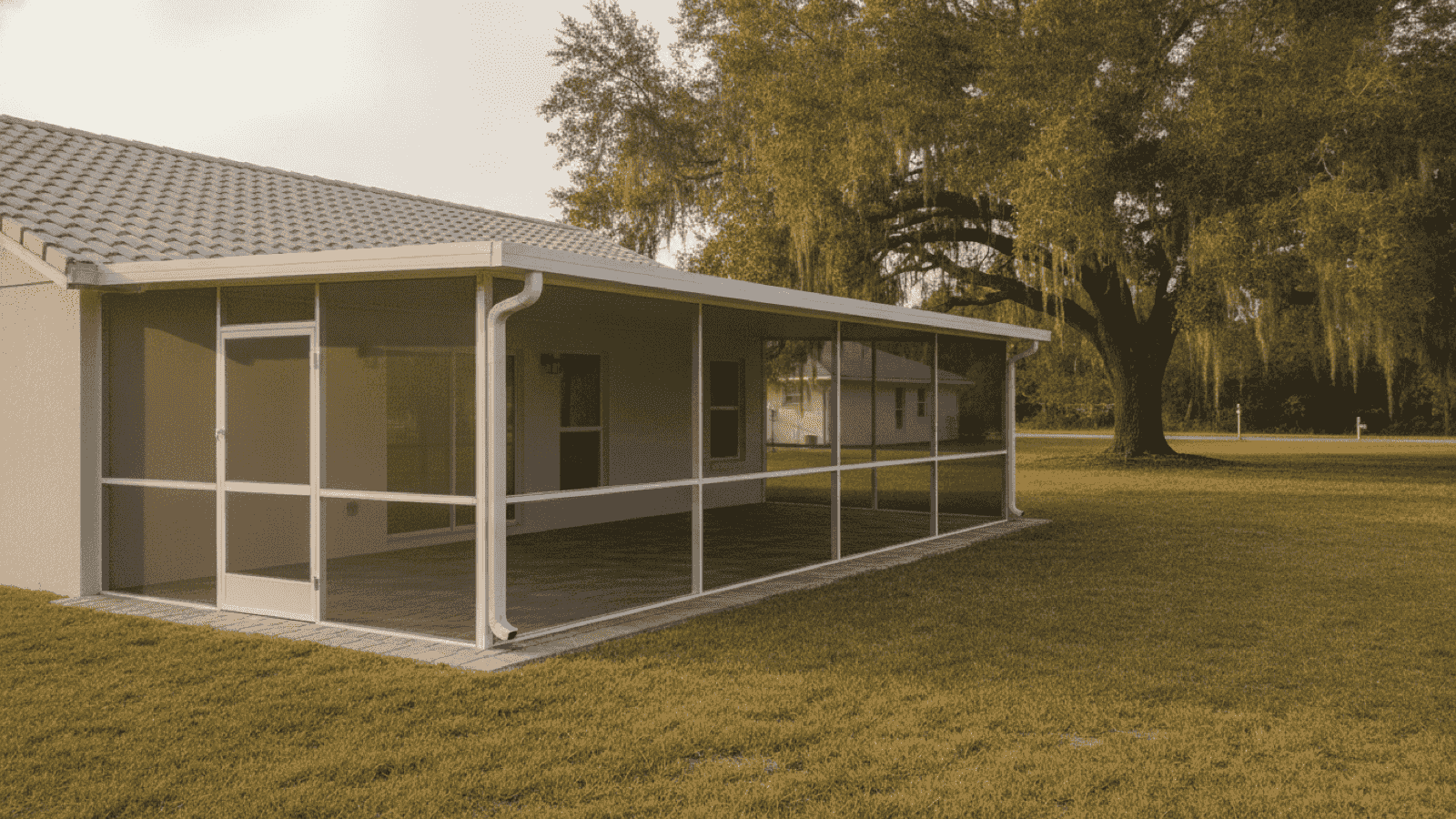
Polk County impact fees are a charge on new construction. A screen enclosure, pool cage, carport or patio cover that adds no dwelling unit doesn’t land on any published residential row. For scale, the county’s building permitting schedule shows Single Family Detached TOTAL ZONE A at $18,027 in the Jan. 1, 2026 column. That’s the charge on a new house, and it’s the number people are thinking of when they ask us this.
What are Polk County impact fees?
They’re a charge on new construction, and Florida Statutes 163.31801 is the statute behind them. The Legislature named it the Florida Impact Fee Act in its own first subsection. The law tells local governments to “ensure that the impact fee is proportional and reasonably connected to, or has a rational nexus with, the need for additional capital facilities and the increased impact generated by the new residential or commercial construction.”
Read that phrase slowly, because it’s the whole answer. An impact fee buys road, park, school and public-safety capacity for the demand that new construction creates. So it gets priced by the unit of demand, not by the square foot.
That also makes it a different charge from your building permit fee, which comes off a valuation table. Our guide to after-the-fact permits in Polk County walks through that side, and the two never get added together the way people expect.
How Polk County and Lakeland actually price them
Look at how the schedules are labeled. In unincorporated Polk County the residential tables are headed “Single Family Detached (Per Dwelling)”, “Multi-Family (Per Dwelling)” and “Mobile Home in Park (Per Space)”. The Jan. 1, 2026 column for Single Family Detached includes EDUCATIONAL $11,124, TRANSPORTATION A $3,710, and TOTAL ZONE A $18,027.
Inside city limits it works the same way. The City’s non-utility impact fees page says “The City of Lakeland collects non-utility impact fees for Polk County at the time of permit.” Every residential row on all four City schedules, transportation, fire, law and parks, carries the Unit of Measure “Dwelling Unit”. Single-Family Detached in the “Rate as of 01/01/26” column runs Transportation $4,856, Parks & Recreation $3,750, Law $595 and Fire $430.
Nowhere on those residential schedules is there a row priced by the square foot. The square-foot rows are the commercial ones, for retail, office and industrial space. Water and wastewater are a separate City department and a separate conversation, and the statute says plainly that “This section does not apply to water and sewer connection fees.”
So does a screen enclosure or pool cage trigger an impact fee?
An aluminum enclosure adds no dwelling unit, so it doesn’t appear on any residential row of either schedule. That’s what the published schedules show, and the permit desk reviewing your specific application is the authority on your parcel.
That covers most of what we get asked about: a new pool cage, a screen room over an existing slab, an aluminum carport, a patio cover. None of them adds a household to the county’s rolls, and none of them has a row waiting for it.
Where a sunroom is a different question
The risk isn’t square footage on its own. It’s whether what you’re building is really a dwelling unit.
The City schedules do publish an Accessory Dwelling Unit row, and in the “Rate as of 01/01/26” column it reads Transportation N/A, Fire $312 and Law $442, with no Parks & Recreation row for that category at all. A conditioned sunroom isn’t an accessory dwelling unit. The line homeowners cross without meaning to is adding a kitchen, or a second full bath plus a separate entrance, because that’s when a room starts looking like a second household.
Say the category out loud early and the question answers itself. Our guide to sunroom permits in Polk County covers the approval path, and what a sunroom costs in Lakeland covers the property record and assessment side, which is a separate question from this one.
Rebuilding after a storm is its own rule
If the structure was already there, the statute carves it out. F.S. 163.31801(14) says a local government “may not assess an impact fee for the reconstruction or replacement of a previously existing structure if the replacement structure is of the same land use as the original structure and does not increase the impact on public facilities beyond that of the original structure.”
The second half of that subsection is the limiter, and it matters here. If the replacement brings “a significant increase in size, intensity, or capacity of use”, the government “may assess an impact fee in an amount proportional to the difference in the demand between the replacement structure and the original structure.”
For this trade that reads clearly enough. A cage rebuilt to its original footprint sits on one side of that sentence. A cage rebuilt materially larger sits closer to the other. Our guide to pool cage storm damage and insurance covers the claim side of the same rebuild.
When the fee is collected, and what an increase can and can’t do to you
The timing is set by statute. Local governments must “ensure that collection of the impact fee may not be required to occur earlier than the date of issuance of the building permit for the property that is subject to the fee.” Polk County publishes the same thing in its own words: “All construction permit fees are due at time of permit issuance.”
An increase has rules on it too, and they’re worth knowing while the county works through its phase-in. A local government must “provide notice at least 90 days before the effective date of an ordinance or resolution imposing a new or increased impact fee.” More usefully for anyone with paperwork already in: “Unless the result is to reduce the total mitigation costs or impact fees imposed on an applicant, new or increased impact fees may not apply to current or pending permit applications submitted before the effective date of a new or increased impact fee.”
There are ceilings as well. “An impact fee increase may not exceed 50 percent of the current impact fee rate”, and “An impact fee may not be increased more than once every 4 years.”
Polk County’s current schedule is already phased. The county’s page says “On Sept. 17, 2024, the Board of County Commissioners adopted a new Impact Fee Ordinance”, and that “The new rates will go into effect on Jan. 1, 2025.” The published columns step through July 1, 2024, Jan. 1, 2025, Jan. 1, 2026 and Jan. 1, 2027.
What changes on January 1, 2027
The Legislature rewrote part of this statute in the 2026 session. Chapter 2026-161, Laws of Florida, says “This act shall take effect January 1, 2027.” It isn’t in effect today.
Two pieces are worth flagging. The amended subsection (4) opens “For impact fees adopted or increased after July 1, 2026”, which is the date the rewritten minimum requirements are written to reach. And a new subsection gives you an answer on your own money: when a payor submits a written refund or credit request over an alleged overpayment, the government “shall provide a written approval or denial to the payor within 30 days after receiving the written request.”
What the 2026 act didn’t do is create the protections above. The collection-at-permit rule and the pending-application protection are already sitting in the 2025 text, and they apply now.
The Lakeland exemption almost nobody mentions
Inside one part of the city, non-utility impact fees come off entirely. The City’s page describes it plainly: “The Core Improvement Area includes the Downtown Community Redevelopment Area, a portion of the Midtown Community Redevelopment Area, and the City’s historic districts.” Within that area, “the County and City of Lakeland exempts development including construction, alteration or expansion of any structure from all non-utility impact fees.”
Note the words “alteration or expansion”. That’s broader than new construction, and it’s a City of Lakeland boundary rather than a countywide one. The City publishes a map so you can check an address against it before you assume either way. Our Lakeland outdoor living service area page covers the rest of what’s local to that work.
Frequently asked questions
What are Polk County impact fees?
They’re charges local governments assess on new construction to pay for the infrastructure capacity that growth demands. Florida law requires each fee to have a rational nexus with the increased impact generated by new residential or commercial construction. They’re separate from your building permit fee.
Do I pay an impact fee for a screen enclosure in Polk County?
A screen enclosure adds no dwelling unit. Both Polk County and the City of Lakeland price their residential impact fee schedules per dwelling unit, so an aluminum enclosure doesn’t land on any residential row. The permit desk reviewing your application makes the call on your parcel.
Does a sunroom trigger an impact fee?
A conditioned sunroom isn’t an accessory dwelling unit on its own, and the City publishes separate Accessory Dwelling Unit rates. A sunroom only gets near that line if it picks up a kitchen, or a second full bath plus a separate entrance, which starts describing a second household.
Do I owe an impact fee to rebuild a pool cage after a storm?
Florida law bars a fee for replacing a previously existing structure of the same land use that doesn’t increase the impact on public facilities. A proportional fee is available only where the replacement brings a significant increase in size, intensity or capacity of use.
When are impact fees collected in Polk County?
State law says collection can’t be required earlier than the date the building permit is issued, and Polk County says all construction permit fees are due at time of permit issuance. New or increased fees can’t reach permit applications submitted before the increase took effect.
Planning your outdoor living project
We connect homeowners with insured local aluminum crews, and those crews pull their own permits under their own licenses. This article isn’t legal or tax advice, and the fee question on any specific parcel belongs to the permit desk that reviews it. Our guides to after-the-fact permits in Polk County and screen enclosure permits in Polk County cover the rest of the paperwork. Call (863) 777-5379 for a free on-site measure.