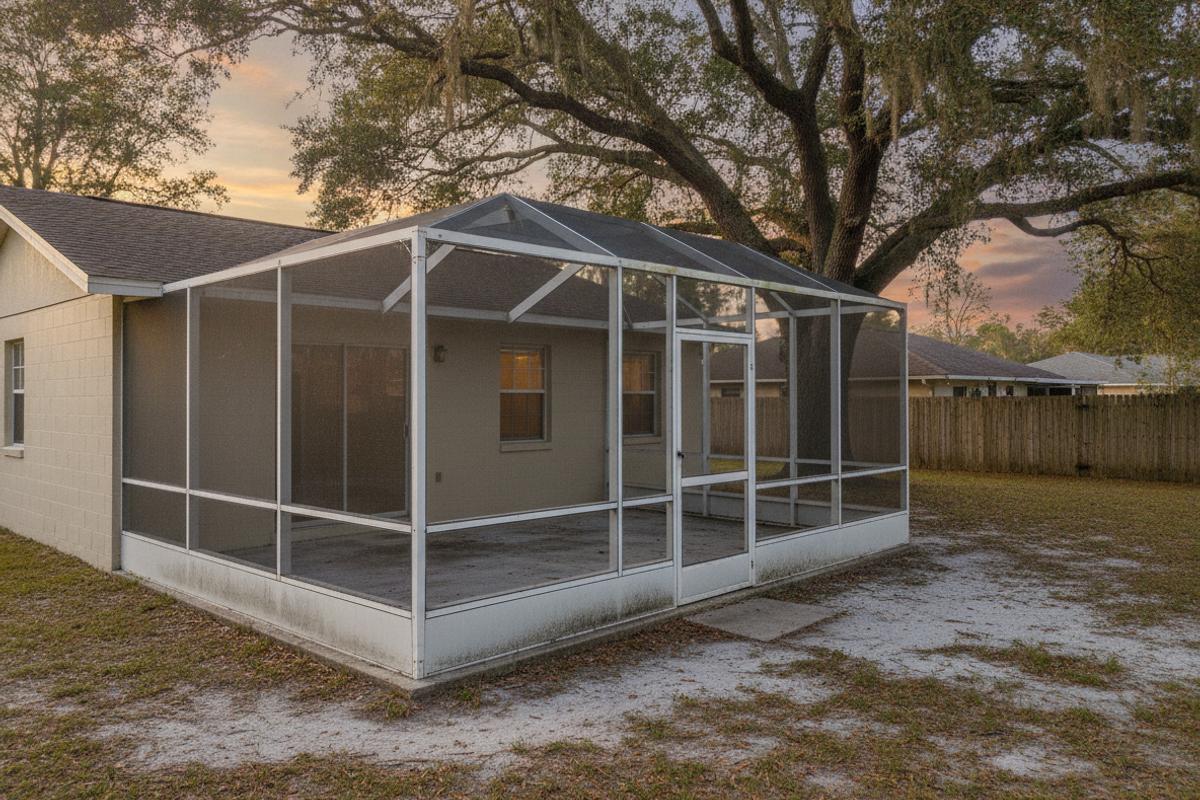
A sale can still move with enclosure work in the picture. It can also stall. Permit status, lender and insurer review, the contract, disclosure questions, safety, and how the agency will resolve the file can all affect a closing. None of those questions comes with a promised result.
The buyer protection for an old, unclosed permit does not cover work that never had a permit. The practical first step is to find out which of those you actually have.
Can you sell a house with unpermitted work in Florida?
Selling the property and resolving the permit record are separate issues. Florida law does not give this page a universal answer that a sale always closes, or that a sale never can.
What can affect a transaction, without predicting yours:
- An open, expired, or never-located permit record.
- What a lender, insurer, or title company will accept.
- What the contract requires the seller to do before closing.
- Disclosure questions about work that is not obvious from a walkthrough.
- Safety or other agency issues that are not the same as an unclosed permit.
- Whether the issuing agency will close an old file, require a new permit, or take another path.
Take your circumstances to your own attorney or title company. Lakeland Outdoor Pro is not a law firm and gives no legal advice.
The Florida statute that does not protect the buyer here
F.S. 553.79(17)(a) addresses an unclosed permit, not never-permitted work.
The paragraph applies to “a building permit applied for by a previous owner” that “was not closed.” The complete protection states:
“A local enforcement agency may not deny issuance of a building permit to; issue a notice of violation to; or fine, penalize, sanction, or assess fees against an arms-length purchaser of a property for value solely because a building permit applied for by a previous owner of the property was not closed.”
The same paragraph continues:
“The local enforcement agency shall maintain all rights and remedies against the property owner and contractor listed on the permit.”
Work with no permit has no application behind it. This paragraph therefore does not reach that situation. It also does not wipe out hazards or unrelated violations.
Our guide to after-the-fact permits in Polk County covers the standing-work side and permit mechanics.
Is the enclosure actually unpermitted?
A blank permit search does not prove that an enclosure is unpermitted. Start with the work performed, then the record.
A missing new permit can mean like-material mesh went back into an existing frame. It can also mean the search missed the issuer, the spelling, the date, or an older address form. Record coverage, annexation, and record type can hide a file that exists.
The existing structure may still have an older permit. Structural or infill work, a rigid-roof carport, or a change in use can be a different permit question than a straight rescreen. This page does not adopt a countywide always-or-never rule for those jobs. Ask the issuing agency to classify the actual scope.
Our Polk County permit search guide explains how to check the address without treating a blank result as the whole story. The screen enclosure permits guide is a place to organize the next step, not a ruling on the sale.
What Resolution 17-025 publishes, and what it does not
If the path is a new permit on standing work, Polk County Resolution 17-025 is the published residential building-permit table this page can cite. It was adopted April 18, 2017 and effective July 3, 2017. Its residential scope expressly includes existing accessory structures.
Resolution 17-025 describes that scope as:
“Applies to : One and Two Family Residential additions, alterations, repairs; accessory structures (new and existing) which are erected alterations, repairs and additions such as (but not limited to): carports, garages, storage buildings, pools, screen rooms, glass rooms”.
Published residential building permit fee examples from that schedule include $85.00 up to $12,000, $103.13 for $14,001 to $15,000, and $301.35 for $49,001 to $50,000. The same schedule lists a $110.00 research fee and a $35.00 reinspection fee. The schedule states, “All Construction Permit Fees are due at time of permit issuance.”
These are permit-only amounts from the published 2017 resolution. They are not total legalization, engineering, documentation, or construction cost. They are not current market prices. They are not proof there is never another fee.
A 2025 follow-up audit describes Resolution 17-025 as the original rate resolution and addresses selected invoicing issues. It is not a complete September 2026 certification of every fee or amendment.
Do not use this site’s service pages as price evidence for legalization or for the sale.
An expired permit and no permit are two different problems
An expired permit has an application and an existing record. Never-permitted work has neither. A search that did not locate a record is still not proof that no one applied.
F.S. 553.79(16)(a) says a property owner, “regardless of whether the property owner is the one listed on the application for the building permit,” may close a building permit.
The owner may “retain the original contractor listed on the permit or hire a different contractor appropriately licensed in this state to perform the work necessary to satisfy the conditions of the permit and to obtain any necessary inspections in order to close the permit.”
The replacement contractor “is not liable for any defects in the work performed by the original contractor and is only liable for the work that he or she performs.”
F.S. 553.79(16)(b) addresses expired permits whose requirements were substantially completed:
“If a building permit is expired and its requirements have been substantially completed, as determined by the local enforcement agency, the permit may be closed without having to obtain a new building permit, and the work required to close the permit may be done pursuant to the building code in effect at the time the local enforcement agency received the application for the permit, unless the contractor has sought and received approval from the local enforcement agency for an alternative material, design, or method of construction.”
F.S. 553.79(16)(c) adds:
“A local enforcement agency may close a building permit 6 years after the issuance of the permit, even in the absence of a final inspection, if the local enforcement agency determines that no apparent safety hazards exist.”
The word “may” matters. This is local agency discretion, not a homeowner entitlement, and not a closing date you can put in a listing.
Owner-builder status on a house you are selling
The ordinary owner-builder exemption is written for qualifying owners building for their own use. It is a poor fit for a house already being marketed, but it is not a blanket ban.
F.S. 489.103(7) describes the qualifying residential scenario this way:
“When building or improving farm outbuildings or one-family or two-family residences on such property for the occupancy or use of such owners and not offered for sale or lease.”
The statute also contains a one-year presumption:
“In an action brought under this part, proof of the sale or lease, or offering for sale or lease, of any such structure by the owner-builder within 1 year after completion of same creates a presumption that the construction was undertaken for purposes of sale or lease.”
That language creates a presumption, not an automatic prohibition.
The statute also contains a qualified takeover path. Under 489.103(7)(a)4, an owner may complete a permit where the listed contractor substantially completed the project, as determined by and with approval from the local permitting agency. That path includes an accessory structure. An owner who qualifies is not required to occupy the home for at least a year after completion. Our guide to owner-builder permits in Polk County keeps that exception in view.
A licensed contractor pulling the permit under their own license avoids the owner-builder exemption risk. It does not make every sale, permit, or disclosure issue disappear.
Frequently asked questions
Do I have to disclose unpermitted work when selling in Florida?
Johnson v. Davis, 480 So. 2d 625 (Fla. 1985), holds that “where the seller of a home knows of facts materially affecting the value of the property which are not readily observable and are not known to the buyer, the seller is under a duty to disclose them to the buyer.” All four conditions travel together: the seller knows the facts, they materially affect the value, they are not readily observable, and they are not known to the buyer. The case is about disclosure. It says nothing about permits, and it is not a rule that the structure must be permitted before sale. Take your situation to your own attorney or title company. This site is not a law firm and gives no legal advice.
Does Florida law protect the buyer from my unpermitted screen enclosure?
F.S. 553.79(17)(a) does not cover work that never had a permit. It addresses “a building permit applied for by a previous owner” that “was not closed,” and only agency action solely on that basis against an arms-length purchaser for value.
Never-permitted work has no permit application behind it. The statute’s buyer protection therefore does not reach that situation.
Can I sell without permitting the enclosure first?
This page cannot promise that a sale will close, or that it will not. An unpermitted enclosure does not, by itself, tell you the outcome. Permit, lender, insurer, contract, disclosure, safety, and agency-resolution questions can all affect the closing. Any of those decisions should be reviewed with the seller’s attorney or title company.
How much does it cost to permit an existing pool cage in Polk County?
The published Resolution 17-025 residential table is valuation-based, not an all-in project price. Residential valuation up to $12,000 carries an $85.00 building permit fee. The $14,001 to $15,000 row is $103.13, and the $49,001 to $50,000 row is $301.35.
A reinspection fee is $35.00, and the research fee is $110.00. Those are permit-only amounts from the 2017 resolution. Other project costs depend on the existing structure and required work. Do not use this site’s service prices as that evidence.
Can I pull the permit myself before I sell?
The ordinary owner-builder exemption covers qualifying residential work for the owner’s occupancy or use and “not offered for sale or lease.” Offering the structure for sale within 1 year after completion creates a statutory presumption.
There is a separate, agency-approved takeover exception when a listed contractor substantially completed the project. The cleaner path for a marketed house is usually a licensed contractor pulling the permit under their own license. That still does not erase every other sale issue.
Clear the enclosure record before listing
Start by confirming whether the project actually required a permit. Then separate an expired or unclosed permit from work that never had one, and from a search that simply did not locate a record.
Our guides cover screen enclosure permits in Polk County and sunroom permits in Polk County. We also serve homeowners throughout our Lakeland outdoor living service area.
Call (863) 777-5379 to discuss the enclosure work. We connect homeowners with licensed and insured local aluminum crews. Ask whether the matched crew will pull any needed permit under its own license.