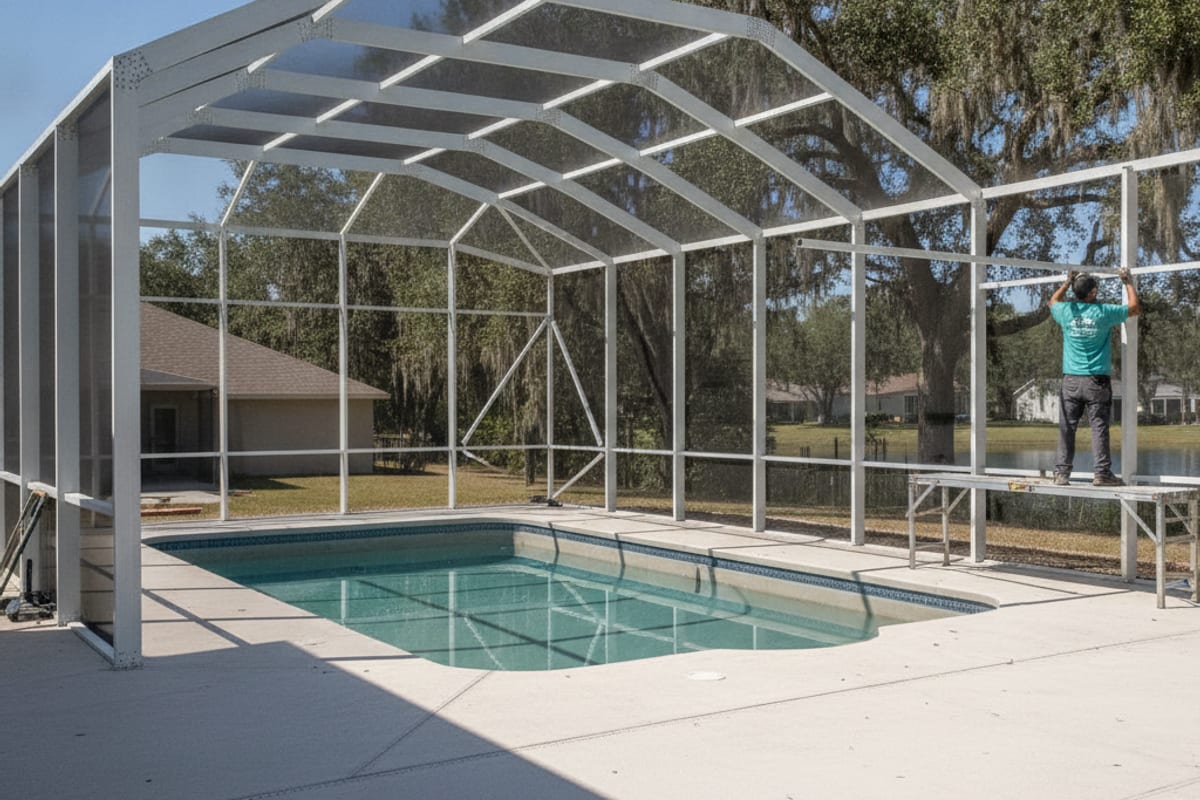
A new pool cage in the Lakeland area runs $9,000 to $18,000 for a typical residential build. A large deck, a two-story mansard tied into the house wall, or a high clear span pushes that to $20,000 to $35,000. Price tracks the aluminum, the engineering, and the height far more than the screen itself.
That last part surprises people shopping their first cage. The mesh, which is the part everyone focuses on, is one of the cheapest components in the whole structure.
What does a new pool cage cost in Polk County?
Most residential cages land between $9,000 and $18,000. What you are paying for is extruded aluminum framing, an engineered design sealed for the wind speed at your address, permits, inspections, and the labor to set the whole structure plumb and square over your deck.
Screen is a small fraction of that number. It is the one component of a pool cage designed to be replaced two or three times over the structure’s life, which is exactly why pool cage rescreening later costs so much less than the original build. If you are comparing a rescreen quote to a new-cage quote and the numbers look nothing alike, that difference is the reason.
Why the engineering is most of the price
A pool cage is a permitted structure, and the sealed engineered drawing behind it, not the aluminum you can see, is what actually decides whether it stands after a storm. Inland Polk County sits far enough from either coast to carry a lower design wind speed than Pinellas, Sarasota, or Lee County, which is real savings on the same cage. It is not a reason to skip the engineering, and any bid that comes in dramatically low is usually missing exactly that line item. Wind load, engineering, and why inland Polk County builds cheaper covers what that engineering actually buys you.
Mansard, gable, or dome: how roof style changes cost
Mansard is the default in Polk County: sloped sides into a flat top, good headroom, and it sheds debris well. Most quotes assume this style unless you ask for something else.
Gable gives you the most height at the center and reads better against a two-story house, but it costs more to engineer and build than a mansard over the same footprint.
Dome is the cheapest and the lowest of the three. It is a reasonable choice on a single-story home with no tall doors or diving board to clear, and it is where headroom matters least.
Deck size and clear span move the number more than roof style does. A large deck, or a tall mansard spanning a wide pool and patio in one piece, is what pushes a quote from the standard range into the $20,000 to $35,000 tier.
What a new cage build includes
A real quote covers a lot more than screen and posts. The crew measures the deck and confirms it can carry anchor loads before quoting, gets the frame engineered and sealed for your specific address, and sets a super gutter along the house side so roof runoff does not sheet straight into the pool. Chair rail and a kick plate go in at the base, and doors get hung on every access side with hardware that meets Florida’s pool barrier requirements, not a standard lanai latch.
Pool cage installation in Polk County should also include the permit and the inspection as part of the job, handled under the contractor’s own license rather than left to you. Confirm the contractor’s license yourself at myfloridalicense.com before signing anything. The class written for this work is the structural aluminum or screen enclosures specialty contractor, and a building or residential license can cover it too, which we walk through separately. It takes a minute and it is free.
Where the deck itself changes the number
The deck a cage sits on decides more of the quote than most homeowners expect. Bigger lots around Polk City and Lake Hamilton tend to carry bigger decks, and bigger decks mean longer clear spans, which is the single biggest cost driver on a cage once you get past the standard size. Getting the roof style settled early, before the rest of the design, is what keeps that cost predictable.
Older concrete changes the conversation in a different way. On reclaimed phosphate ground around Mulberry, Bartow, and Homeland, decks sometimes show settlement, and a cage anchored into a deck that is still moving will not stay square no matter how well the aluminum is engineered. A crew should evaluate the deck before designing the cage, not after, and that evaluation is worth asking about directly when you compare bids.
Timeline: budget six to twelve weeks
The build itself, once the crew is on site, is one to two weeks. The rest of the six to twelve week total is engineering, permit review, and material lead time, and it is rarely the shortest part of the job.
Storm season compresses all of it. After a named storm, every aluminum shop in Central Florida is triaging damage, plan review queues fill up, and material gets harder to source. If you want a cage ready for next summer, the honest advice is to start in the fall rather than waiting for the heat to make the decision for you.
If your existing cage looks tired, you may not need a new one
Before assuming a full replacement is the only option, it is worth ruling out the cheaper fixes. If the frame is sound and only the finish has failed, pool cage painting costs a fraction of a new build, and painting a chalked pool cage instead of replacing it walks through how to tell which one you have. If the aluminum is fine but the mesh has gone brittle, pool cage rescreening is the answer, not a full rebuild. Where the frame has actual damage rather than just wear, screen enclosure repair is the right call before anyone quotes a replacement. A new cage makes sense for a pool that never had one, for a lakefront lot around Winter Haven that never got caged, or for a frame that is genuinely past saving.
Frequently asked questions
How much does a pool cage cost in Lakeland or Polk County?
Most residential cages run $9,000 to $18,000. A large deck, a two-story mansard, or a high clear span pushes that to $20,000 to $35,000. The aluminum, the engineering, and the height drive the price far more than square footage alone.
Why is a new pool cage so much more expensive than rescreening?
Because you are paying for the engineered frame, the permit, and the labor to set it, and those do not need to be repeated when the mesh eventually wears out. Rescreening a full cage typically runs $1,400 to $3,200, a fraction of what the original structure cost.
Mansard, gable, or dome roof, which should I pick?
Mansard is the standard choice: good headroom and it sheds debris well. Gable adds height and costs more. Dome is the least expensive and the lowest, and it works fine on a single-story home without tall doors to clear.
Does a pool cage count as a pool barrier in Florida?
It can, under Florida’s Residential Swimming Pool Safety Act, when the door hardware is self-closing and self-latching with the latch out of a small child’s reach. Confirm the hardware being quoted actually meets that standard. That also matters in reverse, which is what our guide to pool cage removal in Polk County works through.
How long does a new pool cage take from start to finish?
Plan on six to twelve weeks total. The physical build is one to two weeks. Engineering, permit review, and material lead time make up the rest, and storm season stretches all three.
Will a permitted, engineered cage survive a hurricane?
A permitted, engineered, properly anchored cage is built to the wind standard assigned to your specific address, which is the honest limit of what anyone can promise. What actually fails in Polk County storms is overwhelmingly the unpermitted work, not the permitted work.
If you are pricing a new cage or trying to decide whether your current one needs replacing at all, call (863) 777-5379. The on-site measure is free, and it starts with an honest look at what your deck and your existing structure can actually support.