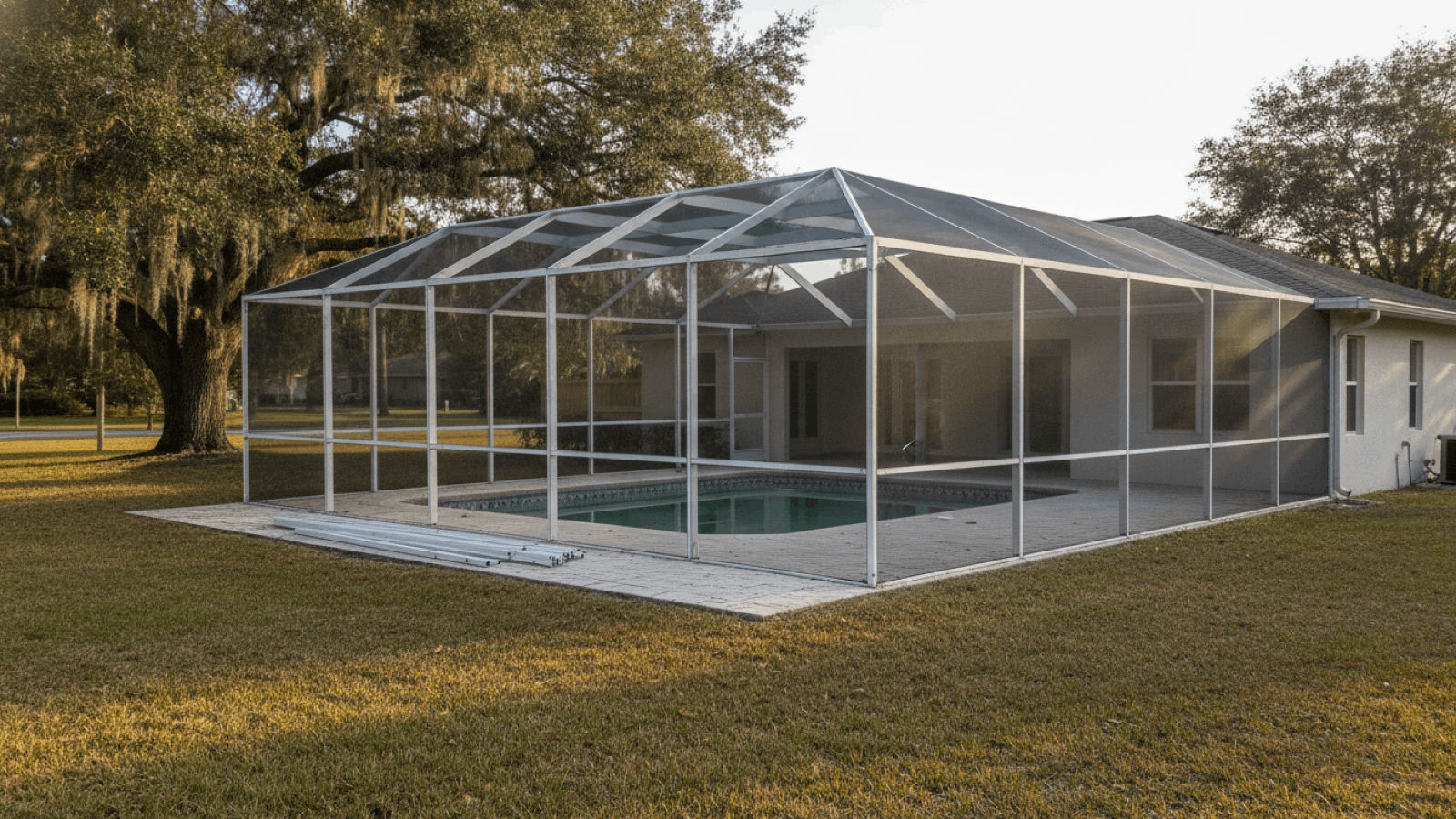
Pool cage removal cost in Polk County only comes from an on-site measure, and two facts come before the number. Polk County lists demolition of any structure, regardless of size, as work that requires a construction permit. And Florida defines a pool barrier to include a nondwelling wall that surrounds the pool, which is very likely your cage. So the job isn’t one decision. It’s a permit, a price, and a plan for what keeps the pool enclosed afterward.
What does pool cage removal cost in Polk County?
There’s no honest one-size number here, so we don’t publish one. The frame, the access, the anchors, the deck and the replacement-barrier plan all move the labor, and none of them can be guessed from a keyboard. A price invented for a web page is worth nothing to somebody trying to schedule a crew.
What is knowable is the county’s side of it. Polk County’s adopted fee schedule, Resolution 17-025 Exhibit A, carries a line reading “Demolition, accessory buildings” at $40.00, plus a “Land Use Fee” at $20.00.
The same schedule says construction permit fees are due when the permit is issued, so those two lines land at the front of the job rather than the end of it.
Read those for what they are. They’re permit fees, not the price of the job, and they cover none of the labor, the hauling, the deck repair or the barrier that replaces the cage.
The labor half turns on things an estimator has to stand in the yard to see. A tall mansard comes down differently than a low flat-pan enclosure. The crew has to decide whether the frame unbolts in sections or gets cut.
Then there’s how the frame was set into the deck in the first place, and what pulling those anchors leaves behind. Access matters more than people expect. Aluminum and screen have to physically get from the back yard to a truck, and a narrow side gate changes the day.
A good quote also says who hauls the material away, and whether a replacement barrier goes in on the same visit. That sequence matters when the cage is what’s surrounding the pool right now.
A free on-site measure is how those details turn into a number. It’s worth reading the pool cage service options first, because full removal isn’t always the scope people end up wanting.
Do you need a permit to remove a pool cage in Polk County?
Yes. Taking a cage down sits on Polk County’s construction-permit list, and it’s the very first line on it.
The first item on that list is, “Construction or demolition of any building or structure regardless of size.”
A second line on the same list reaches the pool itself rather than the cage over it: “Pool/spa repairs, renovations, demolitions and remodels involving structural elements, electrical, gas, solar, geothermal work or additional equipment.”
Those two lines draw the boundary between removing a structure and refreshing its screen. On the other list, the work that needs no construction permit, the county puts “Replacement of screening with like material in an existing structure.”
So a pool cage rescreening service and a full removal aren’t the same filing question. One puts new fabric in a frame that stays. The other takes the frame away.
Polk County also warns, “These examples are not all inclusive and there will be situations that are not addressed here.”
Its next instruction is specific: “If you have a question as to permit requirements, call our Bartow office at (863) 534-6080 and ask to speak with a plans examiner.”
Make that call if the work touches pool equipment or any other regulated system. And if your address sits inside a city rather than unincorporated Polk County, ask that city directly, because the list quoted here is the county speaking for the county.
Our guide to permits for building screen enclosures is the mirror image of this one. That guide covers putting a cage up. This one covers taking it down.
Is the pool cage your legal pool barrier?
It may be. Florida law defines the term by what the structure does.
F.S. 515.25(2) says a barrier is “a fence, dwelling wall, or nondwelling wall, or any combination thereof, which completely surrounds the swimming pool and obstructs access to the swimming pool, especially access from the residence or from the yard outside the barrier.”
A cage is a nondwelling wall, and it surrounds the pool. Its frame, its screen walls and its doors are what control access from the house and from the yard, which is exactly what that definition is describing.
F.S. 515.27 ties pool safety features to a specific inspection point. It states, “In order to pass final inspection and receive a certificate of completion, a residential swimming pool must meet at least one of the following requirements relating to pool safety features:”
One listed option says the pool “must be isolated from access to a home by an enclosure that meets the pool barrier requirements of s. 515.29”.
That option is very often how a screened Polk County pool passed final inspection in the first place. So before the cage comes off, work out which safety feature is left standing, or which one takes its place.
The pool cage door and latch guide deals with a cage that’s staying up, where the door is the weak point. Removal is a different question, because the whole surrounding wall goes with it.
Why removing it is not a simple subtraction
The house wall doesn’t automatically become the missing side of the barrier.
F.S. 515.29(4) states, “A wall of a dwelling may serve as part of the barrier if it does not contain any door or window that opens to provide access to the swimming pool.”
Walk the back of your house and look at every slider, hinged door and window that faces the deck. If any one of them opens into the pool area, that wall doesn’t meet the condition in that sentence. Nearly every Florida lanai has sliders, which is why this catches so many people.
And the definition of a barrier asks for complete enclosure, not most of one. So when the cage goes and the house wall can’t count, the honest description isn’t a partial barrier. There isn’t one. The replacement plan has to handle access from the house and from the yard both.
The surrounding space matters too. F.S. 515.29(5) states, “A barrier may not be located in a way that allows any permanent structure, equipment, or similar object to be used for climbing the barrier.”
That one belongs in the plan before anything comes down, not after. Deck furniture, a storage bench and the pool equipment pad all end up sitting next to a new fence if nobody thinks about it first.
What does the statute require, and what doesn’t it require?
The statute’s stated trigger is final inspection for a residential pool. Its lead-in says, “In order to pass final inspection and receive a certificate of completion, a residential swimming pool must meet at least one of the following requirements relating to pool safety features:”
Its penalty paragraph has a narrower scope than many summaries suggest. F.S. 515.27(2) states, “A person who fails to equip a new residential swimming pool with at least one pool safety feature as required in subsection (1) commits a misdemeanor of the second degree, punishable as provided in s. 775.082 or s. 775.083, except that no penalty shall be imposed if the person, within 45 days after arrest or issuance of a summons or a notice to appear, has equipped the pool with at least one safety feature as required in subsection (1) and has attended a drowning prevention education program established by s. 515.31.”
The load-bearing word there is “new”. That penalty is written for a new residential pool at final inspection, so nobody should tell you that taking a cage off an existing pool is automatically an offense under it.
That isn’t the end of the question for your own pool, though. Ask the permit desk what the demolition plan has to show. Ask your insurer what the barrier change does to your policy, because we haven’t read your policy and nobody should guess at it. Then a licensed contractor can scope the physical work around both answers.
What are the four other ways Florida lets a pool comply?
Beyond the enclosure, the statute lists four more. Each one handles the problem differently, some by blocking access and some by making noise.
An approved safety pool cover is one option. F.S. 515.25(1) defines it as “a manually or power-operated safety pool cover that meets all of the performance standards of the American Society for Testing and Materials (ASTM) in compliance with standard F1346-91.”
Exit alarms provide another option. F.S. 515.27(1)(c) says, “All doors and windows providing direct access from the home to the pool must be equipped with an exit alarm that has a minimum sound pressure rating of 85 dB A at 10 feet;”
Door hardware is a separate choice. The statute describes “a self-closing, self-latching device with a release mechanism placed no lower than 54 inches above the floor”.
A pool alarm is the fourth. The statute says such an alarm “must meet and be independently certified to ASTM Standard F2208”, and it names that standard as the Standard Safety Specification for Residential Pool Alarms. The same paragraph rules out the wearable kind, since it says the term “does not include any swimming protection alarm device designed for individual use, such as an alarm attached to a child that sounds when the child exceeds a certain distance or becomes submerged in water.”
That list is the statute’s, not a recommendation for your back yard. Run whichever one you’re leaning toward past the permitting authority and a licensed contractor before the cage comes down.
If the answer is a fence, what shape does the statute give it?
Florida is unusually specific about what a pool barrier fence has to be.
F.S. 515.29(1)(a) states, “The barrier must be at least 4 feet high on the outside.”
The next paragraph says, “The barrier may not have any gaps, openings, indentations, protrusions, or structural components that could allow a young child to crawl under, squeeze through, or climb over the barrier.”
Placement also matters. The statute says, “The barrier must be placed around the perimeter of the pool and must be separate from any fence, wall, or other enclosure surrounding the yard unless the fence, wall, or other enclosure or portion thereof is situated on the perimeter of the pool, is being used as part of the barrier, and meets the barrier requirements of this section.”
It also requires separation from the water. F.S. 515.29(1)(d) states, “The barrier must be placed sufficiently away from the water’s edge to prevent a young child or medically frail elderly person who may have managed to penetrate the barrier from immediately falling into the water.”
Gate direction and hardware are addressed as well. F.S. 515.29(3) states, “Gates that provide access to swimming pools must open outward away from the pool and be self-closing and equipped with a self-latching locking device, the release mechanism of which must be located on the pool side of the gate and so placed that it cannot be reached by a young child over the top or through any opening or gap.”
Polk County places “Chain link fences of any height and stockade fences up to eight feet high. Check Polk County Land Development Code for prohibited materials for fencing.” on its list of work not requiring a construction permit.
Read that narrowly. It’s a construction-permit exemption, not a blanket no-approval-needed. The county’s own Land Development Code caveat rides along with it, and your HOA is a separate conversation again. Confirm material, location and the whole barrier plan before anyone digs a post.
When is taking the cage down the wrong call?
Sometimes it is. A frame that still has good bones can often be brought back with targeted work instead of a demolition permit. And on a lot of Polk County properties the cage is the only thing keeping the deck usable through a Florida summer, which is worth weighing before the frame goes on a truck.
If the damage is limited, start with an enclosure repair assessment. Our guide to pool cage painting versus replacing walks through the signs that a frame is genuinely finished.
And if taking it down just means putting one back up, weigh that against the new pool cage cost guide before you book anything. Decide what replaces the barrier first. The demolition date comes after that.
Frequently asked questions
Do I need a permit to remove a pool cage in Polk County?
Yes. Polk County lists demolition of any building or structure, regardless of size, as work requiring a construction permit. Its examples aren’t all inclusive, so confirm the filing with a plans examiner.
How much does pool cage removal cost?
It depends on the cage, the access, the anchors, the deck patching, the disposal and the replacement barrier, so we don’t publish a flat number. A free on-site measure is the only honest way to price it.
Does removing my pool cage break the law?
Not automatically under F.S. 515.27. That section’s penalty concerns a new residential pool at final inspection. Ask the permit desk and your insurer what your existing pool needs before the cage comes down.
Does a chain link pool fence need a permit in Polk County?
Polk County’s construction-permit exemption list includes chain link fences of any height. The county also says to check its Land Development Code for prohibited fencing materials, so verify the full plan.
Can I take the cage down and leave the house wall as the barrier?
Only if that wall meets the barrier rule. Florida says a dwelling wall may serve only when it has no door or window opening to pool access. Sliders or doors facing the deck prevent that wall from satisfying the condition.
Plan the removal and replacement barrier together
Treat the demolition and the pool access as one job, because the county and the statute already do. Lakeland Outdoor Pro can set up a free on-site measure with insured local aluminum crews.
Call (863) 777-5379 and describe the cage, the access and what you want standing there afterward. Our outdoor living service in Lakeland page lists the local project types the crews here handle.