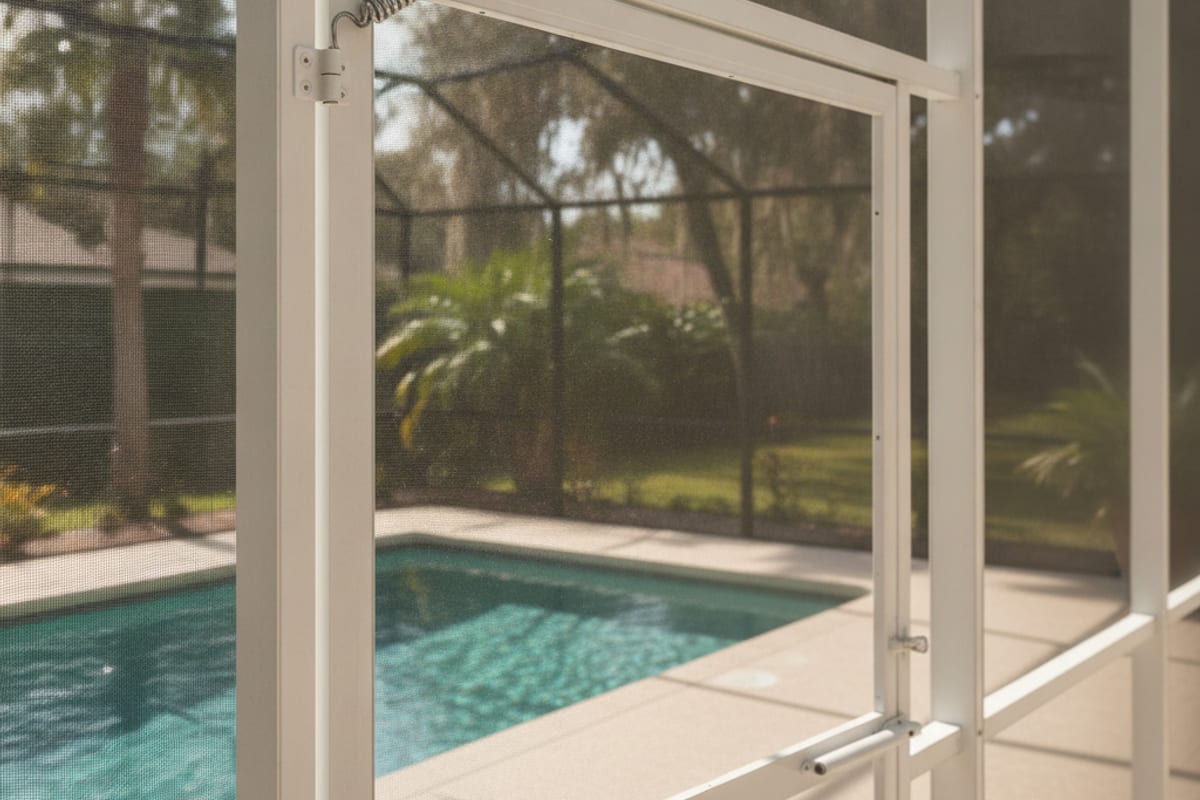
Walk a hundred older pool cages in Polk County and the same thing is wrong with most of them. It is not the screen, it is not the frame, and it is not the anchors. It is a door that no longer closes and latches by itself.
That matters more than it sounds like it does, because on a lot of Florida properties the enclosure is the pool barrier. When the door stops working, the barrier stops existing.
How a screen enclosure becomes a pool barrier
Florida’s Residential Swimming Pool Safety Act requires a pool to have a safety feature, and one of the accepted options is a barrier that meets specific requirements. A screen enclosure can serve as that barrier when it qualifies.
The requirement that decides it, almost always, is the cage door or gate. F.S. 515.29(3) states, “Gates that provide access to swimming pools must open outward away from the pool and be self-closing and equipped with a self-latching locking device, the release mechanism of which must be located on the pool side of the gate and so placed that it cannot be reached by a young child over the top or through any opening or gap.” A standard lanai door with a plain handle does not qualify, and never did.
Keep the 54-inch number on dwelling doors. F.S. 515.27(1)(d) is a different option: “All doors providing direct access from the home to the pool must be equipped with a self-closing, self-latching device with a release mechanism placed no lower than 54 inches above the floor.” That 54-inch release is the house-door option. It is not the cage-door rule.
This is why so many cages fail. The enclosure was built compliant, the closer wore out somewhere around year eight, somebody replaced the handle with whatever the hardware store had, and the barrier quietly stopped being a barrier without anybody noticing.
Why the door is what fails
It is the only part of a screen enclosure with moving hardware, and it gets used every single day.
Closers wear out. Springs weaken. Hinges loosen and the door starts to sag. Latches corrode, which happens fast on open Ridge properties around Lake Wales and Frostproof where sun and wind work on the hardware constantly. Rollers on sliding units wear flat.
The failure is gradual, which is exactly the problem. A door that closes slowly still closes. A door that latches on the second try still latches, if you are paying attention. Nobody wakes up one morning to a door that has obviously failed, and so the fix keeps getting deferred.
Sagging is usually not the door
Here is the diagnostic that saves people money.
When a lanai door drags or will not latch, the instinct is to adjust the hinges. That works for a while. If it keeps coming back, the door is not the problem: the frame around it has racked out of square, and the opening has changed shape.
That happens for a few reasons. Settlement is one, and it is common on the reclaimed phosphate ground around Bartow, Mulberry, and Homeland. An anchor working loose is another. A storm that pushed the frame and left it slightly out of plumb is a third.
Adjusting a door inside an opening that has moved is treating the symptom. A crew should check whether the opening is square before quoting hardware, and if the frame has shifted, that conversation belongs with screen enclosure repair rather than a door swap.
What it costs to fix
This is the good news. Door work is among the cheapest things on a screen enclosure.
Most door repairs run $180 to $500, covering rehanging and squaring a salvageable door, replacing hinges, closers, and latch hardware, or fitting barrier-compliant hardware to a door that never had it. A full replacement door with self-closing, self-latching hardware sits at the top of that range.
Compare that to the cost of the cage it hangs in, or to the consequence of not having a compliant barrier, and it is not a close call. It is genuinely one of the highest-value few hundred dollars you can spend on a Florida pool property.
Rentals, and why this is not optional there
On the short-term rental properties across Davenport, Four Corners, Loughman, and the Haines City growth ring, door hardware is the single most common failure we hear about, and it is the item that matters most.
Guest traffic wears closers faster than owner use does. Guests also do not know or care that a pool door is a safety barrier, and a door that does not self-latch is a door that gets left open. When the owner is out of state, nobody is checking.
If you manage rental properties in the corridor, the practical advice is to add a door check to the turnover routine between guests. It takes ten seconds: open the door, let go, and watch it close and latch on its own. If it does not do both, it needs work before the next booking.
Panels, while someone is there
Torn panels are the other single-item repair worth doing rather than living with. Individual panels run $35 to $90 each, and replacing two or three is a same-visit job.
The only downside is color. New mesh will not match sun-faded mesh around it, and the seam is visible from the deck. If it is somewhere you look at constantly, doing a full elevation is worth considering, and if most of the enclosure is tired, a full rescreen is usually better value per panel.
A kick plate is the other thing worth adding while a crew is on site, particularly on a door a dog uses. Pet-grade mesh on the lower panels plus a kick plate on the door handles most of what actually happens to screen at ankle height.
The ten-second check
Do this today on your own cage.
Open the door all the way and let go. Does it close by itself, all the way, without help? Does the latch catch on its own, without you touching it? Is the release on the pool side, placed so a young child cannot reach it over the top or through a gap?
Three yeses and your barrier is doing its job. Any no is a few hundred dollars and one visit away from being fixed.
Frequently asked questions
Does a screen enclosure count as a pool barrier in Florida?
It can, under the Residential Swimming Pool Safety Act, when it meets the requirements. For the cage door or gate, F.S. 515.29(3) requires self-closing, self-latching hardware with the release on the pool side, placed so a young child cannot reach it over the top or through any opening or gap. The 54-inch release in F.S. 515.27(1)(d) is the dwelling-door option, not the cage-door rule.
Why does my lanai door keep sagging?
Usually because the frame around it has racked out of square rather than because the door itself is worn. Adjusting hinges buys a few months. If it keeps returning, have someone check whether the opening or an anchor has moved.
How much does it cost to fix a screen door?
Most door work runs $180 to $500 depending on whether you are rehanging, rebuilding with new hardware, or replacing the door outright with barrier-compliant hardware.
Can I replace just the door hardware myself?
Simple closer and latch swaps are within reach for a handy owner. What is worth a professional look is whether the opening is still square, since new hardware on a racked frame will fail again quickly.
Does replacing a screen door need a permit?
Generally no. Replacing a door or hardware in an existing permitted enclosure is maintenance. Structural changes to the frame are a different conversation.
If your cage door does not close and latch on its own, that is a same-visit fix and it is worth doing before anything else on the property. Call (863) 777-5379 and say it is a barrier hardware issue, because that is a fast job most crews will slot in quickly.