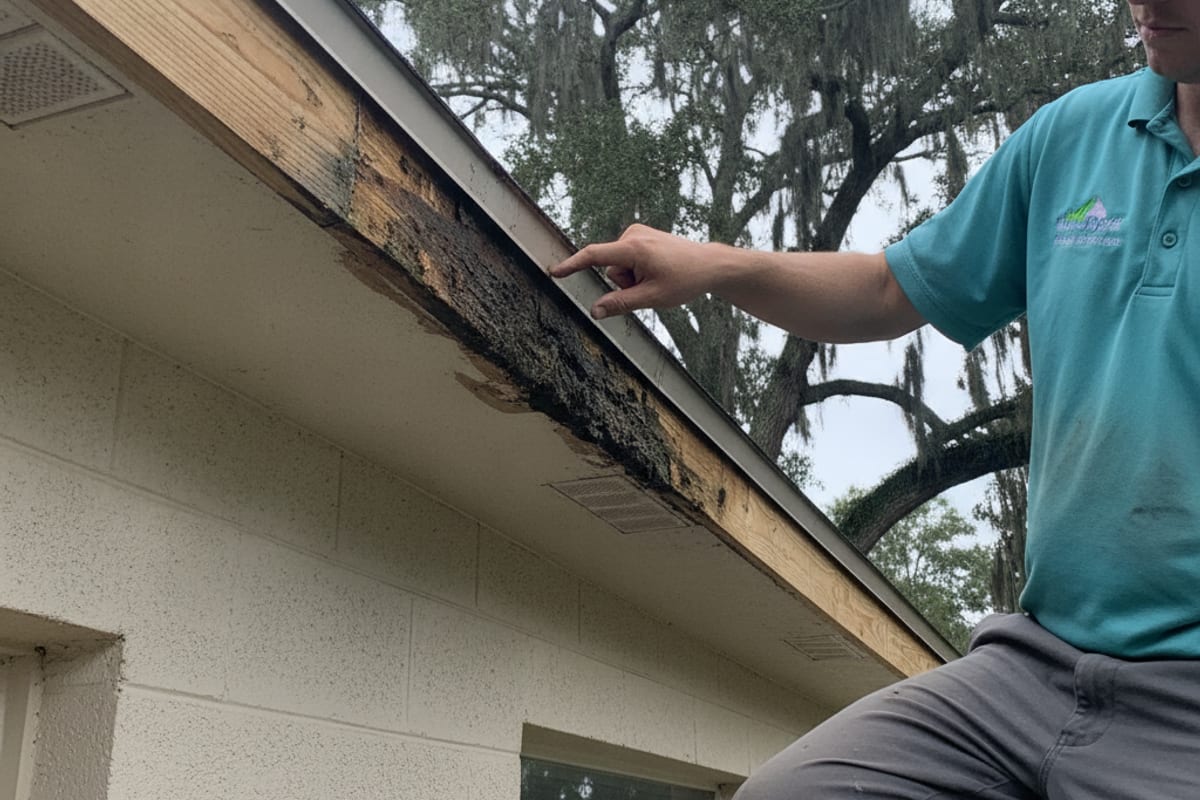
Fascia is the board behind the gutter. It is the fastening surface for hangers, and it is the trim that closes the rafter tails. When water sits against it, the board can soften, the gutter can pull, and the leak can move into the soffit.
A useful fascia quote identifies board length, product, height, access, removal, finish, and whether deterioration reaches the soffit framing or rafter tails.
The gutter installation visit is often when the board is first seen clearly, because the old trough comes off.
What you are actually buying
Ask the bidder to write the unit in plain language.
Length is linear feet of board replaced, not linear feet of house perimeter, and not “a typical house.” One bay can be a few feet. A whole elevation is a different job. Wrapping every eave is a different job again, and it is not a hidden default.
Material is the board product: treated lumber, engineered trim, or another named product the crew will actually install. Species, thickness, and whether it comes pre-primed change both durability and paint work. Do not treat “fascia” as one SKU.
Access is height, ladder versus lift, and whether a porch roof or screen room is in the way. A single-story run you can reach is not the same job as a two-story rake.
Removal is whether the gutter, drip edge, or soffit panel has to come off to see the board. Finish is primer, paint, and whether color match is in the price.
Structural repair is separate. Soft fascia can stop at the trim. It can also continue into soffit framing or rafter tails. Visible dark wood does not prove how far that goes. A fingernail test on one spot does not map the elevation.
If rot has reached framing, the quote should say so and should not bury that work inside a trim number. Replacing trim and repairing soffit framing or rafter tails are different permit questions. Have the contractor confirm the exact work with the issuing jurisdiction.
How water gets behind the board
Gutters are supposed to catch roof runoff and send it to downspouts. Water reaches the fascia when a joint leaks, the trough overflows, pitch holds a puddle, or the outlet is packed. PNNL Building America treats the trough, the outlets, and discharge as one system. An undersized or poorly drained run is one way the board stays wet. It is not the only way.
Hot-humid climate is the Building America setting that calls for more gutter and leader capacity. That is climate design context. It is not a measured year-round humidity number for Polk County, and it is not a clock that says the board fails in a set number of seasons.
Paint that is peeling in long strips, a gutter pulling away, or a spongy spot you can reach safely from the ground are reasons to have the board looked at. Sagging does not, by itself, prove the fascia is gone. The hanger, the fasteners, and a heavy clogged trough can all contribute.
Do not paint over a board that is already soft. Coating does not restore a fastening surface.
Do the fascia while the gutter is off
If you are already replacing gutters, the open eave is the time to cut back to sound wood, fasten new board to a sound substrate, flash and finish it, then hang the new trough. Installing new gutter on a board that cannot hold hangers repeats the leak.
The same look applies when a pool cage or enclosure ties near the eave. That crew should say if the house fascia is part of their scope. A cage structural gutter is still a different member from the house run.
Size the new trough from catchment and outlets, not from a six-inch habit. Gutter sizing for Lakeland roofs covers that. Senox catalogs 5-inch, 6-inch, and 7-inch K-style parts. Building America says a wider channel only helps if the downspouts keep up.
Cleaning interval is not a universal twice-a-year rule. Discharge distance is not a universal six-foot rule. Building America’s educational surface-discharge figure is at least 5 feet from the foundation, as program guidance, not a verified local code. Extension cost is not a number we have from a provider. Paint-cycle years are not a number we have either.
On 2026-09-05, Gutter Works advertised 6-inch seamless gutter at $9.60 per linear foot and take-down from $2.00 per linear foot. Those dated house-gutter line items do not price fascia. Keep them on the installation-cost article.
Frequently asked questions
What is fascia board and why does it rot?
It is the board behind the gutter. It stays wet when roof water leaks or overflows against it, then the fastening surface can soften. The actual cause on your eave has to be looked at. A photo does not date the damage.
How much does fascia board replacement cost?
We do not have a verified local per-foot or per-job figure. Ask for length of board, product, height, whether gutter removal is included, finish, and whether framing is involved.
Can I paint over rotted fascia?
Not if you need the board to hold a gutter. Paint does not turn soft wood into a fastening surface.
Should I fix fascia before or during gutter installation?
During, if the old gutter is coming off. That is when the board is visible. Hanging new gutter on a soft board repeats the failure.
What do I do if I can see dark, crumbled fascia from the ground?
Call for an inspection. Visible damage is enough to look. It is not, by itself, a structural diagnosis or a deadline we can certify from a photo.
Get the board looked at with the gutter
Lakeland Outdoor Pro connects Polk County homeowners with licensed and insured local crews. If the gutter is pulling, staining, or sitting against wood that looks dark and soft, call (863) 777-5379. Ask the crew to write fascia as its own scope, with units you can check.