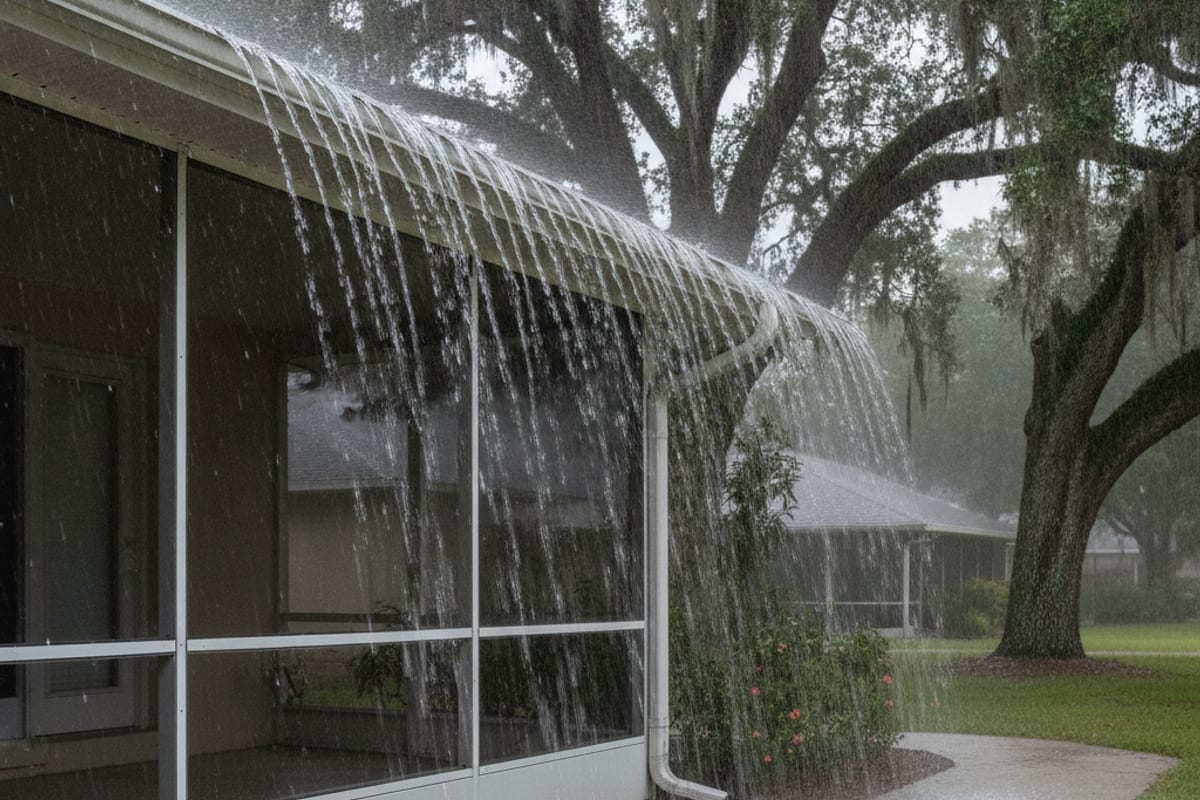
Overflow looks the same from the ground whether the trough is small, the outlets are few, the pitch has a belly, or the channel is packed. Treating every sheet-over as a clog, or every clog as proof the gutter is too small, picks the wrong repair.
PNNL Building America is the design reference for this page. It tells you to size channels and downspouts together for roof runoff. A wider trough does not fix an outlet that cannot drain. That guide is educational building practice, not a Lakeland permit and not a soil report for your lot.
The gutter installation hub explains the measured installation scope. This article explains roof catchment, trough profile, outlets, downspouts, slope, and discharge.
Catchment first, then the trough
Water arrives from the roof area that actually drains to each run, not from the house’s floor plan. A steep pitch and a valley both concentrate flow. Two houses on the same street can need different troughs because their roof planes are different.
Building America names typical stock channels at 4, 5, and 6 inches. Senox’s 2026 catalog also lists 7-inch K-style end caps and miters. None of those profiles is “what most Polk County homes need.” Choose the profile after the catchment and the outlets are known.
The same guide says a larger gutter conducts more water only if there are enough downspouts. Upsizing a long run with one outlet at the far end can still overflow. That is a bathtub with a slow drain.
Slope belongs in the same conversation. Building America calls for at least 1/16 inch per foot of run toward the outlets. A belly holds water against the fascia even when the profile looks large enough on a spec sheet.
Outlets and downspouts are the drain
Building America places downspouts at least 20 feet apart and no more than 50 feet apart, and allows 1 square inch of downspout cross-section for every 100 square feet of roof. A 2x3 downspout is 6 square inches. A 3x4 is 12. Those are design ratios from the guide’s cited context (JLC 2003), not a flow test we ran on a Lakeland roof.
An extra outlet can be the cheaper fix. It is not always cheaper, and it is not a substitute for a trough that is genuinely undersized for the plane that feeds it. Count both.
For more on leaders as their own decision, see downspout sizing. Read that page’s gallon-per-minute table with care. This article does not repeat those unverified peak-flow figures.
Hot-humid and high-wind rain regions, including the Gulf, are told to increase gutter and rain-leader capacity and to use strong attachments. Central Florida sits in that climate conversation. That is a reason to design for peak roof runoff, not for an annual rainfall total.
Where the water leaves the building
Once water is in the downspout, it still has to leave. Building America / EPA Indoor airPlus educational guidance sends surface discharge to sloping grade at least 5 feet from the foundation, or to an underground catchment at least 10 feet away that is not connected to the foundation drain. Do not treat those distances as a Polk County code we verified.
A splash block, an extension, or a designed buried line can all be the right last piece. A buried line tied into a footing drain is the example the guide warns against. County geology does not, by itself, prove a foundation hazard on your lot.
Partial gutter is still legitimate. ENERGY STAR does not require gutters on slab-on-grade homes or in dry climates. Polk County is not a dry-climate exception. Slab-on-grade is not a local legal pass to ignore washout at a door or walk. Skip a run only where you can point to the elevation and say water landing there is not a problem.
Do not take Ridge sand, or any named community, as proof you can skip gutters.
Roll-formed parts, fascia, and covers
Seamless gutter is coil roll-formed to length. Senox still catalogs end caps, miters, outlets, and hangers as separate parts. Color choice is wide. It is not three aluminum colors.
Fascia is the fastening surface. Soft board is a scope item when the old run comes off, not a reason to invent a per-foot repair rate here. Fascia board damage covers that inspection.
A gutter guard keeps some debris out of the trough. Building America notes leaf guards for that job. The cover does not add capacity. If the system already sheets over, size it first. We do not have a verified local guard price, and we do not have a source that every coarse screen fails in one season.
Sequence a new roof first, then the gutter. New drip edge changes the plane. The same order holds after a carport or patio cover, because those change where water lands.
On 2026-09-05, Gutter Works advertised 6-inch seamless at $9.60 per linear foot and 3x4 downspouts at $9.60 per linear foot. That dated list belongs in the installation-cost article. It is not a sizing rule and not our quote.
Frequently asked questions
How much do seamless gutters cost in Lakeland?
See the dated Gutter Works line items on the cost article. This page does not convert them into a typical-house total.
Do I need 5-inch or 6-inch gutter?
You need the profile that matches catchment and outlet capacity. 5-inch, 6-inch, and 7-inch K-style parts exist. There is no county default.
Where should downspouts discharge?
Away from the building on a planned path. Building America’s educational 5-foot and 10-foot figures are program guidance, not a verified local code.
Do gutter guards replace a larger gutter?
No. A cover manages debris. Capacity is still trough plus outlets plus downspouts.
Should gutters go on before or after a new roof?
After. New drip edge changes what the trough has to catch.
Measure the roof you have
If water is going somewhere it should not, call (863) 777-5379. Lakeland Outdoor Pro connects you with licensed and insured local crews who will look at catchment, outlets, and discharge before they talk linear feet.