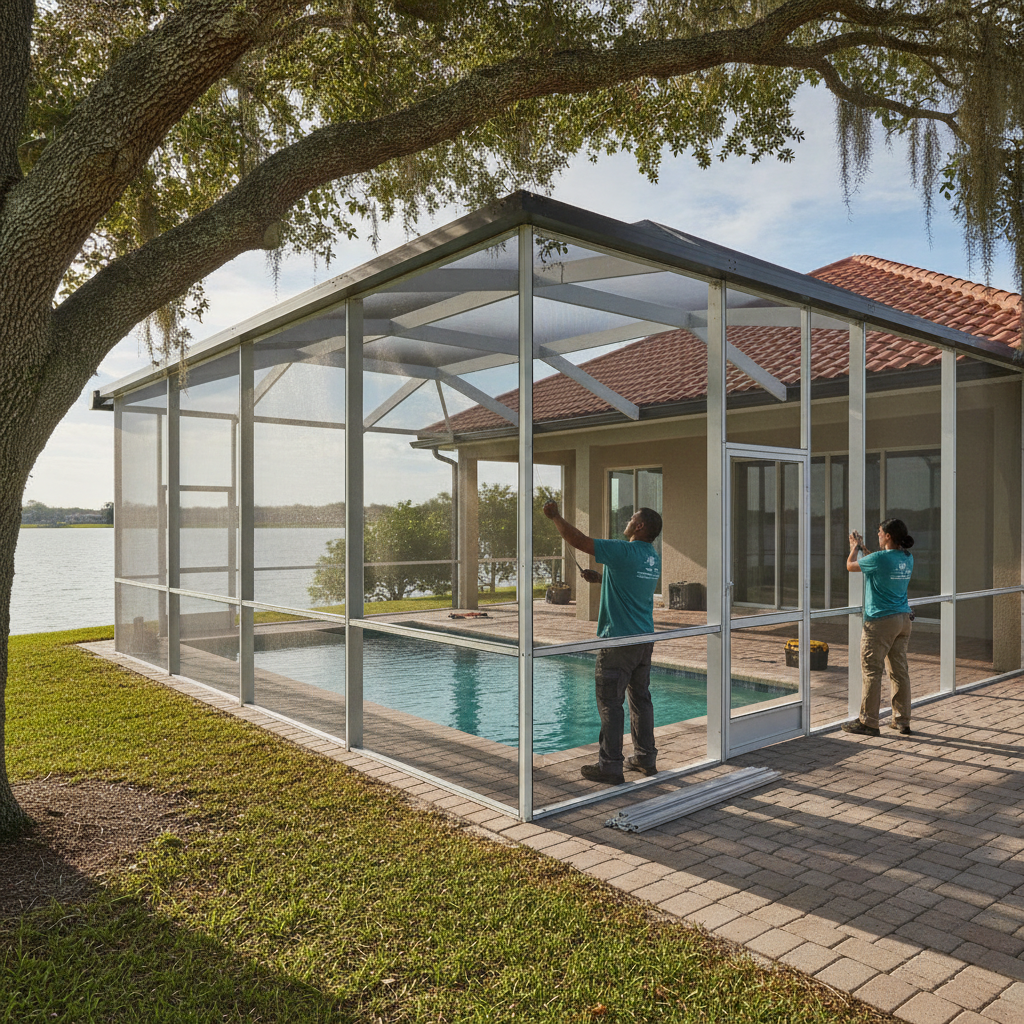
Open water is why so many Winter Haven patios get enclosed. You want the lake view without the mosquitoes, and if there is a pool you want oak litter and spray out of the water. What Polk County homeowners mean by patio enclosures is usually a screen room on a slab they already have, a wrap on a covered lanai, or a tall pool cage over the water.
Winter Haven lots, lake wind, and a cage that takes spray
Winter Haven, Auburndale, Eagle Lake, Cypress Gardens, and Wahneta sit on the highest pool density in Polk County. A large share of those cages went up in the 1990s. The aluminum is often still standing. The mesh is not.
The lake-facing wall fails first. Wind has room to run across the Chain of Lakes and drives rain into a loose spline. South and west elevations take the sun. Screen in Central Florida lasts roughly seven to twelve years, and it fails unevenly. The shaded north side of a Cypress Gardens cage can still look decent while the west panels are brittle and the spline is creeping out of the channel.
This is inland weather. Polk County has no salt air and no storm surge. The load is hurricane-season wind from June 1 to November 30, plus the afternoon thunderstorm that stacks up over the lakes. The Florida Building Code assigns an ultimate design wind speed to your address. The engineered drawing in the permit package states the value the structure was designed to. Inland Polk carries a lower number than a Gulf-front county, which is why the same cage prices differently here. A round mph figure quoted as the county number is not how the code works. Wind load on a Polk County screen enclosure is an address-level call.
A Lakeland bungalow off Lake Morton is a different job than a Winter Haven lake lot. Downtown Lakeland still has pre-1960 houses with thin rear patio slabs and no perimeter footer, which is an anchoring problem. Around the chain, the typical project is a 1990s pool deck that already has a cage, or a covered lanai left unscreened. One is a rescreen. The other is a wrap.
Mesh follows that exposure. Phifer Fiberglass 18x14 is built to withstand debris from harsh winds and storms, keep out most insects, and still let cooling breezes through. Closer to the water, evening gnats and no-see-ums show up, and Phifer No-See-Ums is a 20x20 mesh designed to keep out most of those smaller flying insects. Dogs that use the kick area need a different panel. Phifer PetScreen is pet-resistant screening designed to be tear and puncture-resistant for patio and porch enclosures. Glas-Shield is an 18x14 vinyl-laminated wall mesh. It is not intended for use as roofing material or in horizontal applications, so it stays on lower panels.
A full-cage rescreen on a structure that is still sound runs $1,400 to $3,200. Standard fiberglass is about $2.50 to $4.00 installed per square foot of screen. Individual panels run $35 to $90 each. Those are published ranges for those jobs, not a quote on your cage. Hurricane damage to screened enclosures and aluminum-framed carports commonly sits on an endorsement rather than the base homeowners policy. Some carriers also fold pool cages and awnings into that endorsement. The answer is on your declarations page.
Patio screen versus a full pool enclosure
A patio screen enclosure closes a slab or a covered lanai with aluminum and mesh. A pool cage is a taller structure over water and deck. Mixing those words on a quote changes the engineering, the permit drawing, and the price.
| Build | What it is | What changes the job |
|---|---|---|
| Patio screen or lanai wrap | Aluminum and mesh on a slab or under a roof you already have | An existing cover and slab versus a new roof, a longer span, or a new pour |
| Pool cage | A tall aluminum structure over the pool and deck | Footprint, height, a two-story mansard, a house-wall tie-in |
| Glass sunroom | Windows in place of mesh, still a permitted structure | Conversion of a lanai versus a new enclosed room |
Screening in an existing covered lanai, or a basic screen enclosure over an existing slab with an aluminum mansard roof, is published at $1,500 to $3,500. Local companies advertise entry-level screen rooms near $1,499 plus permit, and that number is real for a small standard-size room. Add an insulated roof panel, a longer clear span, or a new slab, and the screen-room range is $6,000 to $14,000. A new residential pool cage in the Lakeland area is $9,000 to $18,000. A cage with a large deck, a two-story mansard tied into the house wall, or a high clear span is $20,000 to $35,000. Lake lots around Winter Haven often look like that larger end when the cage wraps water and a sitting area, not a tight rectangle behind the house.
An aluminum patio cover is a different product if what you actually want is shade without mesh walls. Installed and permitted, that range is $3,500 to $9,000.
If the goal is a real room, mesh will not get you there. A screen enclosure is still outdoor air. Converting an existing lanai in the Lakeland area is published at $8,000 to $20,000. A glass sunroom in Polk County is $22,000 to $45,000. That path is sunroom construction, not a thicker screen. Screen room versus a three-season room versus a sunroom is the comparison to read before you sign a drawing that cannot take glass later without a new engineering pass.
Pool cages pick up a second set of rules because of the water. Florida’s Residential Swimming Pool Safety Act lists ways a residential pool may be made safe. One option is an enclosure that meets the barrier requirements in the statute. The statute never names “screen enclosure” as a category. A screened structure only satisfies that option if it independently meets the barrier specifications, and whether a particular cage does is a determination for the building official reviewing the permit.
The statute asks a barrier to be at least 4 feet high on the outside, to have no gaps, openings, indentations, protrusions, or structural components a young child could crawl under, squeeze through, or climb over, and to carry gates that open outward, self-close, and self-latch, with the release on the pool side and out of a child’s reach. Pool-cage door hardware is where those details live. The barrier specifications are in Florida Statutes 515.29. A sales sentence is not a verdict.
City permit versus unincorporated Polk
Unincorporated Polk County treats screening that needs structural or infill framing as permit work. The Polk County Building Division FAQ says so in those words. Screen enclosure permits in Polk County follow that same split.
The county’s published list also names all carports or similar structures with rigid roofs. Patio covers are not separately named on that page, so their status is a question for the Building Division on the specific design.
The City of Lakeland runs its own Building Inspection division and publishes its own permit requirements. That list names screening of any space that requires structural or infill framing, plus carports and porches. It also states that all accessory buildings such as detached carports, garages, workshops, and storage sheds require a building permit. A Winter Haven city address is not a Lakeland address. Do not use Lakeland’s page as the rulebook for a parcel on the chain. Confirm with the building official for that address which desk reviews aluminum enclosures.
HOA architectural review is a separate gate from the permit. Lake-neighborhood covenants around Winter Haven often care about roof color, screen color, and how the cage meets the house. That review does not replace the building permit.
Florida law is blunt on who may contract the work. A person must be certified or registered in order to engage in the business of contracting in this state. Several license classes lawfully build screen enclosures, pool cages, carports, and patio covers. Ask which class the contractor holds, then verify it yourself with the Verify a License tool. The crews we send are licensed and insured. Lakeland Outdoor Pro matches you with those crews. It is not the licensee on the permit.
If the initial payment is more than 10 percent of the contract price for residential work, Florida Statutes 489.126 requires the contractor to apply for the permits necessary to do the work within 30 days after that payment. That clock is for your protection. It is not a reason to skip the permit.
How much do patio screen enclosures cost in Polk County?
A wrap on an existing covered lanai, or a basic screen enclosure over an existing slab with an aluminum mansard roof, is published at $1,500 to $3,500. Local companies advertise entry-level screen rooms near $1,499 plus permit for a small standard-size room. A 20-by-20 patio is 400 square feet on the plan, but the quote follows the roof and the slab, not a secret per-foot rate. If that patio needs a new roof, a longer clear span, or a new slab, the published screen-room range is $6,000 to $14,000. A pool cage is a different structure and prices in the Lakeland-area new-cage bands of $9,000 to $18,000, or $20,000 to $35,000 when the deck, height, or span grows.
Can I enclose my patio and turn it into a room?
You can enclose it with screen and still have outdoor air, which is the point of a lanai wrap. Turning that space into a room means glass, and often a different roof and a different permit drawing. Conversion of an existing lanai in the Lakeland area is published at $8,000 to $20,000. A glass sunroom in Polk County is $22,000 to $45,000. Tell the contractor on the first visit if glass is the endgame, because a light screen mansard is not automatically a sunroom frame.
Does a Winter Haven pool cage count as the pool barrier?
The statute asks a barrier to be at least 4 feet high on the outside, with no gap a child could squeeze through or climb, and a self-closing, self-latching gate with the release on the pool side. A screened structure is not a named category in the act. Whether a given cage does all of that is what the building official signs off on.
When to call us
A new frame, a pool-cage door that is part of a barrier, anchors into a slab, or a rescreen at height is licensed contractor work. We match Winter Haven and Polk County homeowners with licensed local screen and aluminum crews, and we cover the rest of the county the same way. Call us at (863) 777-5379.