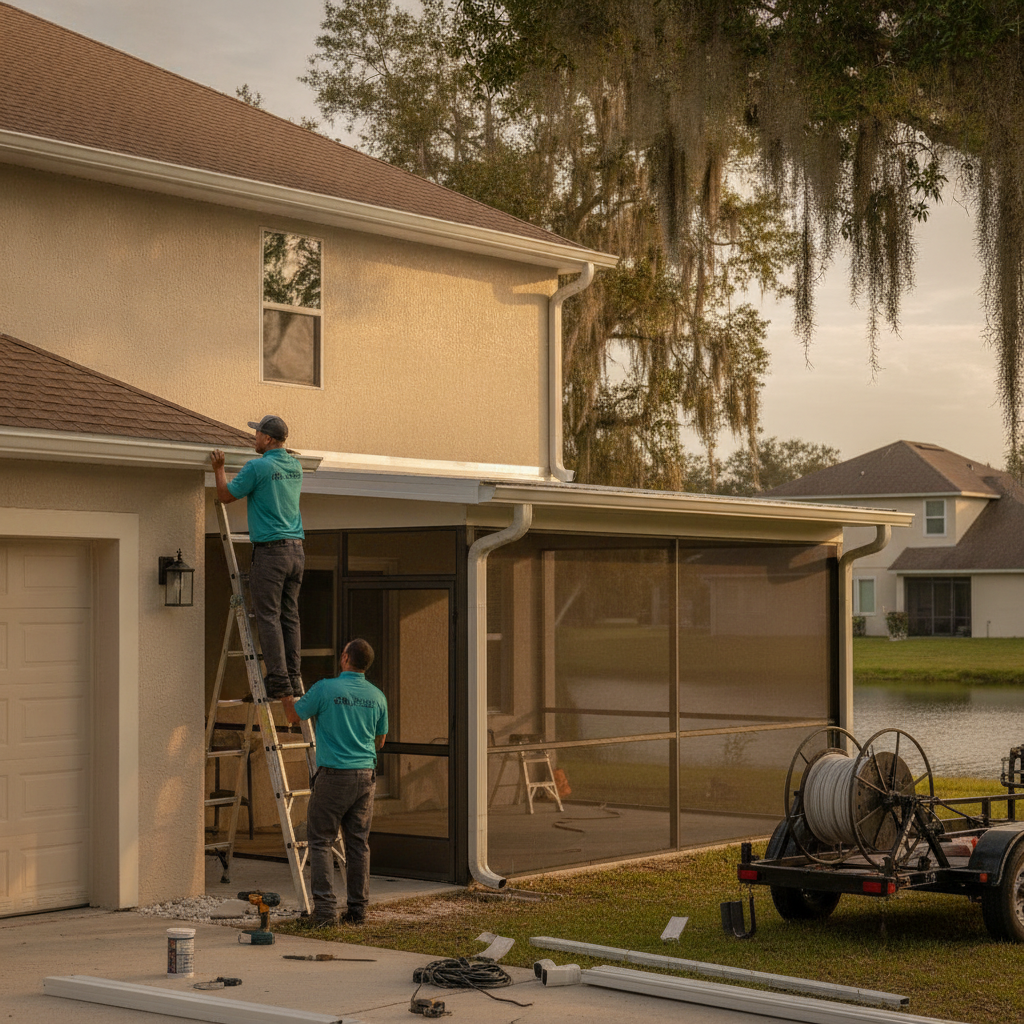
A summer storm over South Lakeland puts the whole roof’s water at the eave in a few hard minutes. A store kit leaks at every joint it was cut to. A seamless gutter is one continuous trough, formed to that eave, so the only openings are the corners and the downspout outlets you actually planned.
That is the job in this county: a trough that holds a Polk rain, hung on fascia that can take the screws, with downspouts that throw water onto sand that will not stay put.
Why a seamless gutter beats a kit on Florida rain days
A seamless gutter is roll-formed on site from a coil of painted aluminum. The machine sits in the driveway and pushes out one piece the length of the eave. There is no splice in the middle of a run. Water has nowhere to sneak out except the outlet.
A kit is a different product. Those sections arrive in fixed lengths. Every joint is a drip waiting for an August downpour. On a west-facing eave in Medulla, that drip stains the block, then soaks the sand at the footer. Repeat that from June through hurricane season and the stain is the small problem. The soil next to the slab is the real one. The Atlantic hurricane season runs from June 1 to November 30.
Live oaks over Lake Morton and Dixieland drop catkins in spring and acorns in fall. That debris sits in a trough and dams the flow. A joint under a dam overflows first. One continuous run still clogs, but it clogs as a channel, not as a zipper of leaks.
The crews we send hang that channel on hidden hangers driven into the fascia. They do not reuse the old spike-and-ferrule hardware that pulls out of soft wood. Spike hangers are why you see a wavy trough on a 1960s bungalow near Lake Morton after a few wet years. The gutter did not fail. The fastener crawled out of the board.
If the house also needs a screen room off the back, the eave above that room still has to catch the house roof. The screen does not. Water that overshoots a short gutter sheets down the mesh and puddles on the slab. Same story on a builder-covered lanai in Davenport or Four Corners, where the roof was finished and the trough was left as a separate line item.
| Section kit | Seamless gutter | |
|---|---|---|
| Joints | A seam every factory length | One piece per eave, joints only at corners and outlets |
| Storm behavior | Leaks at the seams first | Holds the water until the downspout |
| Fit | Cut and joined on a ladder | Formed to the actual eave in the driveway |
| Color | A limited stock set | Painted coil matched to the fascia |
A kit can look fine on a dry Tuesday. It is the daily thunderstorm over Bartow or Mulberry that finds every splice.
Downspout placement on sandy lots
Downspouts are the part of seamless gutter installation that actually protects the house. The trough only collects. The pipe decides where the water lands.
Building America, a federal building-science program, tells you to discharge surface flow at least 5 feet from the foundation, and to keep an underground catch at least 10 feet from the foundation. That is program guidance, not a local code we verified. It still matches how sandy Polk lots behave.
Polk sand does not pond the way clay does. It also does not stay put under a waterfall. A downspout that dumps at the corner of a Dixieland slab will cut a hole in that sand in one wet June. The void next to the footer is how a thin 1950s patio pour starts to crack. The same splash against a pool cage post stains the aluminum and keeps the soil wet around the anchors.
Place outlets at the low points of each run, and at the ends of long eaves. Valleys concentrate water. A valley with no nearby outlet is how a wide trough still overruns. More outlets often beat a fatter trough when the roof has several valleys, which is common on the ranch plans around Kathleen and Combee Settlement.
On a Winter Haven pool home, the cage roof is its own watershed. It dumps at the corners. House gutters should not fight that dump. Keep the house downspouts from throwing onto the cage roof, and keep cage splash from soaking the house footer. Cypress Gardens and Eagle Lake stock a lot of 1990s cages. The house eave and the cage have to be designed as two roofs, not one afterthought.
Splash blocks help on a short throw. Extensions and buried pipe help when the grade falls back toward the slab, which happens on a lot of lots around the Chain of Lakes. Point the water toward a swale, not toward the neighbor’s driveway and not toward a septic mound. On the Lake Wales Ridge, rural parcels add a different problem: the throw has to respect the grade you already have, because there is often no curb and no storm inlet to hand the water to.
Gutter downspout sizing is a separate decision from trough size. A 3-by-4 downspout moves more water than a 2-by-3. Outlet spacing and downspout cross-section work together. Undersize the pipe and the new trough still overflows at the outlet, which is the same stain you were trying to stop.
On 2026-09-05, Gutter Works / Lakeland Seamless Gutters advertised 3x4 downspouts at $9.60 per linear foot. Those are one provider’s dated line items, not our rate and not a market survey. Tax, fascia, access, and unlisted labor are not in that list.
Color, size, and a fascia that can hold the hangers
Neither 5-inch nor 6-inch is a default for Polk County roofs. Building America notes that gutter channels are typically available in 4-, 5-, and 6-inch sizes. The choice follows roof catchment per run, pitch, valleys, outlet spacing, and downspout cross-section. A steep south roof on a two-story in Highland City is a different job from a low ranch in Kathleen.
A bigger trough helps when a long eave has few places to drop a downspout. More downspouts often help more than jumping a size. Seamless gutter sizing walks that tradeoff in more detail. Anyone who tells you 6-inch is “the Florida size” is selling a default, not reading your roof.
Color is baked onto the coil. Match the fascia or the window clad and the trough disappears. White on a white eave in a Davenport subdivision is what most HOA boards expect. Dark bronze on a 1990s Winter Haven ranch hides the oak tannin. The finish is the same either way. You are picking visibility, not a different product.
The fascia has to hold the hangers. That board is the whole structure of a gutter. If it is soft, the hangers crawl out and the trough rolls. Fascia board damage is the usual reason a new gutter fails in year two. Crews who skip a rotten fascia are hanging a new trough on a failing board.
On pre-1960 bungalows around Dixieland and Lake Morton, that fascia is often thin, and the patio slab behind the house was poured without a perimeter footer. Neither likes extra water. Fix the wood, then hang the gutter. Paint over punky fascia does not count. South along US-98 the lots open up and the eaves get longer, which means more hangers and more chances for a soft stretch of board to let go.
Hangers should land in the fascia, not only in the drip edge. A trough full of water and oak mash is heavy. Wider runs ask more of each screw. Two-story work in Haines City and along the I-4 corridor adds access, which is why those jobs sit differently than a one-story ranch in Polk City.
If you want less cleaning under those oaks, gutter guards sit on top of the new trough. Installed guards on this site run $5 to $14 per linear foot. Coarse screens mat with catkins in April. Micro-mesh sheds that stuff better and still needs a rinse. Guards are not a substitute for outlets that throw water far enough from the slab.
A pool cage rescreening job does not replace house gutters. If overflowing eaves have been spraying the south screen, that mesh was already taking extra sun and extra water. Get the house trough working before you blame the screen.
How much does gutter installation cost in Lakeland?
Aluminum seamless gutter, installed, runs roughly $8 to $14 per linear foot, which puts most Polk County homes between $1,300 and $2,800. Gutters are sold by the foot of eave, not by the square footage of the house. A 1,500-square-foot ranch and a 1,500-square-foot two-story do not share an eave length, so they do not share a price.
On 2026-09-05, Gutter Works / Lakeland Seamless Gutters advertised 6-inch seamless gutter at $9.60 per linear foot, 6-inch corners at $27.50 each, 3x4 downspouts at $9.60 per linear foot, 7-inch gutter at $18.80 per linear foot, and take-down from $2.00 per linear foot. Those are one provider’s dated line items, not our rate and not a market survey. Tax, fascia, access, and unlisted labor are not in that list.
A 40-foot run at $8 to $14 per linear foot is $320 to $560 for the trough itself. Corners, outlets, elbows, and take-down sit on top of that. Most houses are not a 40-foot job. Longer eaves, two-story work, and rotten fascia push toward the top of the published range. A simple ranch with sound wood sits lower.
Do I need a permit to install gutters in Polk County?
The Polk County Building Division FAQ names screening that requires structural or infill framing, rigid-roof carports, and in-ground pools. Gutters are not on that list. Inside city limits, Lakeland’s Building Inspection division publishes its own permit requirements and names accessory buildings, carports, porches, and screening that needs framing. Gutters are not named there either.
That is not a verdict that every gutter job is exempt. If the work turns into fascia replacement, or it is bundled with a patio cover or a screened room, ask the Building Division on that design. The City of Lakeland runs its own shop. A crew that mostly works unincorporated Polk can hit friction inside city limits, and the honest move is to ask before the coil shows up.
Florida law is clearer on who may do the work. A person must be certified or registered in order to engage in the business of contracting in this state. Ask which class the contractor holds and verify it yourself with the state’s Verify a License tool. The crews we send are licensed and insured. Lakeland Outdoor Pro matches you with those crews. We do not hold the contractor license, and we do not hang the trough.
If a contractor takes more than 10 percent of the contract price up front on residential work, they must apply for the permits necessary to do the work within 30 days after that payment. That rule is in Florida Statute 489.126. Gutters often travel without their own permit. The duty still matters if the same contract includes fascia rebuild or other work that does.
When to call us
When the fascia is soft, the trough pulls away, or a storm keeps soaking the sand at the slab, that is licensed contractor work, not a weekend ladder job. The crews we send form and hang a seamless gutter, set the downspouts, and tell you if the wood has to come off first. Call us at (863) 777-5379.