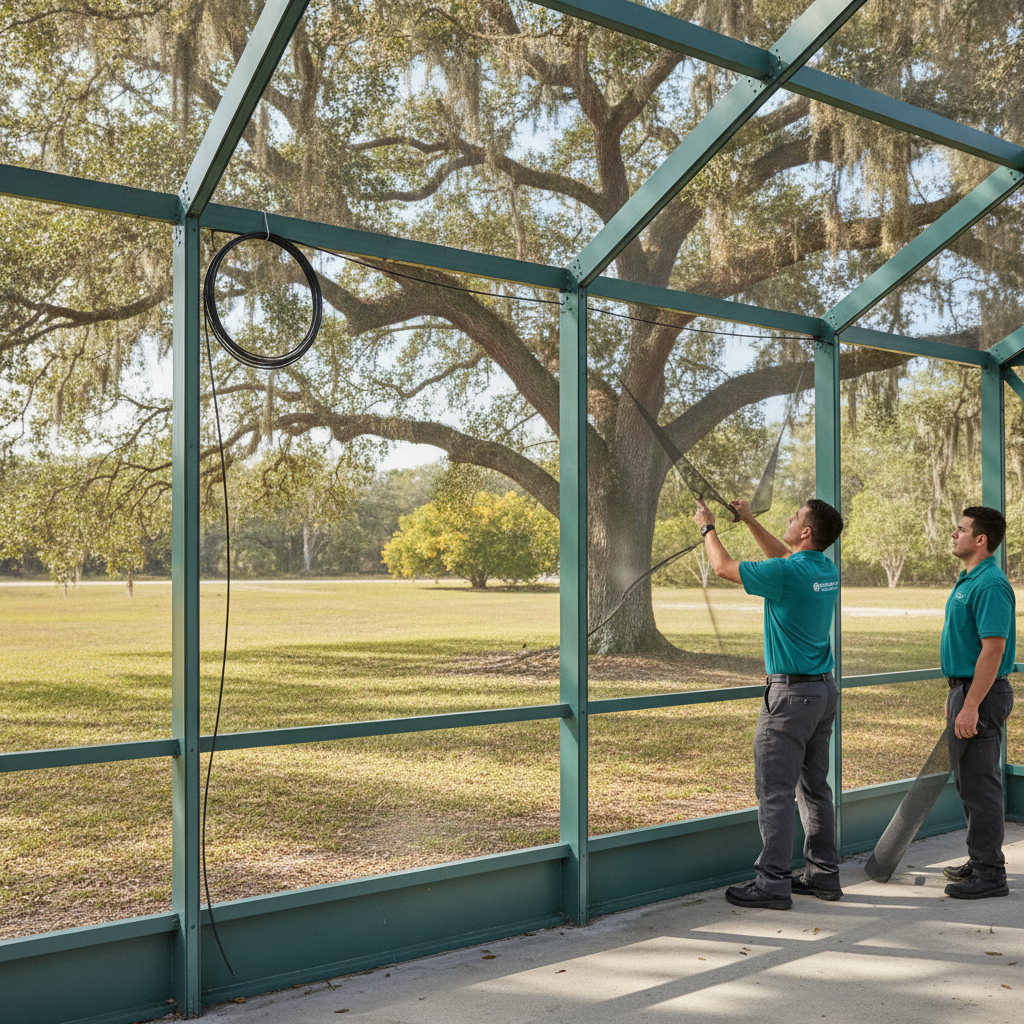
The west wall of a Lake Morton porch often goes slack years before the north side does. Mesh sits in an aluminum channel, and a rubber spline is what holds it there. When that spline dries, a dog blows a corner, or inland sun cooks the coating, the panel bags and the bugs walk in. One torn bay is a small repair. A lanai whose south and west walls feel like paper is a replacement.
A baggy lanai versus one torn panel
A baggy lanai is a replacement job. A single tear, a popped spline, or a dog-punched corner is a panel repair.
On a Lakeland porch the screen is not glued to the house. It is stretched across an aluminum frame, tucked into a groove, and locked with a round rubber spline. Pull the spline and the mesh comes out in one sheet. Lay new mesh, roll new spline, trim the extra, and that bay is done. That is why a crew can swap one panel without touching the rest of the enclosure.
A baggy wall is a different signal. Fiberglass mesh loses its give under Central Florida sun. The coating chalks. Threads snap at the channel. New spline will hold in cloth that still flexes. It will not save cloth that has already gone brittle. Dead mesh tears again the first time a thunderstorm gets under the panel.
Pets make the same failure look sudden. A Dixieland bungalow porch sits close to the grass. A dog hits the lower bay, the spline walks out of the channel, and the whole sheet flutters in the afternoon breeze. The frame is usually fine. The cloth is not. Pet-resistant screening is built to take that abuse from most dogs and cats, and it is a common upgrade on those older close-to-the-yard porches around Lake Morton and Dixieland.
Cost follows the scope. Individual screen panels run $35 to $90 each, which is the right number when one or two bays are torn and the rest of the cloth still has life. Once most of the walls have gone dull and stiff, you are buying cloth by the square foot. Standard fiberglass is about $2.50 to $4.00 per square foot installed. A full-cage rescreen, the job on a pool enclosure rather than a small porch, runs $1,400 to $3,200.
If you only have one ripped bay on an otherwise sound porch, start with patio screen repair in Lakeland. If the enclosure sits over a pool, the same panel logic still applies, and pool screen repair covers that case. Whole-lanai cloth is the job when those walls have already lost their give.
| What you see | Panel repair | Full rescreen | | A dog punched a lower bay and the rest of the cloth still flexes | Swap that bay | Leave the rest | | South and west walls chalk, tear at the spline, and bag in a breeze | A patch lasts weeks | New cloth on every bay | | Roof mesh holds oak litter and has gone brittle while the north wall still looks new | Roof bays if the walls are sound | Roof and walls together when the walls match the roof |
South and west mesh that dies first
Screen on a Lakeland lanai lasts roughly seven to twelve years, and it fails unevenly. Sun kills the mesh on the south and west elevations years before the shaded north side.
That is an inland pattern. Polk County sits well inland of either coast. What cooks the vinyl is daily UV plus heat off the slab. A west wall on South Florida Avenue, or a south bay in Highland City, takes the afternoon blast. The north wall under a live oak off Lake Morton can still look new while the west wall is already chalked and tearing at the spline. Tight lots in Dixieland, Lake Morton, and Kathleen hide that north side. Open lots south along US-98 do not. The west wall on those wider parcels cooks in the open.
Oaks add their own wear. Catkins mat on roof panels in April. Acorns and twigs sit on the mesh after every storm. Coarse roof screen holds that debris. Extra weight and extra UV on a dirty panel shorten the life of the roof bays, which is why a crew often finds the roof gone while the north wall still has years left.
A 1990s cage around Winter Haven or Cypress Gardens shows the same split, and plenty of Lakeland Core houses from that era do too. The aluminum can still be straight. The cloth is not. Paint on the frame does not save the mesh, and new mesh does not save a chalked, pitted frame. Those are two different jobs.
Wind finishes a failing panel. The Atlantic hurricane season runs from June 1 to November 30. You do not need a named storm. A summer cell over Combee Settlement will get under a loose bay, pop more spline, and turn one tear into three. Baggy cloth is a sail.
Mesh choice is how you buy the next stretch of years, not how you hide a dead wall. Phifer Fiberglass 18x14 is the usual insect cloth: it keeps out most insects and still lets breeze through. Phifer No-See-Ums is a 20x20 weave designed to keep out most smaller flying insects like no-see-ums, gnats, and sand flies. Phifer PetScreen is a tear- and puncture-resistant cloth for the lower bays a dog actually hits. Screen mesh types for Central Florida walks through those choices in one place.
What a full lanai rescreen includes
A full lanai rescreen is new cloth on an existing frame. The crews we send pull the old spline, strip the old mesh, clean the channels, stretch new cloth, and roll new spline into every bay. They trim the excess, check the door, and haul the old rolls off.
That is not a new enclosure. Beams, uprights, and the roof stay. If a bay is bent, a sill is corroded, or an upright has walked on a thin 1950s patio slab in Dixieland, that gets called out before the cloth goes back on. Those older slabs were often poured without a perimeter footer, so an anchor that used to hold can work loose. Anchors and structural members are licensed contractor work. A homeowner can swap a ground-level panel. Working at height on a two-story mansard is not a weekend project.
A rescreen on a pool enclosure is the same cloth job at a larger scale, which is why pool cage rescreening is the service to ask for when the lanai is really a cage. If the covered patio was never screened and you want a room, that is a new screen room, not a rescreen. Screening in an existing covered lanai is a different price band, $1,500 to $3,500, because it is adding cloth and often infill, not swapping worn mesh.
Permits follow the framing, not the fabric. The Polk County Building Division FAQ lists “Screening of any space, which requires structural or infill framing to be added” among work that needs a permit. The City of Lakeland Building Inspection list names screening of any space that requires structural or infill framing, plus porches, among items for which permits are required. A crew that only pulls old mesh and restocks existing channels is not adding framing. Confirm the specific job with the city if you are inside Lakeland limits, or with the county if you are not. A crew that mostly works unincorporated Polk can hit friction inside the city, because Lakeland runs its own Building Inspection division.
If that lanai wraps a pool, the cloth job and the barrier question are separate. Florida’s Residential Swimming Pool Safety Act never names a screen enclosure as a category. Section 515.29 asks a barrier to be at least 4 feet high on the outside, to have no gap, opening, or protrusion a young child could crawl under, squeeze through, or climb over, and to carry a gate that opens outward, self-closes, and self-latches, with the release on the pool side and out of a child’s reach. Whether a given lanai does all of that is what the building official signs off on. New mesh does not decide it. Door hardware does more of that work than cloth does.
Florida requires the person contracting the work to be certified or registered. Several license classes lawfully build and repair aluminum enclosures. Ask which class the contractor holds, and verify it yourself with DBPR’s Verify a License tool. The crews we send are licensed and insured. We match homeowners across Lakeland, Winter Haven, Bartow, and the rest of Polk County. The brand answers the line. The licensed crew does the cloth.
Is one torn panel enough reason to rescreen the whole lanai?
No. One tear in cloth that still flexes is a panel swap at $35 to $90. Rescreen when the south and west walls have gone brittle, when spline will not stay in the channel, or when more bays are failing than holding. Matching one new charcoal panel against a wall of faded ones is a taste call, not a structural one.
What if the lanai is also the wall around a pool?
Treat the rescreen as a cloth job, then look at the gate as its own hardware. The statute wants height, no climbable gap, and a self-closing, self-latching gate with the release on the pool side. The building official decides whether that enclosure does it. New mesh does not.
How do crews price a Lakeland lanai rescreen?
Standard fiberglass is about $2.50 to $4.00 per square foot installed. Small panel work stays in the $35 to $90 range. A full-cage rescreen runs $1,400 to $3,200. A longer clear span, a roof that takes a ladder, pet-resistant lower bays, or a 20x20 weave all move the number up because they add cloth and labor.
When to call us
Call when the west wall bags, when spline will not stay seated, or when a pool enclosure needs new cloth and a licensed look at the door. The crews we send rescreen existing lanais and cages. They do not treat a mesh swap as a barrier verdict, and they do not add framing without walking the permit question first.
Call us at (863) 777-5379.