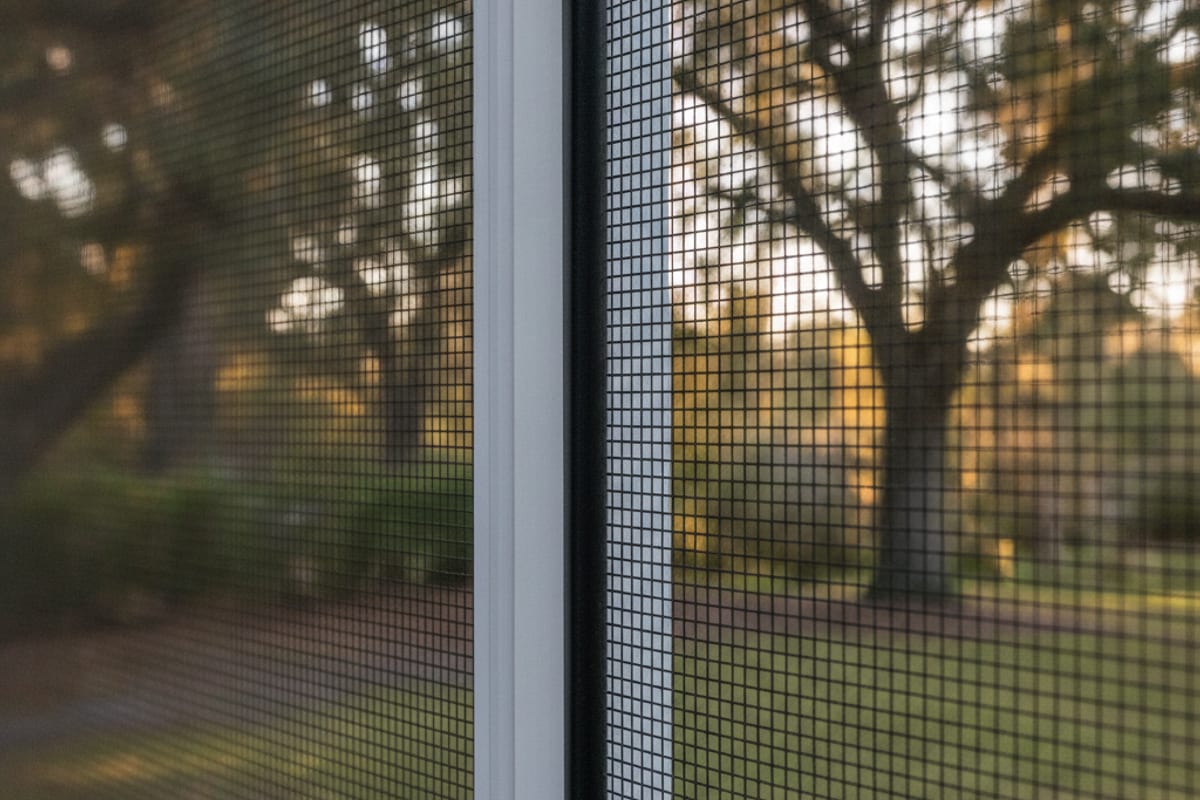
The mesh in a pool cage is not one product. Weave, fiber, and coating change airflow, visibility, insect size, pet wear, and whether a panel belongs on a roof or a wall.
Phifer’s pool and patio screening is the product line this page uses. Those pages describe specific fabrics. They do not set a local lifespan, a guaranteed insect-free cage, or a price.
Get the product name in writing on the quote, by elevation. “Screen” is not a spec.
18x14 pool and patio fiberglass
Phifer’s 18x14 fiberglass is the common pool and patio insect screen. Eighteen strands per inch one way, fourteen the other. It is sold for ordinary flying insects and for cutting wind-blown debris.
It is the usual baseline on a pool cage rescreen unless you name something else. Roof panels and wall panels can both use an open fiberglass weave of this kind.
It is not a complete insect barrier. Gaps at doors, splines, and any coarser leftover panel still let insects in.
20x20 small-insect mesh
Phifer’s No-See-Ums 20x20 is a tighter fiberglass weave. The company describes it as keeping out most tiny insects, including the midges people call no-see-ums, while still letting breeze through.
“Most” is not all. A 20x20 panel does not make the enclosure insect-tight if other walls, the roof, or the door gaps still use a coarser weave.
If small insects are the goal, treat that as a whole-enclosure question: every screened opening, plus how the doors close. Putting 20x20 only on the water-facing side does not stop insects that enter through the rest of the cage.
Tighter weave changes airflow and the look of the view. How much you notice depends on the fabric and the enclosure, not on a rule that nobody feels it.
PetScreen
Phifer PetScreen is vinyl-coated polyester. The manufacturer describes it as tear- and puncture-resistant against damage by most dogs and cats, for high-traffic patio, porch, window, and door use, with good outward visibility.
That is pet-wear resistance. It is not a golf-ball impact rating. It is not a fall barrier, a pool safety barrier, or a promise that an animal cannot push through, chew through, or get out.
Thicker strands can change how clear the view looks next to 18x14 fiberglass. Running PetScreen only on the lower panels a dog actually leans on is a wear choice, not a law. It is also not a substitute for a door that latches.
Glas-Shield
Phifer Glas-Shield is 18x14 fiberglass with a vinyl lamination. Phifer positions it for privacy and for keeping dirt and debris off lower enclosure panels. It is for vertical applications such as walls. It is not made for roofs.
Use it where privacy or splash and dirt on a lower wall actually matter: a neighbor sightline, an equipment pad, a chair-rail band. Do not treat a lower-panel suggestion as a rule that laminated mesh can never go higher on a wall, and do not put it on the roof.
Laminated mesh is a different airflow and visibility product than open weave. Compare the panel you can see through with the panel you cannot.
Mixing panels without overselling the mix
You do not have to run one fabric everywhere. A useful mix is a set of jobs:
- Open 18x14 on roofs and on walls where standard insect screening is enough.
- 20x20 where the insect goal for those openings is smaller insects, knowing other openings still count.
- PetScreen where claws and leaning are the wear, usually lower walls.
- Glas-Shield on selected vertical panels for privacy or splash, never as roofing.
That mix can cut material compared with upgrading the whole cage to the most demanding fabric. It can also add labor. There is no fixed savings figure, and a contractor will not always agree to every combination. The enclosure still has to work as one structure: channels, spline, and designed infill have to accept the fabrics you pick.
Insect control and pet or privacy panels are different decisions. A fine-mesh water-facing wall does not exclude insects that walk in through a coarser roof, a side panel, or a door that does not close.
What actually wears mesh out
Sun, pet contact, furniture, storm debris, and a frame that has moved all wear mesh. UV is one cause. It is not the only cause, and it does not give you a calendar.
Color, chalking, and a panel that no longer springs back are condition clues. They do not prove a date, a brand failure, or a neighborhood pattern. Do not treat a treeless lot, a lakefront address, or a rental listing as a diagnosis.
Inspect the mesh you have. Look at each elevation. If the aluminum is out of square or anchors are working loose, new mesh on that frame is the wrong first job. That conversation belongs with screen enclosure repair.
Matching what you can see from the deck
New mesh does not match sun-faded mesh. There is no product that erases that seam.
If the look from the deck matters, replacing a whole elevation at once reads cleaner than scattered new panels in an old wall. That is an appearance choice. It is not a required replacement cycle.
Ask what spline they are using and whether the channels get cleaned before the new mesh goes in. Old spline in a dirty groove can leave a panel poorly seated. Ask them to look at the frame while they are up there.
What is the best screen for a Florida pool cage?
There is not one best fabric. 18x14 fiberglass is the usual pool and patio baseline. 20x20 is the small-insect product, with the “most tiny insects” limit. PetScreen is for pet wear, not restraint. Glas-Shield is laminated 18x14 for selected vertical and lower panels, not roofs.
Does 20x20 keep all the small insects out?
No. Phifer describes 20x20 as keeping out most tiny insects, not all of them. Insects can still enter through other coarser panels, roofs, and gaps.
Can I use different screen on different sides?
Yes, for wear, privacy, splash, and airflow. Do not treat a mixed elevation plan as whole-cage insect control, impact protection, or a safety barrier.
How long does screen last in Central Florida?
There is no fixed local lifespan on this page. Condition, exposure, and wear decide when a panel is done, not a year count.
Does PetScreen stop a dog?
It is sold as tear- and puncture-resistant against damage by most dogs and cats. It does not restrain an animal, replace a latching door, or serve as a pool barrier.
If you want mesh named by elevation on a written quote, call (863) 777-5379. Lakeland Outdoor Pro connects you with licensed and insured local crews who will spec the fabrics against the enclosure you have.