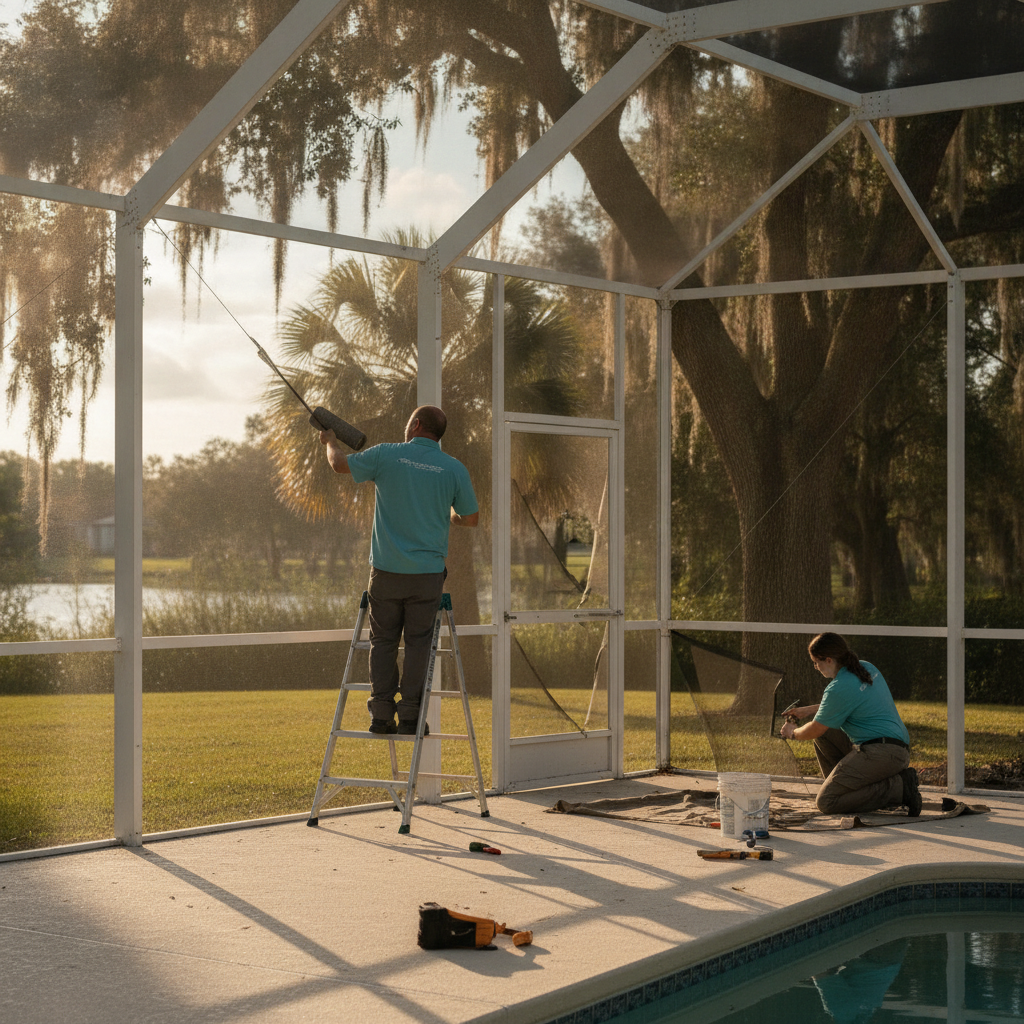
The hole in the south wall of a Cypress Gardens cage is not a mystery. It is one panel whose spline let go, a door that no longer latches, or mesh that has gone brittle on every sunny elevation. Those three jobs are priced differently, and they are not interchangeable. A licensed crew walking a Lakeland pool cage can usually tell which one you have before anyone pulls a roll of mesh.
A torn panel vs a failed door vs a full rescreen
Most pool screen repair in Lakeland is one of those three jobs. Mixing them up is how a $35-to-$90 panel becomes a conversation about a $1,400-to-$3,200 rescreen.
A single torn panel is the smallest of the three. Screen sits in an aluminum channel, and a rubber spline holds it there. When a dog punches through at kick-plate height, or a live-oak limb drops on the roof after an afternoon storm, the crew pops the spline, pulls the old mesh, and rolls in a new piece. Individual screen panels run $35 to $90 each. A ground-level wall panel is a homeowner job if you are comfortable with a spline roller. Roof panels, and anything you would need a ladder to reach, are not.
A failed door is a different problem. The mesh can look fine while the closer has quit, the latch no longer catches, or the slab has settled and the door drags. Screen door work to rehang, rebuild with new hardware, or replace the door runs $180 to $500. On a pool enclosure that hardware is not only a convenience. Florida’s Residential Swimming Pool Safety Act asks a barrier to be at least 4 feet high on the outside, to have no gap a child could squeeze through or climb, and to carry a self-closing, self-latching gate with the release on the pool side. The barrier specifications in s. 515.29 do not name screen enclosure as a category. Whether a given cage does those things is what the building official signs off on. If the closer is tired or the latch no longer returns, that is the repair, not a new panel. Our pool cage door hardware post walks through that mechanism in more detail.
A full rescreen is the job when the mesh itself is done. Standard fiberglass in Central Florida lasts roughly seven to twelve years, and it fails unevenly. The south and west elevations go brittle years before the shaded north side still looks new. Once you are counting torn panels in double digits, or the roof mesh tears when you touch it, swapping one panel at a time is throwing money at a cage that needs pool cage rescreening. A full-cage rescreen is $1,400 to $3,200. Priced per square foot of screen, standard fiberglass runs about $2.50 to $4.00 installed.
If the aluminum is bent, the house beam has pulled, or the anchors have walked in a thin Dixieland patio slab, that is not a screen job. New mesh on a moving frame will fail in the next storm. That is enclosure repair, or a conversation about a new cage.
A lanai with no pool uses the same spline-and-channel repair. That structure is a screen room, not a cage over water, and the crew still starts by counting panels before anyone talks about a full rescreen.
| Job | What you are looking at | Why the quote is different |
|---|---|---|
| One or a few panels | A tear, a popped spline, or a pet hole in otherwise sound mesh | The frame and the rest of the cage still have life. The crew swaps the damaged panels and leaves the rest. |
| Door only | The mesh is intact, but the door drags, the closer is dead, or the latch no longer catches | Hardware and alignment, not yardage of screen. On a pool cage this also touches the barrier specifications the building official reviews. |
| Full rescreen | Chalked, brittle, or baggy mesh on the sunny sides, or more holes than sound panels | The mesh has reached the end of its Central Florida life. New panels in a dying field look like patches within a year. |
Lakeland sun and screen life
Pool cage screen in this county dies from sun first, then from debris. The mesh on a west wall off Lake Morton takes a different beating than the same product on a shaded north elevation two bays over.
That is why a 1990s cage around Winter Haven or Cypress Gardens so often shows up with a south wall that crumbles in your fingers and a north wall that still looks serviceable. The cage is one age. The exposures are not. Chain of Lakes neighborhoods have the county’s highest pool density and a large stock of cages now sitting in that seven-to-twelve-year window. South Lakeland and Highland City see the same pattern on west-facing walls that take the afternoon sun with no tree cover.
Debris finishes what UV starts. Live oaks over Dixieland and Lake Morton drop catkins in April that mat on roof panels, then acorns in the fall. Afternoon thunderstorms shove limbs into the same roof. The Atlantic hurricane season runs from June 1 to November 30, and inland Polk takes wind and yard debris, not salt air. A panel that was already chalked on the sunny side is the one that splits when the wind gets under a loose spline.
New construction along I-4 through Davenport, Four Corners, and Haines City is a different cage. Builder-covered lanais were often left bare, and screening was a separate line item. Those panels are younger. A tear there is more often a chair, a dog, or a ball than end-of-life mesh. Putting a full rescreen on a three-year-old Davenport cage because one panel is torn is the same mistake as patching a Cypress Gardens roof that has no tensile strength left.
Mesh choice is the other half of the life. Phifer Fiberglass 18x14 is built to keep out most insects and still let cooling breezes through, and it is the standard field on most Polk cages. Phifer No-See-Ums is a 20x20 mesh meant for smaller flying insects such as no-see-ums, gnats, and sand flies. Phifer PetScreen is pet-resistant screening designed to resist tearing and puncture from most dogs and cats. Phifer Glas-Shield is an 18x14 fiberglass mesh that has been vinyl-laminated, and it is a wall and lower-panel product, not a roof product. It is not intended for use as roofing material or in horizontal applications. Upgrading mesh makes sense on a full rescreen. Dropping one PetScreen panel into a field of tired fiberglass just makes the next tear more obvious. Screen mesh types for Central Florida is the longer walk through those products.
What a repair quote includes
A useful quote starts with a walk, not a panel count shouted from the driveway. The crew should press on the roof mesh, look at the south and west walls in daylight, and say out loud whether they are looking at a few holes or at a cage whose mesh is finished.
On that walk they are also reading the door closer, the latch, the kick plates, and the screws where the cage ties to the house. A popped fastener or a sagging door can be the reason a panel keeps working loose. Pricing the mesh and ignoring the door is how the same hole comes back. For a fuller breakdown of how those line items stack, see pool cage rescreening cost in Polk County.
Permit status follows the work, not the word repair. Unincorporated Polk County’s Building Division FAQ names screening of any space which requires structural or infill framing to be added. Inside city limits, the City of Lakeland permit requirements list screening of any space that requires structural or infill framing among the items that need a permit, and the city runs that list through its own Building Inspection division. Rolling new mesh into an existing channel is not the same job as adding infill, a new door opening, or members. A crew that mostly works unincorporated Polk can hit friction inside Lakeland city limits if they treat those two desks as one.
Florida law is plain on who may contract the work. A person must be certified or registered in order to engage in the business of contracting in this state. Several license classes lawfully build and repair aluminum structures, so the useful move is to ask which class the contractor holds and verify it yourself at myfloridalicense.com. The crews we send are licensed and insured. Lakeland Outdoor Pro matches you with those crews. It does not hold the license and it does not pull the permit.
Storm damage has its own paper trail. Coverage for screened enclosures and aluminum-framed carports damaged as a result of a hurricane commonly comes from an endorsement rather than the base policy, and carriers differ on whether pool cages ride along. The answer is on your declarations page, not in a generic promise that a cage is covered. If a deposit on a larger rescreen is more than 10 percent of the contract, Florida’s contractor-deposit rule is the consumer protection to read before money changes hands.
What moves the number is straightforward. More damaged panels cost more. Roof work costs more than a ground-level wall because of access and because the wrong mesh does not belong on a horizontal surface. Pet-resistant or 20x20 mesh costs more than standard fiberglass. A door rebuild is its own line. A two-story mansard is a different day than a single-story cage in Medulla. None of that is a flat rate. It is the cage in front of you.
How much does a pool cage rescreen cost in Lakeland?
A full-cage rescreen is $1,400 to $3,200. Standard fiberglass is about $2.50 to $4.00 per square foot installed. Individual panels are $35 to $90 each when the rest of the cage is still sound. Those ranges are for rescreening an existing structure, not for building a new one.
How long do pool cage screens last in Florida?
Screen life in Central Florida is roughly seven to twelve years, and it fails unevenly because sun exposure kills mesh on the south and west elevations years before the shaded north side. A Winter Haven cage from the 1990s is often in that window now. A new Davenport panel that a dog tore last month is not.
What is a screen over a pool called in Florida?
It is a pool cage, or a pool enclosure: an aluminum-framed screened structure over the pool and deck. A screened lanai with no pool is a screen room. Homeowners searching pool screen repair are almost always talking about the cage.
How much does it cost to put a screen around a pool in Lakeland?
A new residential pool cage in the Lakeland area is $9,000 to $18,000. A cage with a large deck, a two-story mansard tied into the house wall, or a high clear span runs $20,000 to $35,000. That is new construction. Do not stretch a rescreen range onto a new cage.
When to call us
A ground-level panel with a popped spline is one kind of afternoon. A pool cage door that no longer self-closes, a roof that is coming apart, or work that adds infill framing is licensed contractor work, and it needs a crew that will walk the elevations before anyone orders mesh. Call us at (863) 777-5379. We cover Lakeland, Winter Haven, Bartow, and the rest of Polk County, and we match you with a licensed local crew for the job you actually have.