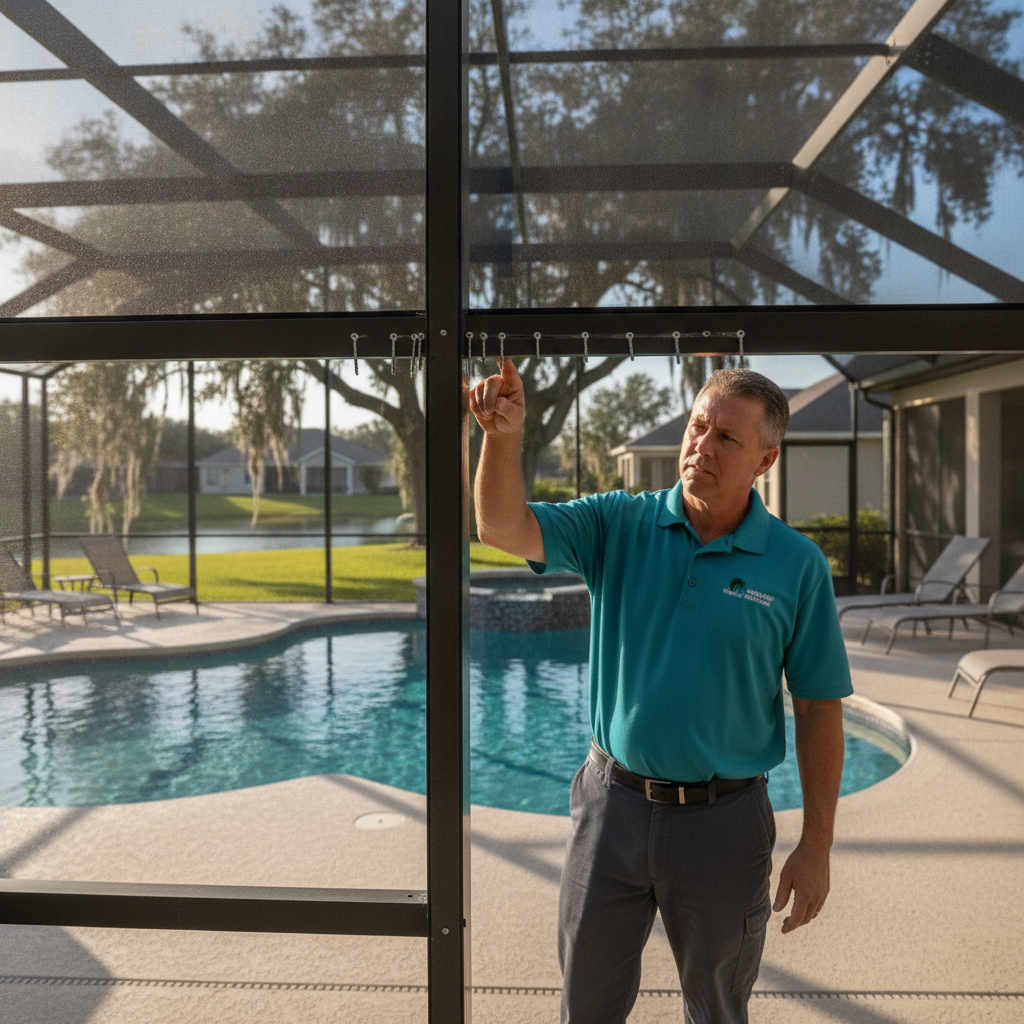
A hex-head sitting on the deck under a Cypress Gardens cage is not leftover hardware. It is a pool cage screw that walked out of the beam, usually after a summer of afternoon storms and the aluminum growing and shrinking on the south and west sides. Left alone, one loose fastener becomes a line of them, then a panel that slaps, then a joint that no longer lines up.
Why stainless and coated screws still back out
Stainless and coated screws still back out because backing out is a motion problem, not only a rust problem. A Polk County cage lives in heat, rain, and wind every week of the warm season. The aluminum on a Winter Haven pool cage grows a little in the afternoon sun and shrinks after dark. Each cycle works a tiny bit of play into a joint that was tight the day it was built.
Wind does the rest. This county is inland, thirty-plus miles from either coast, so the load is hurricane wind and daily thunderstorms, not salt air. The Atlantic hurricane season runs from June 1 to November 30, and even outside a named storm the regular summer cell loads a mansard, lets go, and loads it again. A fastener held only by thread friction ratchets a fraction of a turn at a time. After enough cycles the head sits proud of the beam. Then it hangs. Then it is on the pavers.
Rust still matters, just not the way the hardware aisle sells it. Builder-grade steel in aluminum, with pool splash and fertilizer wash at the base, starts to stain. The red bloom on a bronze beam is the head shedding. As the steel wastes away, the hole in the extrusion opens. A later stainless screw in that wallowed hole has nothing honest to bite. It spins. That is why a nicer screw in an old hole can walk out faster than the cheap one it replaced.
Coated screws fail at the drive first. The coating chips where the nutsetter seats. Bare steel shows at the head while the threads still look fine. The head rusts, the recess rounds, and the next person who tries to back it out cams out and wrecks the hole.
Locking is what actually keeps a cage screw in the beam. Serrated washer heads, thread-forming points that cut into the extrusion, and nylon-patch threads all resist that ratchet. None of that saves a hole that is already oversized. The crews we send pick the fastener for the joint they are in, not from a one-size kit in a bag. Color matching (white, bronze, mill) hides the head on a painted cage. Color is not holding power.
The same walking-out pattern shows up on a screen room over a patio slab, especially on west-facing covers along US-98 south of Lakeland, where the afternoon sun sits on the roof all day. New subdivision cages along the I-4 corridor through Davenport and Four Corners can show it early if the builder used plain steel. The 1990s stock around Winter Haven, Auburndale, and Eagle Lake shows it because those joints have been working in the wind for a long time.
Live oak canopy adds a smaller shove. Catkins and leaf mat on a mansard in April around Lake Morton and Dixieland hold water against the roof members. That is more of a mesh and gutter problem, but wet aluminum at the joint is also what lets a steel screw start staining.
A popped screw versus a beam that has shifted
A popped screw is a local failure. The member is still in plane, the spline is still in the channel, and you can put a finger on one proud head. A shifted beam is a geometry failure. The cage has racked. Corners that used to be square are not. A roof beam has a kink or a droop. The screen is baggy in one bay and drum-tight in the next.
You tell them apart by looking at more than the fastener. Walk the cage from the pool deck, not from a ladder. Sight down a long beam the way you’d sight a fence. If the line is straight and only a few heads are proud, you are looking at fasteners walking. If the line waves, if a corner post has a gap at the slab, or if a mid-post has walked off its clip, the screws are the symptom. The frame has moved.
That split comes up constantly on Chain of Lakes cages already in their rescreen window. Screen life in Central Florida is roughly seven to twelve years, and it fails unevenly because sun exposure kills mesh on the south and west elevations years before the shaded north side. People call about baggy screen and then notice the screws. Sometimes the mesh is the whole job. Sometimes the mesh is hiding a joint that has been working for years.
Base fasteners are a third thing. Beam screws are one family. The anchors that pin a post to the concrete are another. A thin 1950s patio slab in Dixieland or Lake Morton often has no real perimeter footer. An anchor in that slab can loosen because the concrete itself is crumbling, not because a screw backed out of aluminum. Resetting those anchors is licensed work. On a bad slab it can turn into a conversation about whether the cage even has a sound place to land.
A two-story mansard tied into a house wall is the high-stakes version. Fasteners up there see more lever arm and more wind. Do not climb it. A proud head at twelve feet is a signal to get a licensed crew, not a reason to drag a household ladder onto wet decking after a storm.
If the frame has racked, new screws in the old holes will not pull it true. The crew has to relieve the joint, check whether the extrusion is cracked or ovaled, and decide whether the member can be re-fastened or has to be cut out. That is enclosure repair territory, not a hardware-store afternoon. Wind load on a Polk County screen enclosure is assigned to a specific address by the Florida Building Code. The engineered drawing in the permit package states the value the structure was designed to. Inland Polk carries a lower number than a Gulf-front county does. A cage with missing fasteners is not the cage on that drawing.
| What you notice | Likely cause | What actually needs to happen |
|---|---|---|
| A few hex-heads proud or on the deck, beams still straight | Fasteners walking in the original holes | A fastener pass into sound metal |
| A beam that waves when you sight it, a corner out of square, screen tight in one bay and slack in the next | The frame has racked or a member has moved | Repair the joint or the member, then fasten |
| A post spinning on the slab or a rust halo in the concrete | The base anchor or the slab, not the beam screw | Licensed anchor work, and an honest look at the concrete |
What a fastener pass actually includes
A fastener pass is a licensed crew going joint by joint through an existing cage and replacing the screws that hold aluminum to aluminum, and often the anchors at the slab, with new fasteners chosen for those holes. It is not spinning a few heads you can reach from the ground and calling the cage done.
With the screen still on, the work is slow. Walk boards, ladders, and long material have to move around live mesh. One slip and a panel tears, and then you are buying screen you did not plan to buy. Individual screen panels run $35 to $90 each, so a “just the screws” visit that punches two bays is no longer just the screws.
With the screen off, the same pass is a different job. That is why fastener work often rides along with pool cage rescreening. A full-cage rescreen in this market runs $1,400 to $3,200. Once the mesh is out of the way, the crew can see every connection, drive every fastener square, and move equipment without dancing around spline. The cost driver is access and time. Screen off is faster. Screen on is slower and harder on the mesh.
What the pass actually covers, in practice:
- Beam-to-beam and beam-to-post screws get pulled and replaced, including the ones hiding under kickplates and at the house wall.
- Heads that have already wallowed a hole get an honest repair, which can mean a larger fastener, a new hole in sound metal, or a short section of extrusion if the wall is torn.
- Slab anchors get checked for rust, spin, and broken concrete, which is a different failure than a screw walking out of a beam.
It does not include guessing a wind number for your street. Putting the fasteners back is how you return the structure to the joints it was built with. It is not a new engineering stamp you pick up at the register.
Permits follow the work, not the shopping list. In unincorporated Polk, the Building Division’s published list names screening of any space that requires structural or infill framing to be added. Inside Lakeland city limits, Building Inspection publishes its own permit requirements, and screening that needs framing is on that list too. Swapping fasteners in an existing cage is not the same job as adding a bay. If the crew is cutting in new members, you are in permit territory. If they are only replacing screws in place, ask them what they are pulling and who is calling the Building Division.
Several licence classes can lawfully do this aluminum work. Florida law requires a person to be certified or registered to engage in contracting. Ask which class they hold, then check it yourself at myfloridalicense.com.
Leave the high work and the slab anchors to that crew. Replacing one spline-set screen panel at ground level is a fair homeowner job. Erecting or modifying the frame, resetting anchors, or working a two-story mansard is not.
Questions about pool cage screws
What type of screws are best for a pool cage?
The best pool cage screws are corrosion-resistant fasteners with a locking head or thread, sized to the extrusion they are joining, driven into metal that still has a round, tight hole. Stainless and coated both belong in this trade. Stainless still walks out of a sloppy hole. Coated still rusts where the coating chips. Matching the finish keeps the head from advertising itself on a painted cage, but color is not the holding power. Holding power is the lock, the length through both walls of the member, and a hole that has not been egg-shaped by rust or a stripped drive. People searching for screws “in a pool” usually mean the cage over the deck, not hardware sitting in the water. Ordinary drywall or deck screws from the bin do not belong in that aluminum.
How do you replace pool cage screws?
You replace them by supporting the joint, backing the old fastener out without spinning the hole larger, and driving a new locking fastener of the right length into sound metal. If the old screw is rust-welded, the head shears and the stub has to be drilled. If the hole is wallowed, a same-size screw will walk out again. That is the step a bag of stainless from a catalog cannot fix on a 1990s Winter Haven cage that has been working in the wind for years. A licensed crew does this as a pass across the structure, not as a few heads you can reach from a chair.
How long does a pool cage last in Polk County?
The aluminum frame is not the part that ages out first. Screen in Central Florida lasts roughly seven to twelve years and dies on the south and west elevations first. A properly stripped and primed cage repaint holds a finish for eight to fifteen years. Fasteners and mesh are the wear items. Keep the screws in the beam and the mesh in the channel, and the frame can stay in service through more than one rescreen cycle. Let the screws rain onto the deck, and you are no longer talking about maintenance.
When to call us
Call when screws are sitting on the deck, when a beam no longer sights straight, or when you want fasteners handled as part of a rescreen rather than as a separate climb around live mesh. That work belongs with a licensed contractor, not a household drill and a ladder on wet pavers. Call us at (863) 777-5379.