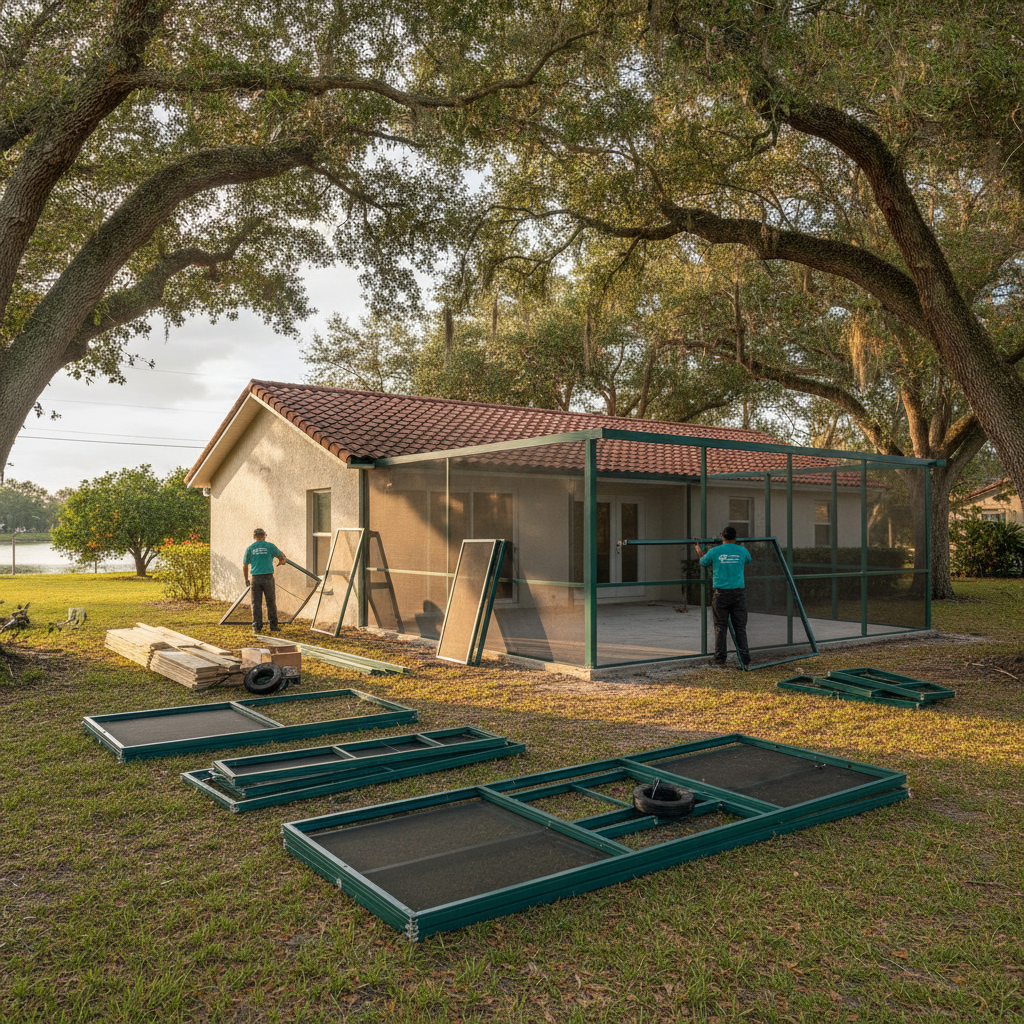
The crew pricing a Florida room on a Winter Haven lake lot is looking at a different job than the crew standing on a thin patio slab in Dixieland. Same county. Different anchors, different oak canopy, and a different permit office if the house sits inside Lakeland city limits. Hire on the bid, the license class, and which building department will see the drawings.
What a Florida room bid in Polk actually covers
A usable bid names the frame, the infill, the slab or footer work, who applies for the permit, and the license class of the person signing the contract.
In Polk County that package can be four different jobs wearing the same nickname. Screening in an existing covered lanai is one. A new aluminum room with an insulated roof panel and a longer clear span is another. Acrylic panels in the openings make a three season room. Glass in those openings makes a sunroom. The naming split is already covered in our Florida room vs sunroom guide. This page is about the person you hire and what their number has to include.
Local companies advertise entry-level screen rooms near $1,499 plus permit, and that number is real for a small standard-size room. Screening in an existing covered lanai often lands between $1,500 and $3,500. Once you add an insulated roof panel, a longer clear span, or a new slab, the same kind of room moves into the $6,000 to $14,000 range. Conversion of an existing lanai in the Lakeland area typically runs $8,000 to $20,000. A glass sunroom in Polk County typically runs $22,000 to $45,000. Those ranges move with span, infill, and foundation.
The slab is the quiet line item. A lot of pre-1960 bungalows around Lake Morton and Dixieland have rear patio slabs poured thin, with no perimeter footer. An aluminum upright has to land on concrete thick enough to hold an anchor. If the slab will not take that load, the bid has to carry a new footer or a new pad. South along US-98 the lots open up, and the work turns into a full room off a west-facing cover that takes afternoon sun all year.
A builder-covered lanai in a Davenport, Four Corners, or Haines City subdivision is the other common starting point. The roof is already there. Screening or glazing was a separate line item, and the crew is finishing what the tract builder left open. A longer clear span means heavier beams carrying the same roof, and heavier beams cost more per foot. Glass weighs more than acrylic, and acrylic weighs more than screen, so the infill choice belongs in the first number, not as a later add-on.
The contract itself has two Florida rules sitting in the paperwork. A contractor who takes an initial payment totaling more than 10 percent of the contract price for residential work must apply for the permits necessary to do the work within 30 days after that payment, under Florida Statutes 489.126. A residential contract over $2,500 must carry a written statement about the Florida Homeowners’ Construction Recovery Fund. If those lines are missing, the paperwork is incomplete before anyone sets a post.
Hurricane coverage for a screened enclosure commonly comes from an endorsement rather than the base policy. Carriers differ on what rides along. The answer is on your own declarations page, and it is worth matching that page to the structure in the bid.
License class, city permit, and county permit
Florida requires the person in the business of contracting to be certified or registered. Florida Statutes 489.113 puts it in one sentence: “A person must be certified or registered in order to engage in the business of contracting in this state.”
Several license classes lawfully build aluminum structures. The statute that defines those classes names general, building, residential, and specialty contractors, and the board sets a specialty contractor’s scope by rule. Ask which class the contractor holds, then verify it yourself at myfloridalicense.com. The crews we send are licensed and insured. Lakeland Outdoor Pro matches you with those crews. The license and the permit sit with the contractor who signs the job.
The permit office splits by address. Inside the City of Lakeland, Building Inspection publishes its own permit requirements. That page lists porches and “Screening of any space that requires structural or infill framing” among the items that need a permit. Accessory buildings such as detached carports also need a building permit on that same list. In unincorporated Polk, the Building Division’s published FAQ uses matching language: “Screening of any space, which requires structural or infill framing to be added.” A crew that mostly works the county can hit friction inside city limits because the two offices run their own reviews. Drawings still have to satisfy sunroom permit rules at whichever counter takes the address.
Lakeland collects non-utility impact fees for Polk County at the time of permit, in the transportation, fire protection, law enforcement, and parks categories. The city collects those fees for the county. The dollar amount belongs on the permit, and it follows the address.
On a lake lot in Cypress Gardens or a ridge parcel in Lake Wales, setbacks and easements show up before screen color does. Agricultural parcels toward Bartow, Mulberry, and Fort Meade bring owner-builder questions more often than a new Davenport subdivision does. The county’s owner-builder path is an exemption from the licensed-contractor rule, with its own restrictions, including a signed disclosure that state law requires construction to be done by a licensed contractor. A Florida room with structural framing is the kind of job most homeowners hire a licensed contractor to carry. Match the name on the contract to the name on the license using the contractor license guide for screen enclosures.
The Florida Building Code assigns an ultimate design wind speed to a specific address. The engineered drawing in the permit package states the value the structure was designed to. Inland Polk carries a lower number than a Gulf-front county does, which is why the same room prices differently here. The Atlantic hurricane season runs from June 1 to November 30, and that calendar is why a bid written in April and a bid written in September can feel like two different jobs even when the drawing is the same.
Screen, acrylic, and glass on an inland lot
The infill is the part of the room you live with every afternoon, and on an inland Polk lot the choice follows sun, oak debris, and how much of the weather you want to keep out.
Screen is the lightest and the most open. Phifer’s 18x14 fiberglass mesh is built to withstand debris from harsh winds and storms, keep out most insects, and still let cooling breezes through. Their 20x20 No-See-Ums mesh is designed to keep out most smaller flying insects like no-see-ums, gnats, and sand flies. PetScreen is pet-resistant screening designed to be tear and puncture-resistant for dogs and cats, and the manufacturer lists it for patio and porch enclosures. In Central Florida, screen lasts roughly seven to twelve years, and it fails unevenly. UV kills the mesh on the south and west elevations years before the shaded north side. Under the live oaks off Lake Morton, catkins in April and acorns in fall load a roof screen the way they load a gutter.
Acrylic sits in the middle. A three season room uses acrylic window panels in an aluminum frame, so you keep the insects and a lot of the rain out while the room still reads as outdoor living. On a Chain of Lakes lot in Winter Haven or Auburndale, that is often the upgrade from a 1990s screened lanai whose south wall has gone brittle while the north side still looks new.
Glass is the enclosed end of the same family. A sunroom in Polk County is a closed room with glass in the openings, more flashing, and more load on the slab. The glass sunroom range of $22,000 to $45,000 is the number that usually attaches to that build.
| Infill | What you get | What changes on a Polk lot |
|---|---|---|
| Screen | Breeze, insect control, the lightest frame | South and west mesh age first; oak debris loads the roof |
| Acrylic | Rain and insect control with an outdoor feel | Common upgrade on 1990s Winter Haven lanais |
| Glass | A closed room, more weight, more flashing | Needs a slab and beam package that can carry it |
If the room sits next to a pool, the safety question is separate from the room question. Florida’s Residential Swimming Pool Safety Act lists the ways a residential pool may be made safe. One option is an enclosure that meets the barrier requirements of section 515.29. The statute asks a barrier to be at least 4 feet high on the outside, to have no gap a child could squeeze through or climb, and to carry a self-closing, self-latching gate with the release on the pool side. Whether a given room does all of that is what the building official signs off on.
Haines City, Davenport, and the I-4 corridor add a second review on a lot of new construction: the HOA architectural packet. Color, roof profile, and whether glass is allowed on a rear elevation can stall a bid that already has a clean drawing. Send that packet with the bid, not after the crew is on the calendar.
How do I verify a Florida room contractor’s license in Polk County?
Look the license up yourself on Florida DBPR’s Verify a License tool at myfloridalicense.com. Ask which class the contractor holds, because several classes lawfully build aluminum structures, then match the name on the contract to the name on the license.
Does a Florida room in Lakeland need a city permit or a county permit?
A property inside the City of Lakeland goes through the city’s Building Inspection division. A property in unincorporated Polk goes through the Polk County Building Division. Both offices treat screening that needs structural or infill framing as permitted work. The address decides the counter.
What should be in writing before I pay a deposit?
The contract should name the work, the infill, the slab or footer work, who applies for the permit, and the contractor’s license class. If the initial payment is more than 10 percent of the contract price, Florida law gives the contractor 30 days from that payment to apply for the permits. Residential contracts over $2,500 also need the recovery-fund statement.
When to call us
A Florida room with new framing, a new slab, or glass in the openings is licensed construction, and the permit belongs with the contractor who signs the job. If you want a crew out to look at a lanai in Lakeland, a 1990s room in Winter Haven, or a builder-covered porch in Davenport, we match you with licensed local aluminum crews. Call us at (863) 777-5379.