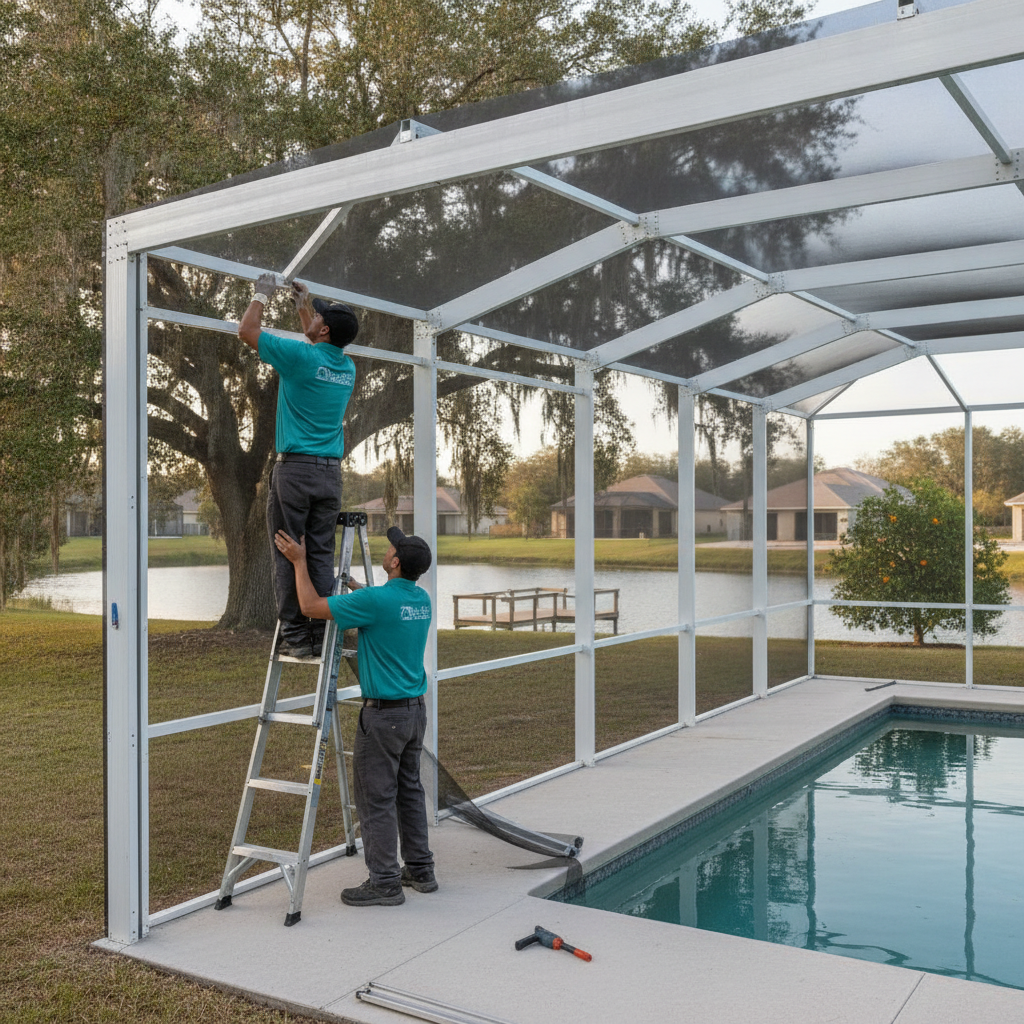
The tape-measure visit is the easy part. A pool cage in Lakeland is an engineered aluminum frame over water, sitting on a slab that may have been poured thin in the 1950s, and it has to take inland hurricane wind plus the thunderstorm that rolls through every summer afternoon. The installer worth hiring is the one who can show a Florida contractor license, name the permit office that actually covers your address, and put a drawing on the table that matches your lot.
License class, permit, and a drawing that matches the lot
Florida law is blunt: a person must be certified or registered in order to engage in the business of contracting in this state. That is Florida Statutes 489.113, not a slogan on a magnet. Several license classes can lawfully build aluminum structures, including specialty, general, building, and residential contractors. None of those classes is the only correct one for a pool cage. Ask which class the contractor holds, then look the name up yourself on Florida DBPR’s Verify a License tool.
The crews we send are licensed and insured. We match you with them. We do not hold the license, and we do not pull the permit. That is the contractor’s job, and a serious bid makes it visible on page one.
Where the permit is filed follows the address, not the crew’s usual route. The City of Lakeland runs its own Building Inspection division and publishes its own permit requirements. Screening of any space that requires structural or infill framing is on that list, along with carports and porches. A Dixieland bungalow, a Lake Morton lot under live oaks, or a South Lakeland pool home inside city limits goes through the city. Unincorporated Polk, which covers a lot of Kathleen, Medulla, Highland City, and the country south toward Bartow, goes through the Polk County Building Division. That office’s published FAQ names the same kind of work: screening of any space which requires structural or infill framing. A crew that mostly works county jobs can hit friction inside city limits. The drawing should already know which counter it is walking up to. We walked the local permit path in more detail in screen enclosure permits in Polk County.
The drawing has to match the lot, not a catalog cage. Downtown Lakeland and Dixieland still have pre-1960 bungalows with rear patio slabs poured thin, often with no perimeter footer. An aluminum upright has to land on concrete thick enough to hold an anchor. If the slab will not take that load, the honest bid talks about a new footer or a different layout, not a cheaper post. South along US-98 the lots open up and the work turns into full cages and west-facing covers. Around Winter Haven, Cypress Gardens, and the rest of the Chain of Lakes, pool density is the highest in the county, and a lot of 1990s cages are in their rescreen window rather than a full rebuild. On the I-4 corridor through Haines City, Davenport, Four Corners, and Loughman, the typical job is a builder-covered lanai left bare, plus an HOA architectural packet before anyone sets a post. Out on the Lake Wales Ridge, setbacks and easements show up more often than screen color. Bartow and south Polk carry the county’s densest supply of owner-builder and unpermitted-work questions, which is a paperwork problem that follows the house, not a bargain.
The Florida Building Code assigns an ultimate design wind speed to a specific address. The engineered drawing in the permit package states the value the structure was designed to. Inland Polk carries a lower number than a Gulf-front county, which is why the same cage prices differently here. Nobody honest quotes you a mph figure over the phone. They point at the drawing.
Door hardware belongs on that drawing, not on a later change order. Florida’s Residential Swimming Pool Safety Act lists ways a residential pool may be made safe. One option is an enclosure that meets the barrier requirements in section 515.29. The statute asks a barrier to be at least 4 feet high on the outside, to have no gap, opening, or protrusion a young child could crawl under, squeeze through, or climb, and to carry a gate that opens outward, self-closes, and self-latches, with the release on the pool side and out of a child’s reach. A screened structure only satisfies that option when it independently meets those specifications. Whether a given cage does is a determination for the building official reviewing the permit. If you want the hardware walkthrough, we already wrote it in pool cage door hardware and the pool barrier.
Money up front has its own clock. A contractor who takes, as an initial payment, more than 10 percent of the contract price for residential construction must apply for the permits necessary to do the work within 30 days after that payment. That is Florida Statute 489.126, and it is the consumer protection that actually moves on this kind of job.
What a real bid includes besides screen
A new residential pool cage in the Lakeland area commonly lands between $9,000 and $18,000. A cage with a large deck, a two-story mansard tied into the house wall, or a high clear span commonly lands between $20,000 and $35,000. Those are this site’s published ranges for this metro, not a quote from us, and not a promise that your backyard sits in the middle. If you want the cost drivers unpacked line by line, start with new pool cage cost in Lakeland.
Screen is the cheap-looking line. The number moves with clear span, because a longer span means heavier beams carrying the same roof, and heavier beams cost more per foot. It moves with height: a two-story mansard is a different structure than a single-story cage over a modest deck. It moves if the existing slab cannot take a perimeter anchor and a new footer has to be poured. It moves with roof style, door count, and mesh. A west-facing cage in South Lakeland takes more sun than a north elevation under oaks, and that shows up later in the mesh, not on day one.
A real bid names those pieces in writing.
- The frame, member layout, and roof style sit on the first page, because that is the structure the engineer stamps for this lot.
- Mesh is specified by product: Phifer Fiberglass 18x14 is built to keep out most insects while still letting breezes through, and Phifer No-See-Ums is a 20x20 mesh aimed at smaller flying insects.
- Phifer PetScreen is a tear- and puncture-resistant fabric for dogs and cats, and a bid that invents a mesh count for it is guessing, because the manufacturer does not publish one.
- Doors, closers, and latches are called out as hardware, not as “a door,” because the latch side and the release height are what the inspector is looking at.
- Permit, engineering, old-cage removal, and any HOA submittal are in the same number as the aluminum, or they are not in the job.
If the water is not inside the enclosure, you may be looking at a screen room over an existing slab or a covered lanai, not a pool cage. Screening in an existing covered lanai commonly runs $1,500 to $3,500. That is a different structure, a different drawing, and a different bid. Stretching a cage range onto a lanai, or a lanai range onto a cage, is how a low number gets into the conversation and a change order gets it back out.
Screen and frame also age on different clocks. Screen in Central Florida commonly lasts roughly seven to twelve years, and it fails unevenly, because sun kills mesh on the south and west elevations years before the shaded north side. That is why a 1990s cage in Cypress Gardens can look fine from the house and still be brittle on the afternoon side. A full-cage rescreen commonly runs $1,400 to $3,200, and individual panels commonly run $35 to $90 each. Swapping a spline-set panel at ground level is a homeowner job. Standing a new frame, setting anchors, or changing barrier-door hardware is not. If the mesh is the problem and the frame is still true, the crews we send rescreen the cage rather than replacing the whole structure.
A Davenport or Four Corners subdivision often adds a step the county counter does not: HOA architectural review. The packet wants elevations, colors, and a site plan before the crew can set a post. Build that into the calendar, or the permit sits while the board meets. We covered that path in HOA approval for a screen enclosure in Polk County.
Questions that separate a reseller from a builder
A catalog seller prices a cage. A builder prices the structure that will stand on your slab.
The difference shows up in the first ten minutes on the lot. A reseller takes two photos, emails a factory, and comes back with one number. A builder walks the footer line in Dixieland and says the slab is too thin for a perimeter anchor. A builder looks up at the live oaks off Lake Morton and talks about limbs, not just mesh. A builder in a new I-4 subdivision asks for the HOA packet before quoting a color. A builder in Winter Haven can tell a 1990s cage that needs a full rescreen from a frame that has already chalked past a paint-and-save. The spline popping out of the channel the first time wind gets under a loose panel is a maintenance problem. A racked two-story mansard is a different crew.
| What you are looking at | Catalog seller | Licensed enclosure crew |
|---|---|---|
| License | A truck magnet and a smile | A license class you can look up tonight on Verify a License |
| Permit office | ”We handle that” with no city or county named | City of Lakeland Building Inspection or Polk County Building Division, by address |
| Drawing | A stock elevation that would fit any lot | An engineered drawing for this slab, these setbacks, and the wind value the code assigns to this address |
| Screen | One mesh, one price | Product named, with the south and west elevations treated as the ones that fail first |
| Door hardware | A promise that you are covered | Height, gaps, outward swing, self-closing latch, release on the pool side, and the building official’s sign-off |
| Deposit | A big check on day one | The 10 percent and 30-day permit clock, in writing |
A sentence that tells you the cage already “meets pool safety code” is a tell, not a comfort. The statute never names “screen enclosure” as a category. The useful answer is the hardware and the inspector, not a verdict from the salesperson.
License class is the other tell. Several classes can lawfully do this work, which is why “I do aluminum” is not enough and “only this one class is legal” is not true either. The useful move is the one in contractor license for a screen enclosure in Polk County: get the class, get the name, and check it yourself. If the person collecting the deposit cannot tell you who applies for the permit, or which office, they are selling a cage, not building one.
How much does it cost to install a pool cage in Lakeland?
A new residential pool cage in the Lakeland area commonly runs $9,000 to $18,000. A cage with a large deck, a two-story mansard tied into the house wall, or a high clear span commonly runs $20,000 to $35,000. Inland Polk is not a Gulf-front county, so the same cage prices differently here because the code assigns a lower design wind value to this address than it does on the coast. Screening a covered lanai or a small screen room is a different job, and those published ranges start much lower, around $1,500 to $3,500 for work over an existing slab.
Do you need a permit for a pool cage in Florida?
A pool cage in this metro needs a permit because it is screening that requires structural or infill framing. Inside Lakeland city limits, the city’s Building Inspection division lists that work among the items for which permits are required. In unincorporated Polk County, the Building Division FAQ names the same trigger. The City of Lakeland and the county are not the same counter, so the crew has to file where the house actually sits. Owner-builder permits exist under a state exemption, with restrictions, but erecting or modifying an aluminum enclosure frame is still licensed contracting work when a contractor is the one doing it.
How long does a pool cage last in Central Florida?
The screen and the frame do not fail together. Screen in Central Florida commonly lasts roughly seven to twelve years, and it fails unevenly because UV kills the south and west elevations years before the shaded north side. A full-cage rescreen commonly runs $1,400 to $3,200 when the frame is still true. Finish life after a properly stripped and primed cage repaint commonly runs eight to fifteen years. The frame itself is a longer clock, set by anchors, members, and whether anyone has already painted or patched past the point of a save.
When to call us
A new pool cage, a two-story mansard, anchors into a slab, or a change to pool-door hardware is licensed contractor work, not a weekend panel swap. We cover Lakeland, Winter Haven, Bartow, and the rest of Polk County, and we match you with licensed local crews for the structure that actually fits your lot. Call us at (863) 777-5379.