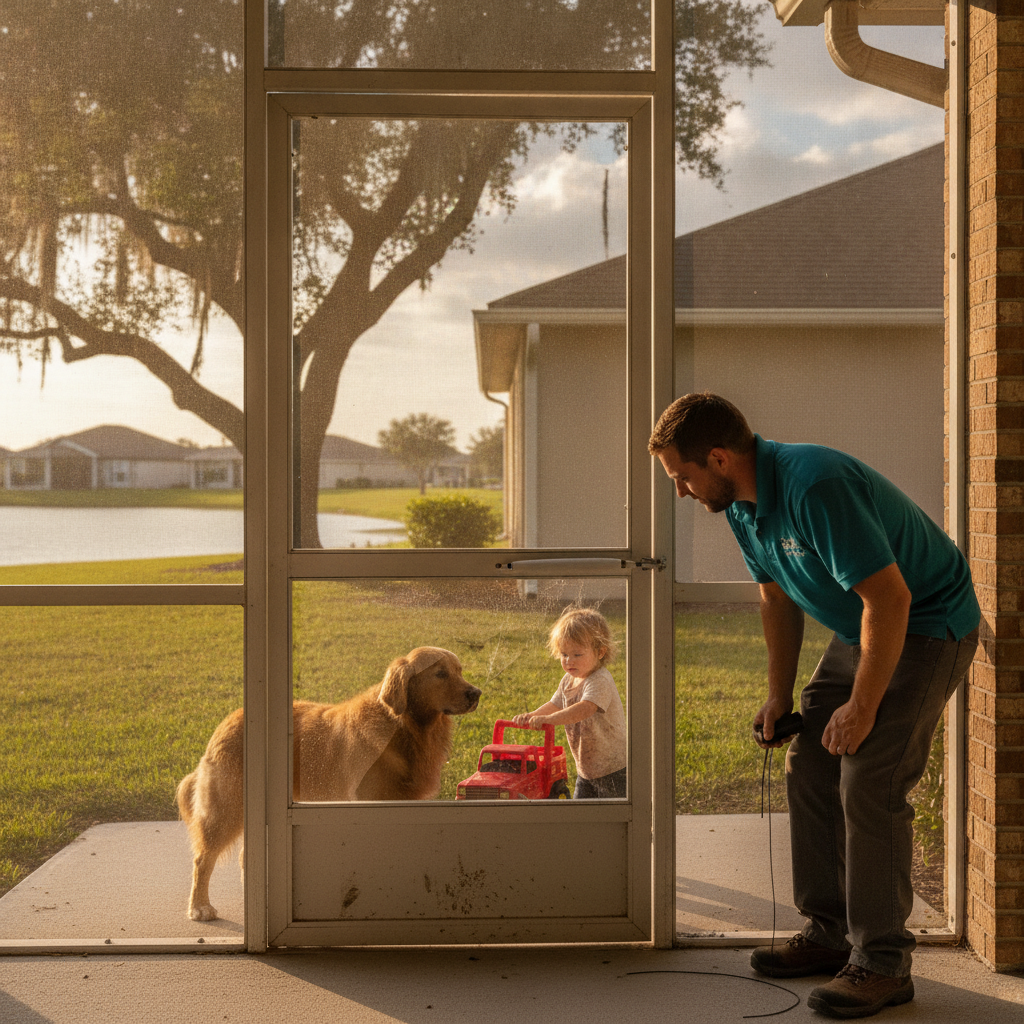
The first thing a lab, a toddler, or a cooler hits on a Winter Haven pool cage is not the latch. It’s the solid aluminum panel at the bottom of the door. That panel is the kick plate, and once it’s dented, rattling, or gone, the mesh above it is next.
What a kick plate is doing on a pool cage door
A kick plate is the solid lower infill on an aluminum screen door. It sits in the bottom rails so shoes, paws, and strollers hit metal instead of mesh.
On a pool cage in Cypress Gardens or along the Chain of Lakes, that door is the high-traffic hole in the enclosure. Kids shove it with a hip. Dogs hit it at a run. You bump it with a skimmer pole or a grocery bag. Fiberglass mesh is not built for that. The plate is.
Look at how the door is put together. Two vertical stiles, a bottom rail, a mid-rail, and a top rail. Screen lives in the upper bay, held in a channel by a rubber spline, the same way a wall panel is held on the cage. The kick plate fills the bay under that mid-rail. Take the plate out and you have left a rectangle of mesh at shin height. That is the rectangle that fails first.
The same job shows up on a screen room door off a Lakeland lanai. New Davenport and Four Corners houses often get a builder-covered lanai left bare, then a screened door later. That door still needs a lower panel, or the first dog through it owns the mesh. Around Lake Morton the traffic is different: live oaks, a patio used as the real front door all summer, and a threshold full of catkins in April. The kick plate still takes the first hit.
A kick plate on this trade is not the brass sheet a hardware store sells for a commercial wood door. Those screw onto the face. On most Polk County aluminum cage doors, the plate is captured in the same frame that holds the screen. Some doors set it with a hidden spline so the plate cannot chatter when the closer slams the door. A loose plate in an open channel rattles every time the door shuts, and it rattles harder once afternoon storms start stacking up after June 1.
Florida’s Residential Swimming Pool Safety Act asks a barrier to be at least 4 feet high on the outside, to have no gap a child could squeeze through or climb, and to carry a self-closing, self-latching gate with the release on the pool side. It does not name kick plates, and it does not name screen enclosures as a category. The plate is there to save the mesh and stiffen the bottom of the door. Whether a given cage does what the statute asks is what the building official signs off on.
From the yard you see the scuffed sheet at shin height. From the pool deck you see the back of the same panel. It is part of the door, not a sticker on one face.
Pets, rust, and a door that no longer latches
Pets go for the lower third of a screen door. A dog that wants the backyard does not aim for the handle. It hits the panel, then the mesh above it if the panel is missing or the spline has popped.
Phifer PetScreen is pet-resistant screening designed to resist tearing and puncture from most dogs and cats, and it is made for patio and porch enclosures as well as windows and doors. Pair that mesh with a kick plate and the dog has metal to hit first. Leave the lower bay as ordinary fiberglass and you are replacing that panel on a schedule. Other screen mesh types belong in the walls and the roof, not at shin height on a door a Labrador uses as a gate.
Rust on a Polk County cage door is usually the fasteners, not the plate. The plate is aluminum. The screws holding the closer, the latch, or a retrofit sheet often are not. Steel in aluminum, sitting in a wet threshold, is how you get orange rings around screw heads and a latch that starts to freeze. Afternoon storms sit in that track. Acorns wedge the door so it never quite closes. People then kick it shut. The plate takes that kick. The latch takes the misalignment.
Once the door is racked, the latch no longer meets the strike. A kick plate that has come loose stops helping the door stay square. The lower panel is a stiffener as much as a shield. When it rattles in the channel, the stiles twist a little every time the closer slams. That is the Winter Haven soundtrack on a 1990s cage: door hits the frame, bounce, rattle, latch that does not catch, closer that drags it back for another try.
South and west elevations cook the mesh first. Screen in Central Florida generally lasts roughly seven to twelve years, and it fails unevenly because sun exposure kills mesh on the south and west elevations years before the shaded north side. A cage in Cypress Gardens often still looks fine on the house side and brittle on the pool side. The door, sitting in that west wall, is the first panel a homeowner notices because they touch it every day.
Paint on an old plate can chalk. Chalking is a fine white powder on the paint film from weathering, and it can look like the color is fading. That is a finish problem on the plate, not a reason by itself to scrap the door. Wash it, let it dry, and judge the metal underneath. Dents, a bowed rail, and a latch that misses are the real tells.
A door that will not latch is also a pool-access problem. Florida law lists several ways to isolate a pool from the house. A gate in a barrier still has to close and latch on its own, with the release on the pool side out of a child’s reach. Kicking a sagging door closed is not the same as a closer and a latch doing that work. Leave the hardware to a licensed crew. Do not start swapping pool-side releases yourself.
Swap the plate or replace the door
Swap the plate when the door still hangs plumb, the closer still shuts it, the latch still hits the strike, and the only failure is the lower panel. The crews we send pop the retainer or the spline, slide the old plate out of the bottom bay, and set a new one that matches the width between the stiles and the height of that bay.
Measure the opening you actually have. There is no universal kick-plate size for a Polk County cage door. The right plate is the one that fills the lower bay without binding the sweep or covering the latch. A plate that is too short leaves a strip of mesh at shin height, which is exactly where a dog will go through it.
Replace the door when the frame is bent, the hinge side has dropped, the closer is fighting a racked stile, or the latch and strike no longer share a plane. A new plate in a twisted frame will rattle by the next storm. Screen door work on this trade, a rehang, a rebuild with new hardware, or a full replacement, typically runs $180 to $500. That range is for the door job, not a lone plate. A taller door on a two-story cage, or a door that also needs a new closer and latch, moves the number up because the labor is in the hanging and the alignment, not the sheet of aluminum.
If the rest of the cage is already in its rescreen window, do the door in the same visit. There is no point in a fresh kick plate under mesh that is brittle on the west wall. Individual screen panels generally run $35 to $90 each when you are swapping a panel at a time. A full-cage rescreen is a different job, generally $1,400 to $3,200, and that is the conversation when the south and west elevations are both going.
A door-only replacement in an existing opening is not the same as adding framing to screen a new space. Unincorporated Polk County’s Building Division lists screening that requires structural or infill framing among work that needs a permit. A property inside Lakeland city limits goes through the city’s own Building Inspection division, which also lists screening of any space that requires structural or infill framing. Ask the Building Division on the specific door before anyone cuts a new opening. Verify the contractor’s license yourself at myfloridalicense.com. Several license classes lawfully build and repair aluminum structures. Ask which class they hold.
If the closer, the hinges, and the latch are the real problem, the plate is only what you see. The hardware is what keeps the door from standing open toward the pool. Read the sister notes on pool cage door replacement and door hardware when the door is the issue, not just the lower panel.
Atlantic hurricane season runs from June 1 to November 30. A rattling plate is annoying in April. A door that will not latch is a different problem once summer storms start shoving the west wall every afternoon.
What is the purpose of a kick plate on a door?
It takes the hits so the screen does not have to. On an aluminum cage or lanai door, the plate fills the lower bay, stiffens the bottom of the frame, and gives pets and feet a solid surface. Dust and debris still blow under a door with a worn sweep, but the plate is not a weather seal. It is a sacrificial panel.
Do kick plates go on the inside or the outside?
On a typical Polk County aluminum screen door, the kick plate is an infill panel, so you see it from both sides. It is not a face-mounted brass sheet. If a crew adds a retrofit plate on top of a damaged bay, they put it on the side that actually gets kicked, usually the approach side from the yard or the patio. The latch release on a pool gate still belongs on the pool side, placed so a young child cannot reach it over the top or through a gap.
What size kick plate does a screen door take?
The size of the lower bay on that door. Measure the width between the stiles and the height from the bottom rail to the mid-rail. A plate that is too tall will crowd the screen above it or the hardware. Order to the door you have, not to a catalog height.
When to call us
Call when the plate rattles, the door no longer latches, or a pet has already gone through the lower mesh. That is licensed aluminum and hardware work, especially on a pool cage door that has to close and latch on its own. We match Polk County homeowners with licensed local crews for the door, the plate, and the rest of the enclosure. Call us at (863) 777-5379.