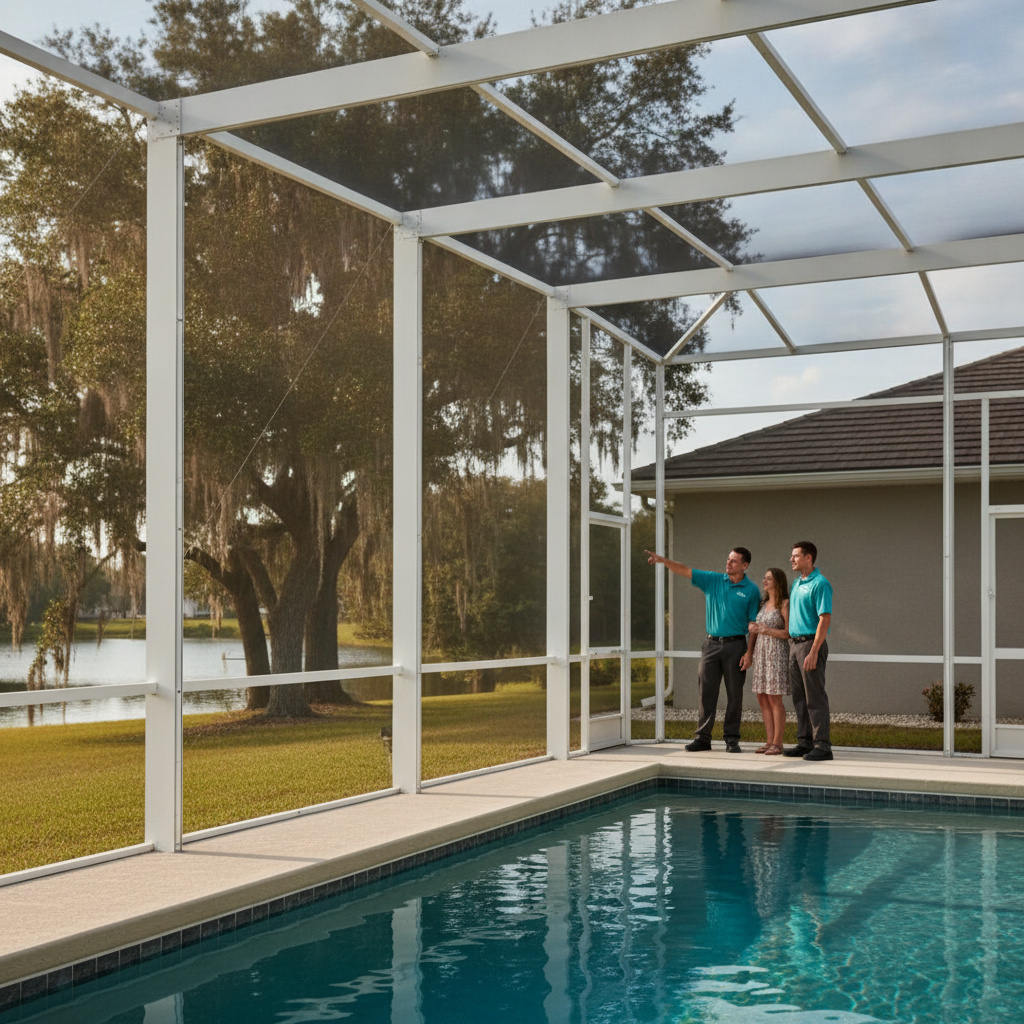
A west-facing pool cage in South Lakeland still takes the full inland afternoon sun, even when live oaks shade the front of the lot. Standard 18x14 fiberglass is an insect screen. It is built to let cooling breezes through, so heat and glare still land on the water, the deck, and the west wall of the house. An energy efficient pool screen in this trade means a denser solar mesh that intercepts that sun. It is not insulation, and it is not air conditioning.
Solar mesh vs standard fiberglass
Standard 18x14 fiberglass is there for bugs and breeze. Solar mesh is there to stop sunlight before it hits the water and the house.
Phifer’s common 18x14 fiberglass insect screen is built to withstand debris from harsh winds and storms, keep out most insects and other unwanted guests, and still allow cooling breezes to flow through. That is the fabric on most 1990s cages around Winter Haven, Cypress Gardens, and Eagle Lake, and on a lot of new subdivision cages along the I-4 corridor in Davenport and Four Corners. You can see through it. Air moves through it. The sun moves through it too.
A 20x20 no-see-um mesh is a tighter insect screen, not a shade screen. It is designed to keep out most smaller flying insects like no-see-ums, gnats, and sand flies. Lake lots around the Chain of Lakes and the North Polk towns pick it for bugs. The weave is denser, so a little less air gets through. Heat is still not the job.
Solar mesh is a different product. The weave is denser and the color is usually darker, so a larger share of incoming light never reaches the deck. You see less through it. Less air moves through it. Each panel also presents more fabric to the wind, because there is less open area. That is the trade, and it is why crews often put solar on the west and south walls, where the afternoon sun actually sits, and leave a more open insect mesh on the roof and the shaded north side when the existing channels allow mixed fabrics.
Pet-resistant screening is a third fork. Phifer PetScreen is designed to be tear and puncture-resistant to resist damage by most dogs and cats, and it is used on patio and porch enclosures as well as windows and doors. The manufacturer does not publish a mesh count for it. Treat it as a claw problem, not a heat problem. For a lower wall that needs privacy more than view, vinyl-laminated 18x14 fiberglass (Glas-Shield is the named product) exists as a wall and lower-panel fabric. It is not intended for use as roofing material or in horizontal applications. Do not put it on the roof of a cage.
| Fabric | What it is for | What you give up |
|---|---|---|
| 18x14 fiberglass | Insects, view, and breeze on a typical Polk County cage | Afternoon sun still comes through |
| 20x20 no-see-um | Smaller flying insects on lake lots | A bit less airflow |
| Solar / shade mesh | Intercepting sun on west and south walls | Darker view, less breeze, more fabric for the wind to push |
| Vinyl-laminated 18x14 | Privacy on walls and kick panels | Not a roof fabric |
A screen room over an existing slab uses the same mesh conversation. The room is still outdoors. If you want glass, acrylic, or an insulated roof, you have left insect screen behind and you are in a different product.
Other screen mesh types used in Central Florida follow the same split: insect control, pet resistance, privacy, or shade. Pick the job first. The fabric follows.
Heat, glare, and a Lakeland west-facing cage
Inland Polk has no sea breeze to take the edge off a west wall. From mid-afternoon through the last hour of light, a cage that faces US-98 in South Lakeland, a bare backyard in a Davenport subdivision, or a two-story mansard in Haines City sits in direct sun. The water surface flashes. The west wall of the house, the one the cage often ties into, takes radiant load all afternoon. The deck is too hot to walk on barefoot.
Screen in Central Florida lasts roughly seven to twelve years, and it fails unevenly, because sun exposure kills mesh on the south and west elevations years before the shaded north side. That is the same geometry that makes solar mesh useful. The south and west walls are where standard fiberglass goes brittle first on a Cypress Gardens cage from the 1990s. They are also where shade cloth actually changes how the space feels.
What changes, in order:
The glare on the water drops, so the cage is usable at 4 p.m. instead of only after the sun slips behind the house. Radiant load on the west wall drops with it, which is the closest this product comes to “energy efficient.” You are intercepting sun before it heats glass, stucco, and the room behind that wall. The deck stays in partial shade, which is why people ask for solar in the first place.
What does not change: the cage is still an outdoor room. Humidity still sits in it after the daily summer thunderstorm. Air still comes through the open mesh on the other elevations. A solar wall is not a sunroom, and it is not a three-season room with acrylic. Those products close the envelope. Screen does not.
Oaks off Lake Morton and in Dixieland change the picture on some lots. Catkins mat on the roof in April, acorns rattle through in fall, and the canopy can knock the east and north sides into shade. The west elevation still cooks, because the sun comes in under the canopy late in the day. A rural parcel on the Lake Wales Ridge or south toward Fort Meade has the opposite problem: no canopy, full sky, and a west wall that takes sun from lunch until dusk. Same fabric conversation, different reason.
A denser roof panel is a separate decision from a denser wall. The roof is where wind sees the most area. The Florida Building Code assigns an ultimate design wind speed to a specific address, and the engineered drawing in a permit package states the value the structure was designed to. Inland Polk carries a lower number than a Gulf-front county does. That is directional, not a figure you can read off a blog. Swapping wall mesh in existing spline channels is a fabric choice. Changing the roof to a much heavier shade cloth is a conversation with the licensed crew and, on a permitted cage, with whatever the drawing already assumed.
Mesh is also not a pool-barrier product. Florida’s Residential Swimming Pool Safety Act asks a barrier to be at least 4 feet high on the outside, to have no gap a child could squeeze through or climb, and to carry a self-closing, self-latching gate with the release on the pool side. Whether a given cage does all of that is what the building official signs off on. Shade cloth does not decide it. Door hardware does. The statute is section 515.29.
What a rescreen in solar mesh costs
A full-cage rescreen on this site runs $1,400 to $3,200. Rescreen priced per square foot of screen, for standard fiberglass, is about $2.50 to $4.00 installed. Individual screen panels run $35 to $90 each. Those are the published ranges, and the per-square-foot line is for standard fiberglass.
Solar mesh is a specialty fabric, so the material itself sits above that standard-fiberglass line. A west-wall-only swap, spline out, new shade cloth in, is a smaller job than a full cage. A two-story mansard, a long clear span, or a roof that also gets the denser fabric moves labor and material together. The pool cage rescreening visit is where that split gets priced against the cage you actually have, including which elevations need shade and which can stay 18x14.
A few panels on a kick wall or a west elevation can land in that $35 to $90 panel band when the channels and spline are sound. A tired 1990s cage in Wahneta or Auburndale whose south and west mesh is already chalked and brittle is usually a full rescreen, not a three-panel patch. Screen life here is that seven-to-twelve-year window, and it is already failing on the sun sides first. There is a longer rescreening cost breakdown for Polk County if you want the job shapes side by side.
If the cage itself is the problem, undersized anchors on a thin 1950s patio slab in Dixieland, a bent mansard, a door that will not latch, you are not in a mesh upgrade. A new residential pool cage in the Lakeland area runs $9,000 to $18,000. A pool cage with a large deck, a two-story mansard tied into the house wall, or a high clear span runs $20,000 to $35,000. Screening in an existing covered lanai, the builder-left-it-bare version common in Davenport, sits in a different band: $1,500 to $3,500 for screening an existing covered lanai.
Permits follow the framing, not the color of the mesh. In unincorporated Polk County, the Building Division’s published list includes screening of any space which requires structural or infill framing to be added. Inside city limits, Lakeland’s Building Inspection division publishes its own list, and it also names screening of any space that requires structural or infill framing. A crew that mostly works unincorporated Polk can hit friction inside city limits because the city runs that division itself. A like-for-like panel swap in existing channels is a different animal from adding infill. Ask the Building Division on the specific job rather than guessing from a blog.
Florida law requires a person to be certified or registered in order to engage in the business of contracting in this state. Several licence classes lawfully build and rescreen aluminum structures. Ask which class the contractor holds, and verify it yourself. Replacing one spline-set screen panel at ground level is a homeowner job. Working at height on a two-story mansard, changing roof fabric on a permitted cage, or touching pool-gate hardware is not.
HOAs along I-4, Grenelefe, Posner Park, Loughman, and the newer Davenport tracts often review color and opacity. Solar mesh reads darker from the street. That is an architectural question, not a building-code one, and it is worth settling before the crew orders the roll.
Can you rescreen an existing cage in solar mesh?
Yes. Screen sits in a channel held by a rubber spline, so a crew can swap fabric panel by panel on an existing pool cage without replacing the aluminum. The usual pattern in Lakeland is solar on the west and south walls, standard 18x14 on the roof and the north side, as long as the channels and the original design will take the mix. A roof-wide shade cloth is a heavier change, and it belongs in the conversation with the licensed crew.
How much does a new pool cage cost in the Lakeland area?
A new residential pool cage in the Lakeland area runs $9,000 to $18,000. Add a large deck, a two-story mansard tied into the house wall, or a high clear span, and the published band is $20,000 to $35,000. Mesh choice sits inside that job. It does not set the job. The frame, the slab, the span, and the roof shape do.
Do tighter mesh screens block airflow?
They do. 18x14 is the breeze fabric. 20x20 no-see-um mesh blocks smaller insects and lets a little less air through. Solar mesh is denser still, which is how it shades, so a west wall in solar will feel quieter and a bit more closed-in than the same wall in 18x14. That is the point on a South Lakeland afternoon. It is the drawback on a still August night if you wrap the whole cage in it.
When to call us
Call when the west wall of the cage is the reason you leave the pool at 3 p.m., when the south elevation is already brittle and the north side still looks new, or when you want solar on some walls and insect mesh on the rest. The crews we send are licensed and insured, and a rescreen or a new cage is licensed contracting work, not a weekend spline project on a two-story roof. Call us at (863) 777-5379.