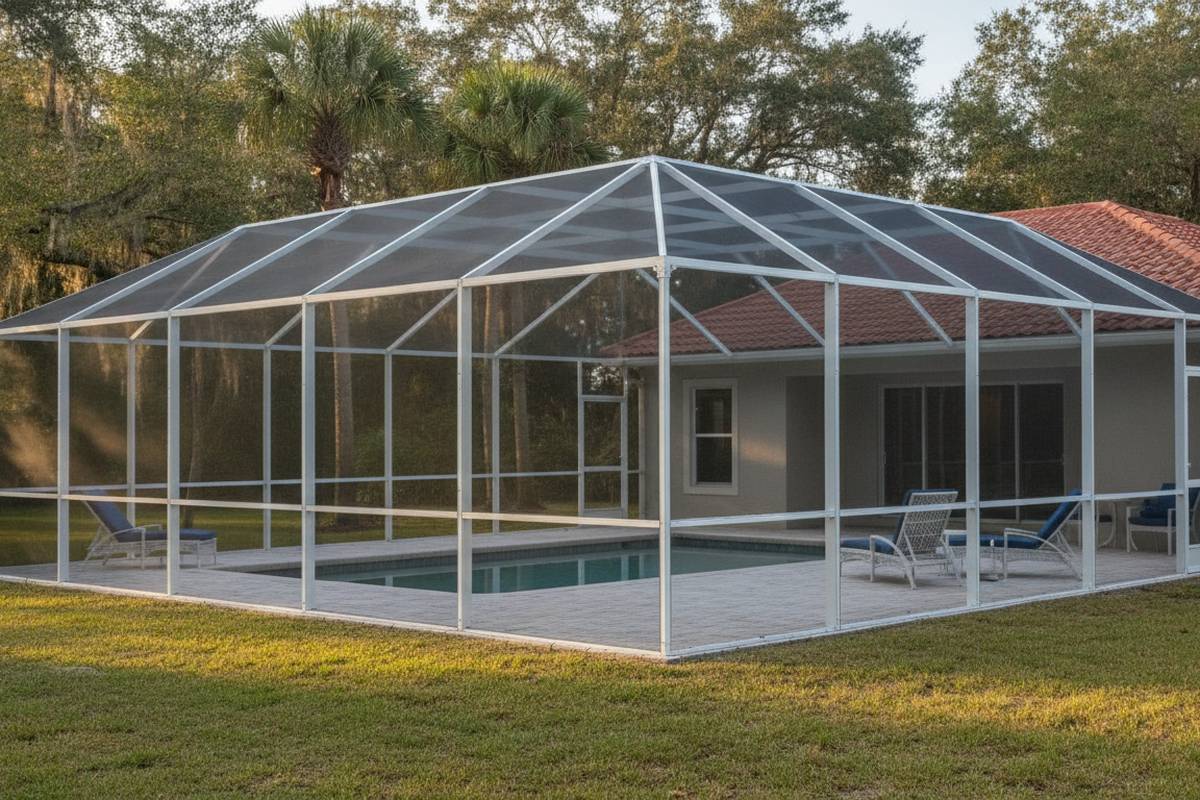
Most new residential pool cages in the Lakeland area land between $9,000 and $18,000. A large deck, a tall mansard tied into a two-story wall, or a long clear span pushes that to $20,000 to $35,000. Those are the honest bands, and the width of them is the whole subject of this post.
The reason the range is so wide has almost nothing to do with the screen. It has to do with how far the aluminum has to reach, how high it has to stand, and what the engineer has to specify to make that work at your address. Two houses on the same street can get quotes $5,000 apart for reasons that are completely legitimate.
What a pool screen enclosure costs in Polk County
Here are the numbers you can plan around, and where each one comes from.
| What you’re buying | Typical Polk County range |
|---|---|
| New residential pool cage | $9,000 to $18,000 |
| Large deck, tall or two-story mansard | $20,000 to $35,000 |
| Screen room built from scratch | $6,000 to $14,000 |
| Screening in an existing covered lanai | $1,500 to $3,500 |
| Full-cage rescreen on a frame you already have | $1,400 to $3,200 |
| Repainting a sound frame | $2,800 to $6,500 |
Read that table from the bottom up before you read it from the top down. A lot of people who think they need a new cage need a rescreen, and the gap between those two numbers is the difference between a weekend decision and a financed one.
Why price per square foot misleads on a new cage
Every national cost calculator quotes screen enclosures per square foot. For a new cage in Polk County, that number will mislead you, and it’s worth understanding why.
Mesh is the cheapest part of the job. On a rescreen, standard fiberglass runs roughly $2.50 to $4.00 per square foot installed. If screen area drove the price of a new enclosure, a cage twice the size would cost roughly twice as much, and it doesn’t.
What you’re actually paying for is the frame. Cost tracks three things: the perimeter of the structure, its height, and the longest distance the aluminum has to span without a post. Those three numbers are what the engineer sizes the members against, and heavier members cost more at every single connection.
The practical consequence surprises people. A tall, narrow cage over a deep-end deck can cost more than a short, wide one covering more square footage. Same screen area, different structure, different price. So when a bid quotes you a per-square-foot figure, ask what span and height it assumes. That’s the question the number is hiding.
The four things that actually move the number
Clear span. The distance between posts is the single biggest lever. Homeowners want an unobstructed view, and every post you remove forces heavier beams to carry the same load. If your quote came back higher than a neighbor’s, span is the first place to look.
Height. A standard cage and a high-ceiling mansard are not the same product. Height increases wind load on the structure and increases the member sizing all the way down. If you have a diving board, a tall slider, or a two-story wall to tie into, that’s driving your price.
Roof style. Covered in the next section, because it’s the one choice where you can genuinely save money without weakening anything.
What your deck will actually hold. This is the one nobody budgets for. Anchors are only as good as the concrete they land in, and older Polk County decks were frequently poured thin with no perimeter footer. If a crew probes the slab edge and finds four inches of unreinforced concrete, the fix is poured footings, and that’s real money that belongs in the quote rather than in a change order. Around Bartow, Mulberry, and Fort Meade, on and near the old phosphate ground, this comes up often enough that a competent crew checks it during the measure.
For the full picture on how design wind speed and the engineered drawing shape all of this, we wrote that up separately in wind load, engineering, and why inland Polk County builds cheaper.
Mansard, gable, or dome
Roof style is the one place you can move the price meaningfully by choice rather than by circumstance.
Mansard is the default across Polk County. Sloped sides into a flat top, good headroom, sheds debris well. Most quotes you get will assume it unless you say otherwise.
Gable gives you the most height through the middle and looks right on a two-story house. It costs more, because the peak has to be framed and carried.
Dome is the cheapest and the lowest. It’s a genuine way to save money on a pool cage if headroom isn’t a constraint for you.
If you have a diving board or tall doors opening onto the deck, headroom decides this for you and the budget follows. If you don’t, this is a real choice worth pricing both ways.
What is usually not in the quote
Ask about each of these before you compare two numbers, because their absence is often the entire reason one bid is lower.
- Footer or slab remediation, if the deck edge won’t hold anchors
- Removal and haul-off of an old cage, if one is standing
- Engineering and the permit, which some low bids quietly skip entirely
- Architectural review through your HOA, which governs frame color and finish in most newer I-4 corridor subdivisions
- Kickplate panels along the bottom, which most owners want and which are sometimes quoted as an upgrade
- Upgraded mesh, if you want no-see-um or pet-grade rather than standard
None of these are tricks on their own. They become a problem when one contractor includes them and another doesn’t, and you compare the totals as though you’re looking at the same job.
When a new cage is the wrong purchase
Aluminum frames outlast the screen in them by decades. That’s the most useful thing to know before you spend $12,000.
If the frame is straight and the anchors are sound and the only real complaint is chalky, sagging, tearing mesh, you need a rescreen, not a replacement. Screen has a working life of roughly seven to twelve years in Central Florida, and reaching the end of it is maintenance, not failure. That’s a $1,400 to $3,200 job against $9,000 or more.
If the frame is sound but the finish has failed and the cage looks tired, repainting runs $2,800 to $6,500. Pair it with a rescreen and you have a cage that looks new for well under half a replacement.
If a section is bent or a storm took panels out, that’s enclosure repair and it’s priced by the damage, not by the cage.
Replacement is the right call when the frame itself is the problem: corrosion at the connections, members out of square from settlement, anchors that keep working loose, or a cage that was never engineered or permitted in the first place. A contractor who talks you out of a replacement you don’t need is showing you how they’ll behave on everything else.
Reading two bids that are $4,000 apart
Line the two quotes up and check five things in this order.
- Is the engineering in there? A signed and sealed drawing for your address, your dimensions, your wind speed. Not a generic detail sheet.
- Is the permit in there, pulled under the contractor’s license? If anyone asks you to pull an owner-builder permit for work they’re performing, stop.
- What span and height did each one assume? Bids frequently differ because one quoted fewer posts.
- What roof style? A dome against a gable explains a lot of gaps on its own.
- What happens if the slab edge fails the probe? Get the answer in writing before, not after.
A bid that comes in dramatically low almost always got there by removing one of the first two items. That’s not the same product at a better price. It’s a different product, and the difference shows up years later at the worst possible moment. We walk through the permit side of that in screen enclosure permits in Polk County.
What downtime costs on a rental property
If the pool serves a short-term rental, the arithmetic changes and most cost guides miss it entirely.
Around Davenport, Loughman, Four Corners, and the Haines City growth ring, a cage that’s off is a listing that’s off, and that carries a nightly number attached to it. Owners in that market consistently price the calendar rather than the invoice. A full-cage job done once beats staged panel work spread over two visits, both for the photos and for the downtime.
The other half is scheduling. Plan on six to twelve weeks from signing to a finished cage. The build itself is one to two weeks. Everything else is engineering, plan review, and material lead time. After a named storm those timelines stretch badly, because every aluminum shop in Central Florida is triaging damage at once. The worst week to start a new enclosure is the week after a hurricane, which is exactly when most people decide they want one.
If your pool sits on open water around Winter Haven and the chain of lakes, factor in that wind gets a longer run at your structure than it does on a sheltered lot, and design accordingly.
Frequently asked questions
How much does a pool screen enclosure cost in Polk County?
Most new residential cages run $9,000 to $18,000 in the Lakeland area. A large deck, a long clear span, or a tall mansard tied into a two-story wall pushes that to $20,000 to $35,000. Span and height move the number far more than screen area does.
Is it cheaper to rescreen than to replace a pool cage?
Substantially, and it’s usually the right call. A full-cage rescreen runs $1,400 to $3,200 against $9,000 or more for a replacement. Aluminum frames outlast their screen by decades, so if the frame is straight and the anchors hold, replace the mesh and keep the structure.
Why is one pool cage quote thousands lower than another?
Usually because it left something out. The most common omissions are the engineered drawing and the permit, followed by footer work the deck actually needs. Ask both contractors what span, height, and roof style they quoted before you treat the totals as comparable.
Does a bigger pool mean a more expensive cage?
Not proportionally. Cost tracks the perimeter, the height, and the longest span between posts, because those set the member sizing. A tall narrow cage can cost more than a wider, shorter one covering more square footage.
Which pool cage roof style is cheapest?
Dome is the least expensive and the lowest. Mansard is the Polk County default and gives better headroom. Gable costs the most and suits a two-story house. If you have a diving board or tall doors, headroom decides it and the price follows.
How long does a new pool cage take in Polk County?
Plan on six to twelve weeks from signing to finished. The on-site build is one to two weeks, and the rest is engineering, plan review, and material lead time. Starting in the fall avoids the post-storm backlog that fills every shop in Central Florida.
Getting a real number for your deck
A number off a calculator can’t tell you what your slab edge will hold, and that’s the item most likely to change your price. The measure is where the real quote comes from.
Lakeland Outdoor Pro connects Polk County homeowners with insured local aluminum crews who quote the engineering and the permit as line items rather than leaving them out to win on price. We cover the whole county, from Lakeland and Winter Haven out to Davenport and the I-4 corridor. Call (863) 777-5379 and the on-site measure is free.