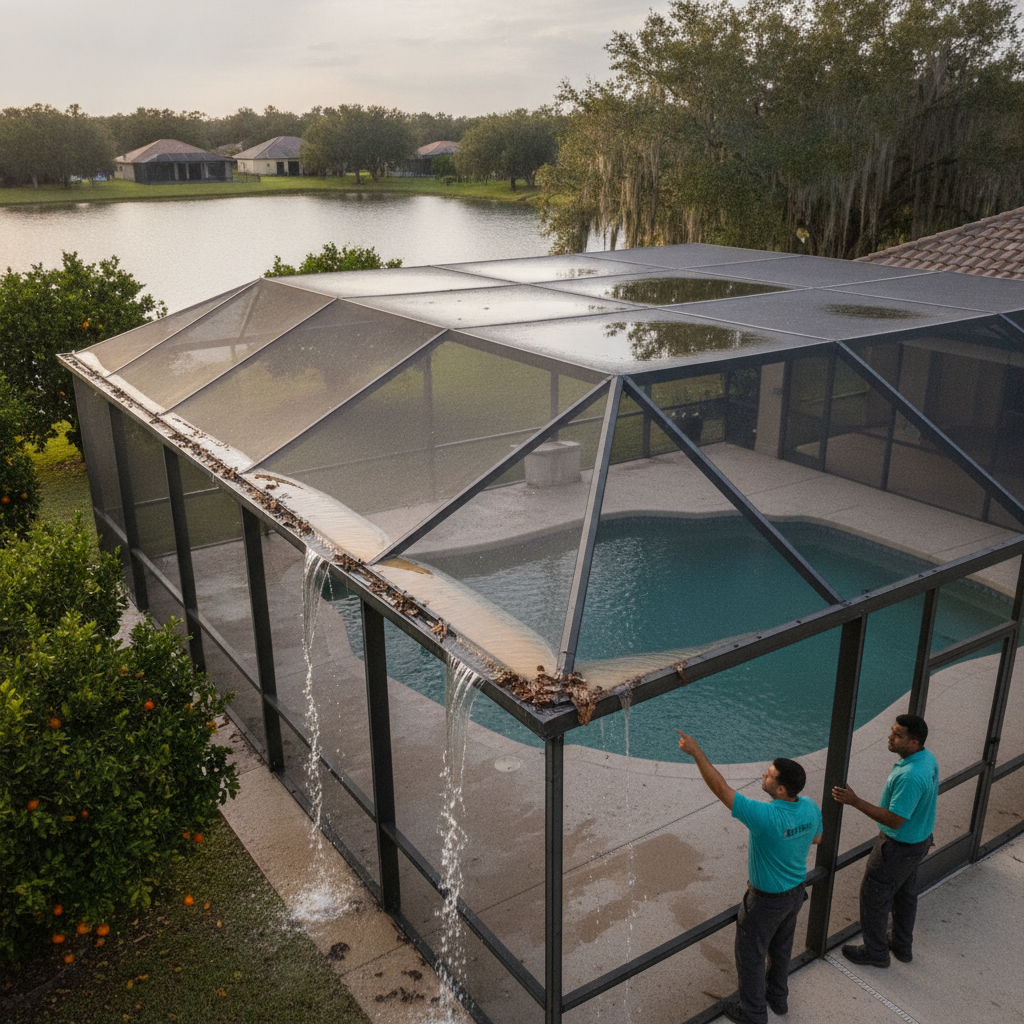
After a summer thunderstorm over Lake Morton, water should be gone from a cage roof in a few minutes. If a dish of it is still sitting over the deep end at dusk, or a dark stripe is still wet along the house wall, that is a screen enclosure repair problem. Standing water is extra weight on aluminum that was never meant to hold a pond.
Standing water on the cage roof after a Polk storm
Water pools on a Lakeland pool cage when the roof is no longer a clean, taut plane, or when the house dumps rain onto the mesh faster than the cage can shed it. A screen roof is not a shingle roof. Rain is supposed to pass through the weave and fall into the pool or onto the deck. When it sits, something is blocking the weave, bagging the panel, or changing the pitch of the frame underneath.
The Atlantic hurricane season runs from June 1 to November 30, and that is when a named storm actually bends a beam. Most pooling starts earlier, in the ordinary afternoon dump. Live oaks around Lake Morton, Dixieland, and South Lakeland drop catkins in spring and a steady rain of leaves after that. Those mats sit on a roof panel like felt. Pine needles on a Kathleen or Highland City lot do the same work. A 1990s cage in Cypress Gardens or along the Chain of Lakes is often already in its rescreen window, and the south and west mesh has gone brittle years before the shaded north side. Brittle weave holds pollen. Pollen holds water.
A two-story mansard in a Davenport or Four Corners subdivision makes this harder to live with, because the upper roof is out of reach of a broom. Clearing a ground-level wall panel is a homeowner job. Climbing a cage roof is not, and a hardware-store kit will not tell you why the water is still there after you sweep.
If the puddle lives on one panel and the beams look straight, the mesh itself may be the dam. Standard 18x14 fiberglass is meant to keep out most insects and still let a breeze through. It is still a fabric. Central Florida sun cooks the south and west elevations first. Screen here commonly lasts roughly seven to twelve years, and it fails unevenly. Once a panel bags, it holds water, and the water stretches it further. That loop does not reverse on its own.
One product mix-up shows up on older cages more than people expect. Vinyl-laminated 18x14 fiberglass is a wall and lower-panel product. The manufacturer says it is not intended for use as roofing material or in horizontal applications. Put that weave on a roof and water has nowhere to go. It sits. Then the extra weight starts hunting for a low spot in the frame.
A screen room over a patio slab ponds the same way a full cage does. Same mesh, same aluminum, same house-gutter problem at the tie-in. The pool is not the required ingredient. The roof geometry is.
Leave a pond up there and it migrates. The next panel takes on the extra weight, the spline creeps out of the channel, and a whole roof bay is ready to tear the first time wind gets under a loose edge. That is how a small dish in June becomes an open roof in September.
Clogged gutter versus a beam that has dropped
Most pooling on a Polk County cage starts at the gutter, not at the aluminum. Walk the house wall first. If every storm leaves a wet stripe where the cage ties into the fascia, the house roof is winning. An undersized or packed gutter on a live-oak lot will overrun in a short burst and dump onto the cage roof. Oak catkins in April mat a coarse gutter screen along Lake Morton. The cage never had a chance.
A seamless gutter is the product that belongs on that house eave, sized to the roof that actually feeds it. Neither 5-inch nor 6-inch is a default for Polk County. The run follows catchment, pitch, valleys, outlet spacing, and downspout size. Building America’s gutters and downspouts guide describes typical channel sizes of 4, 5, and 6 inches, and it points surface discharge at least 5 feet from the foundation. That is program guidance, not a local code. It is still the right picture: if a downspout dumps at the cage corner, that water has to go somewhere, and the mesh is a poor drain. A longer look at how house-roof water should leave the lot is in our notes on gutter and downspout sizing in Lakeland.
A dropped beam looks different from a gutter problem. Gutter overflow is a stripe along the house, or a waterfall at one corner, and it shows up during the rain. A sag is a dish in the middle of a roof bay, or a line of water that follows one beam from upright to upright, and it is still there after the sky clears. Stand at the patio door and sight down the member. A straight beam reads as a clean line. A dropped one reads as a smile.
The smile gets worse because water is heavy. A longer clear span already means a heavier beam carrying the same roof. Add a pond on top of that span and the beam has more reason to keep dropping. Fasteners at the house wall start to pull. An upright that landed on a thin 1950s patio slab in Dixieland, poured without a real perimeter footer, can walk a little in that same direction. New mesh on that frame will bag in the same dish by the next storm.
The Florida Building Code assigns an ultimate design wind speed to a specific address, and the engineered drawing in the permit package states the value the structure was designed to. Inland Polk carries a lower number than a Gulf-front county, which is why the same cage prices differently here. None of that helps a cage that is already holding a pond. Extra water is extra load the drawing never counted. The mechanism is in our notes on wind load and screen enclosures in Polk County.
| What you see after the rain | What it usually is | What actually fixes it |
|---|---|---|
| A wet stripe along the house wall | House gutter or downspout overflowing onto the cage | Clean, resize, or add a gutter run so house-roof water never lands on the mesh |
| A dish in the middle of one roof panel | Bagged mesh, matted debris, or laminated wall screen used on a roof | Clear the debris, then replace the panel, or rescreen if the neighboring panels are as tired |
| Water that follows a bowed beam | The beam has dropped, an upright has settled, or fasteners have pulled | Structural repair of the frame, not another layer of mesh |
A clogged cage gutter, when the enclosure even has one, is the middle case. It is still a water-handling problem. It is not a reason to replace the cage. Pull the leaves and see whether the puddle comes back on a clean roof. If it does, you have moved from debris to geometry.
What a crew checks before anyone talks replacement
A licensed crew looks at the frame before anyone talks about new mesh. New screen on a racked cage fails in the next storm, and it fails in the same low spot you already have. The first pass is visual: sight the beams, push on the roof panels, and look at the fasteners where the cage meets the house and the slab.
Spline that has crept out of the channel on a Winter Haven roof is a panel job. The screen sits in a channel held by a rubber spline, and a single tired panel can be swapped without touching the neighbors. Individual screen panels commonly run $35 to $90 each. If the south and west elevations are faded and brittle, and two more panels bag when you push them, the whole enclosure is due. Full-cage rescreening in this market commonly runs $1,400 to $3,200, or about $2.50 to $4.00 per square foot of standard fiberglass, installed. That is mesh in existing channels. It is not a new cage.
The structural checks are the ones that change the conversation. Bent or racked uprights. A beam that no longer meets the house wall cleanly. Screws that have walked out of the slab. An anchor that has crumbled the edge of a thin patio pour. A door that no longer squares in its opening, so it will not self-close or self-latch. Florida’s pool-barrier statute asks a gate to be self-closing and self-latching, with the release on the pool side and out of a child’s reach, and a barrier at least 4 feet high on the outside with no gap a child could squeeze through or climb. Whether a given enclosure does all of that is what the building official signs off on. A sag that keeps the door from latching is a reason to stop treating this as a screen patch.
If the members have to be replaced, or infill framing has to be added, that is no longer a spline job. That work is screen enclosure repair, and it has to happen before anyone orders a roll of mesh. Polk County’s Building Division lists screening of any space that requires structural or infill framing to be added as work that needs a permit. The City of Lakeland publishes its own permit requirements through its own Building Inspection division and names the same kind of screening. A crew that mostly works unincorporated Polk can hit friction inside city limits. A like-for-like panel in an existing channel is a different conversation than new posts. The Building Division answers the permit question on the specific design.
Florida law requires a person to be certified or registered in order to engage in the business of contracting in this state. Several license classes lawfully build and repair aluminum structures. Ask which class the contractor holds, and verify it yourself.
Replacement is the last conversation, not the first. A new residential pool cage in the Lakeland area commonly runs $9,000 to $18,000. A large deck, a two-story mansard tied into the house wall, or a high clear span runs $20,000 to $35,000. Those numbers are for a new enclosure, not for a rescreen, and not for a single panel. If a bidder quotes a rebuild at rescreen money, the scope is wrong.
If a named storm bent the beam, the insurance conversation is an endorsement, not a guess. Coverage for screened enclosures and aluminum-framed carports damaged as a result of a hurricane commonly comes from an endorsement rather than the base policy. Some carriers also include pool cages and awnings on that same endorsement. It is not automatically in the policy, and it is not a separate product you can assume you have. The answer is on your declarations page.
How much does it cost to repair a screen in Polk County?
A single tired panel commonly runs $35 to $90. A full-cage rescreen commonly runs $1,400 to $3,200, or about $2.50 to $4.00 per square foot of standard fiberglass, installed. Structural repair prices like the frame work it is, not like mesh. Standing water that comes from a dropped beam is the structural job.
How much does it cost to replace a pool cage in the Lakeland area?
A new residential pool cage in the Lakeland area commonly runs $9,000 to $18,000. A large deck, a two-story mansard tied into the house, or a high clear span runs $20,000 to $35,000. Replacement is what you price when the members are racked, not when the roof is holding leaves.
Can I repair a lanai screen myself?
A torn wall panel at ground level, with sound spline channel and a straight frame, is a real homeowner job: pull the old spline, lay new mesh, roll new spline back into the channel, trim the extra. A pooling roof, a bowed beam, a door that will not latch, or any work at height on a two-story mansard is licensed contractor work. A hardware-store kit will not re-pitch a sagging roof.
When to call us
Call when water is still on the cage roof after the storm has passed, when you can sight a smile in a beam from the patio door, or when the screen door no longer closes on its own. That work belongs with a licensed contractor, and it is the kind of matching we do across Lakeland, Winter Haven, Bartow, and the rest of Polk County. Call us at (863) 777-5379.