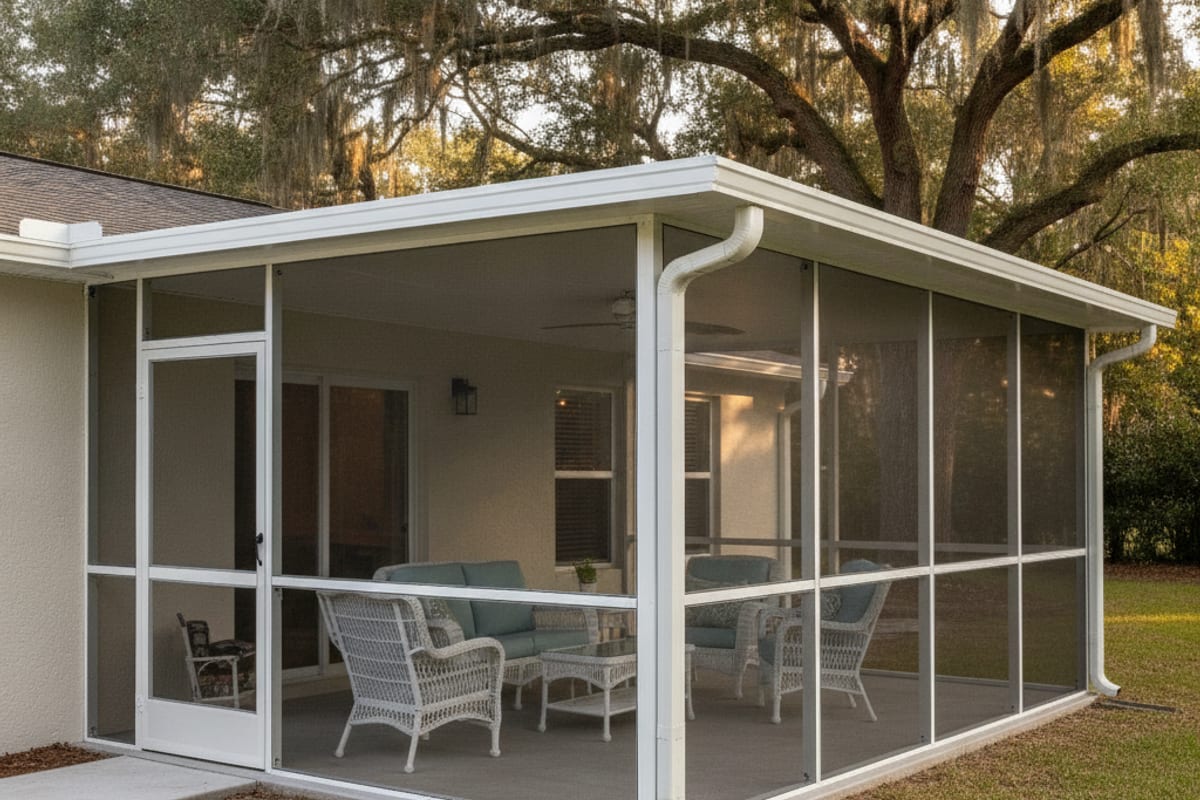
A patio screen does one simple thing: it turns an open patio or deck into an enclosed space where you can sit outside without swatting insects or dodging leaves and pollen. That’s it. No climate control, no insulation, just mesh between you and the weather.
The thing is, in Polk County, that one thing matters more than it sounds. From June through September, mosquitoes are thick, pollen hangs in the air, and afternoon thunderstorms dump debris onto exposed decks. A screened patio lets you use your outdoor space in ways an open deck just doesn’t in summer. You’re not fighting the elements. You’re sitting under a fan or in a breeze with a drink, watching the rain fall six feet away and staying dry.
The market calls these screen rooms or patio enclosures interchangeably. They’re the same thing: aluminum frame, screen mesh in the bays, a self-closing screen door, and nothing else. No roof panels (that’s a three-season room or a patio cover). No glass (that’s a sunroom). Just the essentials.
What a patio screen actually encloses
A basic screen room wraps three or four sides of an existing patio or deck slab. The frame is usually aluminum, white or bronze, and bolts or anchors to the concrete. Each vertical upright sits on a base plate or a kick plate. The mesh runs between the uprights, held in by spline (a rubber cord pressed into a channel), and a self-closing screen door sits on one elevation so you can get in and out.
Some folks screen in a covered lanai, which means the builder already left an open roof structure and you’re just filling in the sides with mesh and adding a door. Others build a screen room from scratch over a bare patio. Both work the same way: mesh replaces open air.
The roof is already there (if it’s a lanai) or it’s open to the sky (if it’s a basic screen room). Either way, rain comes in when it’s driven sideways or heavy, and leaves fall through. The mesh does nothing to keep out a heavy downpour beyond breaking the water surface so it bounces slower. You stay mostly dry in a typical afternoon storm. A hard-driven rain still finds its way in.
Types of mesh and what they do
Not all screen is the same. The most common choice is charcoal fiberglass, which is cheap, durable enough, and tight enough to keep out small insects. It has a visible weave and it yellows a bit in intense sun, but it does the job.
Pet proof or dog-proof mesh is thicker, more durable to puncture, and costs more. If you’ve got a dog that likes to lean on the screen or cats that climb, pet mesh is worth it.
Solar screen or shade screen is specially woven to block heat and uv. It looks darker, more opaque, and it genuinely cuts the temperature inside a screened room by 5 to 10 degrees on a Polk County summer day. It costs more but if you’re in a screen room that faces west or southwest, the investment pays back in comfort.
Removal mesh is a specialty option that unzips or slides out so you can open the screen room completely in mild seasons. It’s more expensive and less common, but if you want maximum flexibility, it exists.
Cost and what drives it
Screening an existing covered patio or builder lanai in Polk County runs $1,500 to $3,500. Building the roof and the enclosure together runs $6,000 to $14,000. Those are this site’s published bands. Linear feet of frame, door configuration, and mesh choice still move a given job inside the band.
Custom door sizes (extra wide, French door style) add cost. Adding a second door on the opposite side adds cost. Pet mesh and solar screen cost more than charcoal fiberglass.
Labor is pretty straightforward because the work is methodical, not complicated. A crew can typically knock out a straightforward screen room in a day. Complex layouts with multiple angles or custom details might take longer.
Why folks choose screens instead of other options
An open patio is free but nearly unusable in Polk County June through September. A screen room is the first upgrade because it buys you usability without a huge budget. You get to sit outside without abandoning the space to insects and weather for half the year.
A patio cover (solid roof) costs more ($3,500 to $9,000) but it gives you real weather protection and no maintenance on the mesh. Screens need occasional cleaning, especially after storms when pollen and leaves coat them. A cover just sheds rain and requires no mesh maintenance.
A sunroom is the premium option ($22,000 to $45,000) because it’s conditioned, insulated, and you can use it year-round. But you lose the outdoor feeling and the openness. A screen room keeps that breeze and that outdoor connection while still keeping bugs out.
When screens make sense
Your patio faces south, west, or east and gets full sun most afternoons. You want to use that space in summer. Open it’s nearly unusable from 1 PM to 6 PM and the mosquitoes are thick. Screened, it’s usable and comfortable.
Your home is surrounded by oaks or near a lake or retention pond. Pollen and bugs are part of the backdrop. A screen room cuts both by a lot.
You’ve got a pool or a pool cage nearby and you want to sit outside without being eaten. The mesh stops mosquitoes from finding you even if they’re hovering around the cage.
You’re renovating a patio but your budget doesn’t stretch to a full cover or room. A screen enclosure buys you years of extra use before a bigger upgrade makes sense.
The one maintenance thing
Screens collect dust, pollen, and debris, especially on the underside where you can’t see it building up. Once or twice a year, rinse the mesh with a soft brush and mild soap. Don’t pressure wash, that tears the mesh. Just a garden hose and a hand brush. The buildup doesn’t block light but it ages the fabric faster if you leave it.
If you live near a lake or have oak trees overhead, you’ll probably clean more often. Pollen season means more frequent cleaning. Storm debris lands on screens after bad weather. It’s not hard work, just part of ownership.
Screened enclosures and Polk County weather
A Polk County summer afternoon storm is fast and heavy. The wind gets strong. The rain is thick. A screen room built right handles it. The mesh flexes but doesn’t fail. Water beads off and runs down to the base. The frame stays anchored. You stay dry enough to not care.
But here’s the thing: a screen room isn’t a shield. It’s a filter. A hard-driven rain from a summer thunderhead finds its way in. Wind spray gets through. That’s fine. Most folks think “I want to sit outside and not be eaten by mosquitoes,” not “I want a rain proof room.” If you need actual weather protection, a patio cover is the right call.
Design and materials matter though. If the frame isn’t properly anchored, a strong wind can twist it. If the mesh isn’t high quality, it tears. If the spline isn’t properly seated, water runs inside the frame channel. Get a pro who knows Polk County wind and rain. It’s worth the money.
Frequently asked questions
What’s the difference between a screen room and a patio screen?
They’re the same thing. A screen room is an enclosed patio with mesh on the sides and a screen door. Some people call it a screened patio, a screen enclosure, or a patio screen. The terminology gets mixed but it all means the same thing: mesh walls and a door on an existing patio or deck structure.
How much does it cost to screen in a patio in Polk County?
Screening an existing covered patio runs $1,500 to $3,500. Building a new roof and screen together runs $6,000 to $14,000. Size, mesh, and door configuration move the number inside those bands.
Do I need a permit to build a screen room in Polk County?
A new screen room needs a permit when it adds structural or infill framing. Polk County’s published list requires a permit for “Screening of any space, which requires structural or infill framing to be added.” The City of Lakeland lists “Porches/Screen Rooms” among work that needs a permit, and the same city page requires a permit for “Screening of any space that requires structural or infill framing to be added.” The no-permit item is like-material mesh replacement. Polk County’s permit-not-required list names “Replacement of screening with like material in an existing structure.” Ask the issuing jurisdiction to classify the actual work. Unincorporated questions go to the Bartow office at (863) 534-6080. Ask for a plans examiner.
Can I add a screen room to a covered lanai?
Yes. If your builder left you an open-sided covered lanai, screening it in is common work. You’re just filling the open bays with mesh and adding a door. The roof is already there, so it’s straightforward.
Does a screen room keep the heat out?
Not really. Regular fiberglass screen mesh doesn’t block sun or heat, it just blocks insects. Solar screen or shade screen does reduce heat by 5 to 10 degrees, but it costs more. If cooling is your main goal, a patio cover with solid panels or a sunroom makes more sense.
What if I want to remove the screens seasonally?
Removable mesh kits exist, but they’re less common and more expensive than fixed screens. Easier is just leaving the screens in place year-round. They don’t really degrade from being open to the sky in winter.
Will mosquitoes get through the mesh?
A good quality mesh with a proper weave stops almost all mosquitoes. No mesh is 100%, but charcoal fiberglass catches them. Gaps around the door or tears in the mesh are where they get in. Keep the door sealed and the mesh intact, and you’re protected.
If you want a real number on screening a patio in Polk County, call (863) 777-5379. The on-site measure is free.