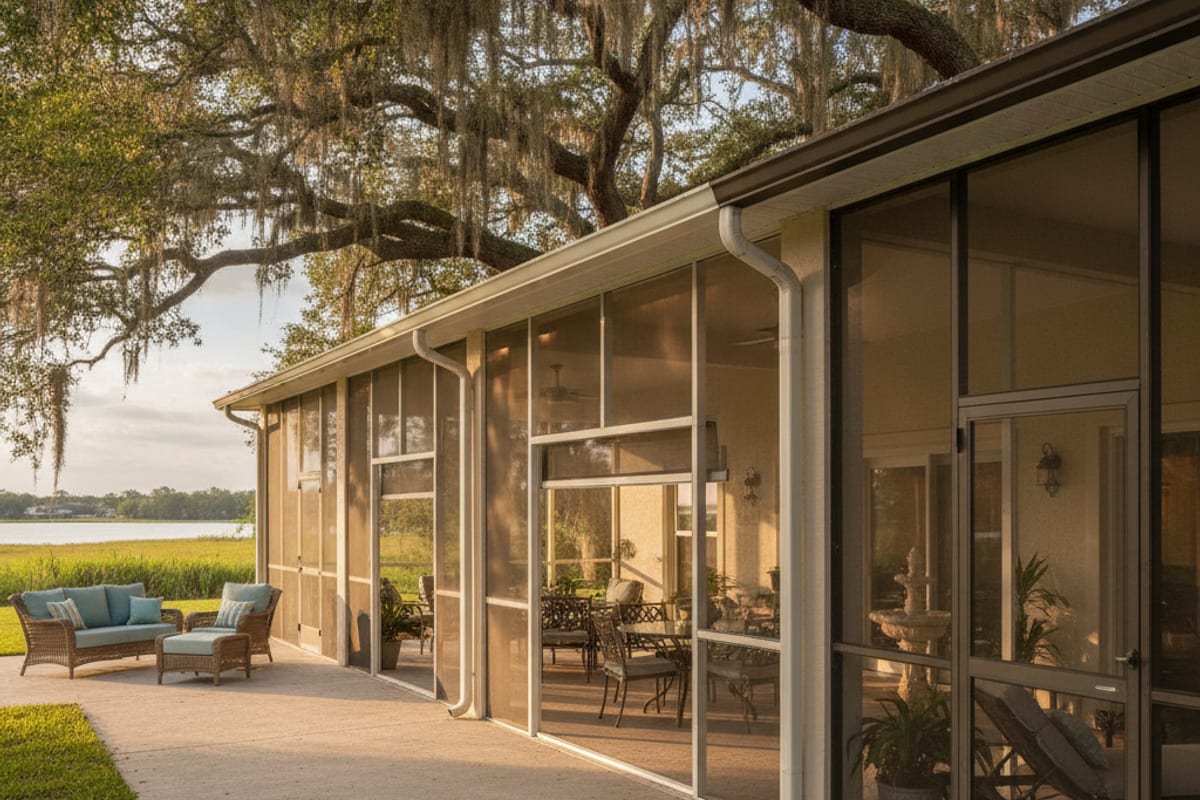
A patio enclosure in Polk County describes any structure that encloses an open patio or lanai. The category stretches from simple screen frames to full glass sunrooms, and the cost difference between the cheapest and most expensive is roughly eight to one. The right choice depends less on what you like and more on what you actually need in a Central Florida summer.
The confusion happens because marketers use “patio enclosure,” “sunroom,” “screen room,” “lanai,” and “three season room” almost interchangeably. They’re not the same thing. Each trades something away to gain something else, and understanding those tradeoffs is the whole job.
The four basic types
All of these get called a Florida room around Central Florida, and what is a Florida room untangles that name. A screen room is aluminum frame and mesh, no glass. It costs the least, keeps out bugs and direct sun, and does nothing against sideways rain or humidity. For most Polk County homeowners sitting under live oak canopy, that’s enough.
A three season room adds vinyl or acrylic panels that slide, stack, or roll closed on the mesh frame. It costs more, handles some wind driven rain, and drops the humidity inside noticeably during spring and fall. Summer still gets humid because the panels are vinyl, not thermally broken glass. It’s the middle path.
A sunroom is an insulated glass room with thermally broken aluminum framing, a conditioned space that needs AC but reads like a room addition rather than an enclosure. It’s the most expensive option and the only one that actually conditions the air.
A hybrid uses screen room framing with acrylic or vinyl panels instead of mesh, or combines screen and glass in different walls of the same enclosure. These are custom and price accordingly.
Cost reality for each type
Screen rooms run $1,500 to $14,000 depending on whether you’re screening an existing covered lanai or building the roof and enclosure together. The roof is the expensive part. Screening an existing covered patio built by your home’s original builder runs $1,500 to $3,500 because the roof is already paid for. Building the roof and screen together from scratch runs $6,000 to $14,000 across most of Polk County.
Three season rooms run $8,000 to $20,000. The vinyl or acrylic panels add cost, the frame has to be stouter to carry the weight, and engineering gets more complex. You’re essentially building a hybrid structure that has to act like both an enclosure and a partially conditioned space.
Sunrooms run $22,000 to $45,000. Thermally broken aluminum, insulated glass, conditioned air, and a tie-in to your house’s HVAC system add up quickly. But it’s a real room addition, and it’s the only option if you want to sit inside in August without sweating through your shirt.
Hybrids price per custom design, but they typically land between three season rooms and sunrooms.
What Polk County climate actually demands
Polk County is inland Central Florida, hot-humid, with afternoon thunderstorms that drive rain sideways and plenty of oak canopy on older properties. That context changes which enclosure type actually solves your problem.
Under mature oaks, the shade is doing most of the work. Direct sun is less of a problem than bugs and leaves and the afternoon temperature swing. A screen room under a thick canopy is genuinely enough, and asking for more enclosure than your yard needs is just paying for features you won’t use. On Winter Haven lakefront, Cypress Gardens, or any wide open lot where there’s no tree cover to block the afternoon sun, that calculation flips completely. There, a three season room or sunroom actually earns the price difference.
Humidity matters more than most people expect. A screen room doesn’t touch humidity. A three season room with panels closed might drop it a few degrees. A sunroom with AC cuts it in half. If you have someone in the home with asthma or joint problems, or if you’re just someone who hates Florida humidity, that one factor might be worth $10,000 more than a screen room would cost.
Sideways rain from thunderstorms happens here regularly. Screen rooms let it in. Three season rooms with vinyl panels mostly stop it, though some will still find a seam. Glass sunrooms stop it completely. That’s not a design flaw in screens or vinyl, it’s just physics.
Permits and engineering in Polk County
Every enclosure type needs a Polk County permit and an engineered design, same as a patio cover. Wind load engineering is more important than most homeowners realize. Inland Polk County has lower wind requirements than coastal zones, which is why you’ll see more screen enclosures and fewer expensive sunrooms in places like Bartow or Haines City than you see in Pinellas. The engineering is cheaper because the wind speed requirement is lower.
Setback rules limit how close any enclosure can sit to your property line, and they differ by jurisdiction. The City of Lakeland publishes its own setbacks. Unincorporated lots use Polk County’s table. Confirm the rule that applies to the parcel during the site visit, not after you have signed a contract.
Verify your contractor’s license at myfloridalicense.com. Look for a structural aluminum or screen enclosures contractor, or a building or residential contractor license that carries the scope to build enclosures. It takes a minute and it’s free.
Existing roof versus new roof
If you have an older home with a covered lanai built by the original builder, you have two choices: enclose the existing roof or tear it off and rebuild it. Enclosing the existing roof is cheaper but inherits whatever flaws the original build had. Rebuilding costs more but lets you update the roof to current engineering and code.
If your covered lanai is sagging slightly, or if you’ve noticed water stains on the soffit, talk to a contractor about both options before deciding. Sometimes the roof rebuild cost is closer to the retrofit cost than you’d expect, and you gain 20 years of warranty and no hidden problems.
Hybrid and custom options
Some homeowners want screen in one section and glass in another. Some want three season room with the south wall full height glass and the west wall mostly screen to let the breeze through except during hot afternoon hours. These custom hybrids are absolutely buildable, but they cost more and take longer to engineer and permit. Get a detailed written quote that breaks down the different sections separately, so you know what each part costs if you decide later to phase the project.
How long does an enclosure take to build?
A screen room is usually two to four days on site once the permit is in hand. Three season rooms and sunrooms take longer on site because of glazing and finishes. This page does not publish how long permit review takes. How long a building permit is good for in Polk County covers the validity clock after issuance.
Frequently asked questions
What’s the cheapest enclosure option in Polk County?
A screen room screening an existing covered lanai, which runs $1,500 to $3,500. You’re only paying for the frame and mesh, not the roof.
Which enclosure stops the most rain?
A glass sunroom, completely. Three season rooms with vinyl or acrylic panels stop most sideways rain if the panels are closed, but they’re not perfectly watertight. Screen rooms let rain in.
Can I add a patio enclosure to a builder’s covered lanai without tearing off the roof?
Yes, that’s called screening in an existing lanai, and it’s common and cost effective. Tell the contractor the plan so they can assess whether the existing roof is sound enough to carry frame load without upgrading.
Do patio enclosures need a permit in Polk County?
Yes, in every jurisdiction. It’s an attached structure and a potential occupancy concern if it’s fully enclosed, which means engineering, inspection, and setback compliance.
What’s the difference between a three season room and a sunroom?
A three season room has vinyl or acrylic panels and isn’t conditioned, so it’s still hot and humid in summer. A sunroom has thermally broken glass, is connected to your HVAC, and functions as a room year round. Sunrooms cost roughly twice as much.
How long does a screen enclosure last in Polk County?
Good aluminum frame lasts 30 years or more. Screen mesh lasts 10 to 15 years before it chalks and sags and needs replacement. That’s a rescreening job, not a rebuild.
Will adding an enclosure hurt my roof or house?
Not if it’s built right. The key is proper flashing where the frame attaches to your house and proper grounding of the aluminum frame so lightning has a path to ground. A licensed contractor knows both of those details.
If you want a real number on a patio enclosure for your Polk County home, including the engineered design and permit strategy rather than a phone guess, call (863) 777-5379. The on-site measure is free.